

When we observe an animal performing an extraordinarily complex behavior without being taught how to do it, we commonly call the behavior instinctive.
But what exactly have we explained by calling it instinct?
Consider bird migration, spider-web construction, salmon returning to their spawning grounds, hibernation, elaborate mating displays, nest building, and countless other examples throughout nature. These behaviors can involve navigation, environmental sensing, chemical recognition, communication, timing, and coordinated sequences of actions. Calling such behavior instinctive identifies a category of behavior. It should not be confused with a complete explanation for how that behavior works or how it originated.
Ants and Aphids
One remarkable example is the relationship between ants and aphids.
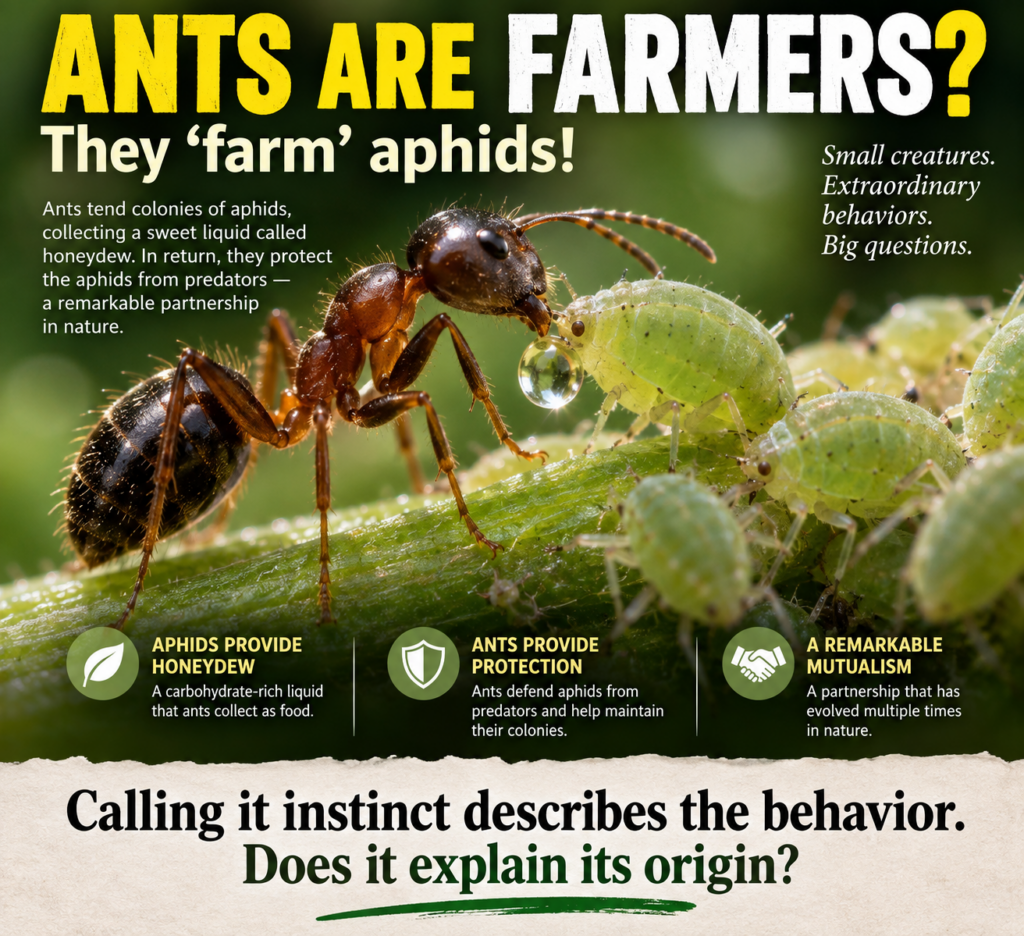
Many ants tend colonies of aphids in a relationship scientists call trophobiosis. Aphids consume plant sap and produce a carbohydrate-rich substance called honeydew, which ants collect as food. In return, ants may protect the aphids from predators and parasitoids and help maintain their colonies. Because of the resemblance to human livestock management, scientists themselves sometimes describe these relationships using terms such as “herding” or “farming.”¹
This is not merely ants stumbling across a convenient source of sugar. Research shows that ant–aphid interactions can involve surprisingly sophisticated communication.
Ants may stimulate aphids with their antennae to induce the release of honeydew. Chemical signals are also involved. Researchers have found that ants can discriminate among aphids using chemicals on their bodies, while aphid alarm pheromones can cause attending ants to assume defensive behavior.² ³
Even more remarkably, experiments have demonstrated learning in this relationship. Ants that have tended aphids can learn to recognize them as mutualistic partners, and information about those aphids can apparently be transferred to inexperienced nestmates through social interactions.⁴
So simply saying, “It is instinct,” leaves important questions unanswered.
WHAT?
What is happening?
We can observe and describe the behavior: ants tend aphids, obtain honeydew, recognize suitable partners, communicate with nestmates, and may defend the aphids against predators.
HOW?
How does the behavior operate?
Science has uncovered parts of the proximate mechanism, including sensory perception, tactile stimulation, chemical recognition, pheromones, learning, and communication between ants.² ³ ⁴
But identifying these individual mechanisms is not the same as explaining why the complete coordinated behavioral system exists.
WHERE DID IT COME FROM?
This is a different question.
Evolutionary biology proposes that such behaviors arose through heritable variation acted upon by natural selection over many generations. Comparative research has identified traits that may have favored the development of ant–aphid mutualism and has found that trophobiotic relationships apparently arose multiple times among ants.¹ ⁵
But a proposed evolutionary history should not be confused with direct observation of that history.
We can experimentally observe ants recognizing aphids. We can manipulate chemical signals. We can test learning. We can measure the benefits received by ants and aphids.
Those are observations of how the existing system operates.
Reconstructing how the entire behavioral system originated historically is a different scientific question, one addressed largely through comparative biology, genetics, ecology, phylogenetics, and evolutionary models rather than direct observation of the original events.
“Instinct” Is Not a Magic Word
Therefore, instinct should not become a placeholder that simultaneously answers:
WHAT: What is the behavior?
HOW: How does the biological machinery produce it?
ORIGIN: How did the entire system first arise?
Those are three different questions.
Calling an extraordinary behavior “instinctive” describes an important characteristic of the behavior, but the word itself does not explain its biological machinery, and it certainly does not demonstrate its historical origin.
The mystery becomes even more striking when we recognize just how much biological coordination can be hidden behind that one little word: Instinct.
Sources
1. LaPolla, J. S., Schultz, T. R., & Kjer, K. M. “Phylogenetic position of the ant genus Acropyga and the evolution of trophophoresy.” Insect Systematics & Evolution. The authors distinguish fungus “farming” from the “herding” practiced by trophobiont-tending ants and report that trophobiosis has arisen multiple times among ants.
Read the study at PubMed Central
2. “Chemical Recognition Cues in Ant-Aphid Mutualism: Differentiating, Sharing, and Modifying Cuticular Components.” Research documents tactile and chemical communication between ants and aphids and investigates the chemicals involved in partner recognition.
Read the study at PubMed Central
3. “Aphid Alarm Pheromone as a Cue for Ants to Locate Aphid Partners.” Research demonstrates the role of chemical signaling in ant–aphid interactions, including ant responses to aphid alarm pheromone.
Read the study at PubMed Central
4. “Social transmission of information about a mutualist via trophallaxis in ant colonies.” Experiments found that ants can learn to recognize aphid partners and that information can be transmitted to inexperienced nestmates.
Read the Royal Society study at PubMed Central
5. “The Origin of a Mutualism: A Morphological Trait Promoting the Evolution of Ant-Aphid Mutualisms.” Comparative research examines traits proposed to contribute to the evolutionary development of ant–aphid mutualism.
Read the study at PubMed Central
