

Published 09/16/2019- updated 09/16/2026
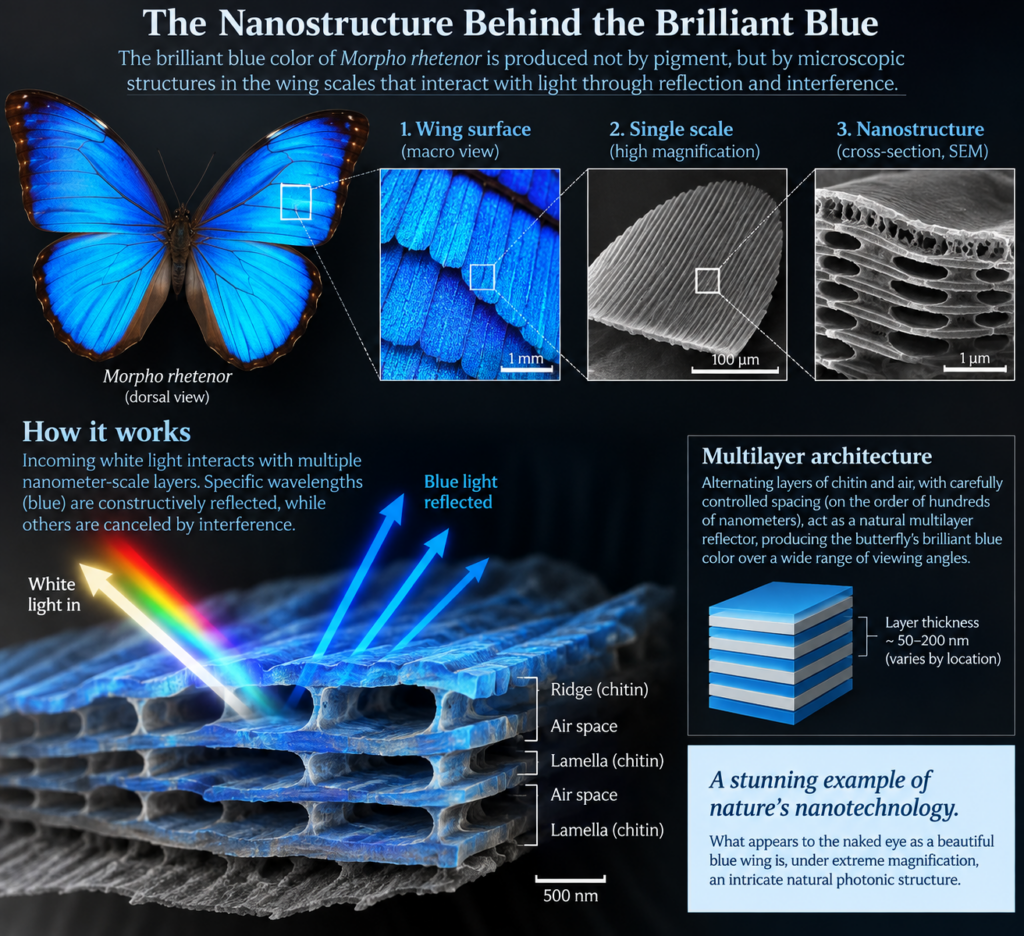
The brilliant metallic blue of the Morpho rhetenor butterfly does not come simply from blue pigment. Instead, much of its spectacular color is produced by microscopic structures built into the scales covering its wings.¹

Under powerful magnification, these scales reveal an intricate architecture of ridges and layers. These structures interact with incoming light through reflection, interference, and diffraction, selectively reflecting wavelengths that produce the butterfly’s brilliant blue appearance. Researchers describe this phenomenon as structural color.¹ ²
The engineering is remarkable. Studies of Morpho butterflies have found multilayered structures within the wing scales that operate on submicron and nanometer dimensions. Researchers have identified features such as alternating lamellae, multilayer reflectors, precisely arranged ridges, and controlled irregularities that together produce intense blue coloration over a surprisingly broad viewing angle.² ³
The effect is sophisticated enough that scientists and engineers have attempted to imitate Morpho wings using modern nanofabrication. One study used electron-beam lithography to manufacture artificial multilayer structures capable of reproducing important optical characteristics of the butterfly’s blue coloration.³
From an evolutionary perspective, these structures are understood as biological features that developed and diversified through evolutionary processes. However, demonstrating how the structures manipulate light is different from experimentally reconstructing the historical sequence by which the complete optical architecture first originated.
From a design perspective, the Morpho wing presents an extraordinary example of biological organization: microscopic structures with specific dimensions and arrangements work together with the physical properties of light to produce a remarkable optical effect. What appears to the naked eye as a beautiful blue butterfly wing is, under extreme magnification, an intricate natural photonic system.
The color is not merely painted onto the wing. Much of it is produced by the physical architecture of the wing itself.
Sources
1. Kertész et al., “Coloration mechanisms and phylogeny of Morpho butterflies,” Journal of Experimental Biology, 2016.
https://pubmed.ncbi.nlm.nih.gov/27974535/
2. Kinoshita, Yoshioka & Kawagoe, “Mechanisms of structural colour in the Morpho butterfly: cooperation of regularity and irregularity in an iridescent scale,” Proceedings of the Royal Society B, 2002.
https://pubmed.ncbi.nlm.nih.gov/12137569/
3. Zhang & Chen, “Nanofabrication and coloration study of artificial Morpho butterfly wings with aligned lamellae layers,” Scientific Reports, 2015.
https://www.nature.com/articles/srep16637
