09/2019 – UPDATED 09/18/2026
In 2003, three amateur fossil hunters made a remarkable discovery in the Hell Creek Formation of South Dakota. They uncovered an extraordinarily well-preserved dinosaur skull with a long snout, a relatively flat head, and an array of prominent knobs and spikes projecting from the back and sides of its skull.¹
Its appearance was so strikingly dragon-like that when the dinosaur was formally described in 2006, researchers named it Dracorex hogwartsia, meaning “Dragon King of Hogwarts.” The name Dracorex was derived from Latin words meaning “dragon king,” while hogwartsia honored Hogwarts School from J. K. Rowling’s Harry Potter books.¹
The Children’s Museum of Indianapolis, where the original specimen is housed, acknowledges the obvious resemblance:

“Dracorex hogwartsia… bears a close resemblance to a fairy-tale dragon, with its bony head covered in spikes and knobs.”¹

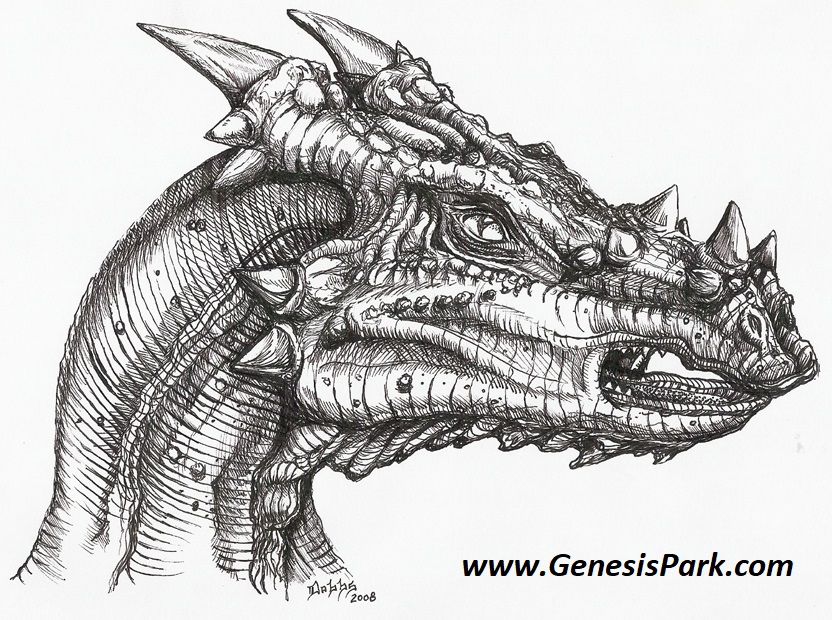
The resemblance is easy to understand. The skull possesses a long, relatively narrow snout, prominent bony knobs, and spikes projecting backward from the skull. These are real anatomical structures preserved in fossilized bone, not features added by an artist.
Interestingly, the classification of Dracorex has changed since its original description. In 2009, paleontologists John Horner and Mark Goodwin presented evidence that Dracorex hogwartsia may not represent a separate dinosaur genus at all. Based upon skull morphology, CT imaging, and bone histology, they proposed that Dracorex, Stygimoloch, and Pachycephalosaurus represent different growth stages of the same dinosaur, with Dracorex representing a juvenile form.²
Whether Dracorex ultimately remains a separate genus or represents a young Pachycephalosaurus does not change the appearance of the fossil itself. A real dinosaur once possessed the long snout, knobs, and dramatic backward-projecting spikes that caused both scientists and museum visitors to immediately compare its skull with a dragon.

DINOSAURS AND THE DRAGON TRADITION
This becomes especially interesting when compared with historical depictions of dragons.
Dragon traditions existed throughout cultures around the world long before modern paleontologists reconstructed dinosaurs. European, Asian, Middle Eastern, and other traditions describe a wide variety of large reptilian creatures, often possessing horns, spikes, elongated skulls, powerful tails, or other reptilian characteristics.
Of course, similarities between dinosaur anatomy and historical dragon artwork do not by themselves demonstrate that ancient people actually encountered living dinosaurs. Artistic traditions can develop from imagination, known reptiles, earlier artwork, fossil discoveries, and cultural transmission.

Nevertheless, fossils such as the Dracorex skull demonstrate an important point: animals possessing anatomical features that modern people immediately describe as “dragon-like” really did exist.
Consider the historical dragon illustration by Friedrich Johann Justin Bertuch from 1806 alongside the skull of Dracorex. The comparison does not prove that the artist had seen such an animal, but it raises an intriguing historical question:
What inspired mankind’s remarkably persistent descriptions and depictions of creatures we call dragons?
The skull resembled the modern vision of a dragon with its flat head, long snout, and spikes sticking out the back of its head. “

Sources
¹ The Children’s Museum of Indianapolis, “Meet Dracorex Hogwartsia”
https://www.childrensmuseum.org/stories/meet-dracorex-hogwartsia
² Horner, J. R., and Goodwin, M. B. (2009). “Extreme Cranial Ontogeny in the Upper Cretaceous Dinosaur Pachycephalosaurus.” PLOS ONE, 4(10), e7626.
https://doi.org/10.1371/journal.pone.0007626