

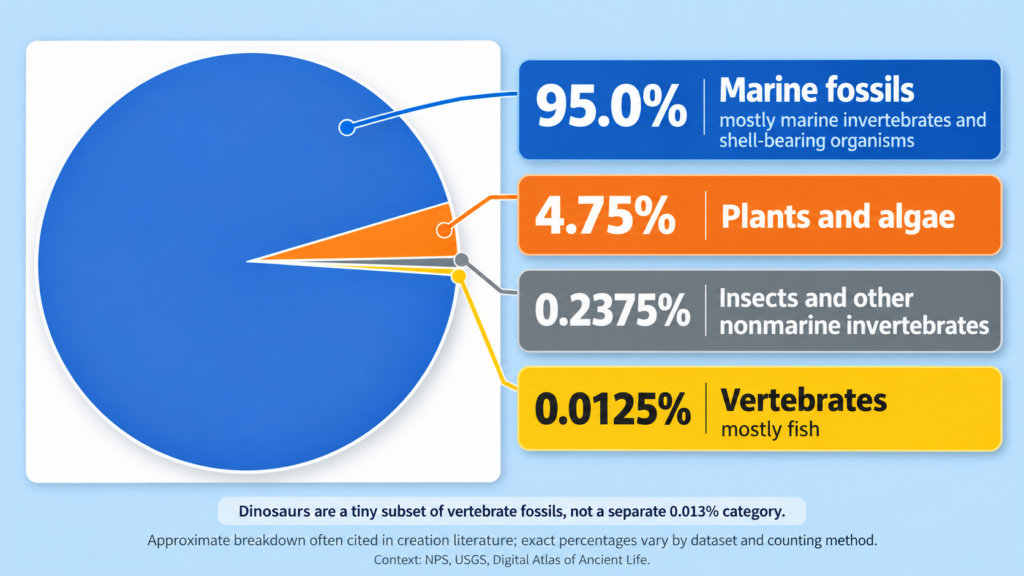
Open almost any museum exhibit on prehistoric life and dinosaurs dominate the display. But dinosaurs do not dominate the actual fossil record, which is overwhelmingly composed of marine organisms, particularly shell-bearing marine invertebrates.
The U.S. National Park Service states:
“Marine invertebrates are by far the most common type of fossil in the rock record.”¹
The U.S. Geological Survey similarly explains that most of the fossil record consists of organisms with shells and microscopic remains preserved within sedimentary rocks.²
This raises an interesting question: Why is Earth’s fossil record so heavily weighted toward organisms that lived in water?

FOSSILIZATION REQUIRES BURIAL
One important fact is not controversial. Dead organisms normally disappear. Scavengers, decomposition, weathering, dissolution, or destruction can remove them. Becoming a fossil requires unusual circumstances, and one of the most important is rapid burial.
The National Park Service explains:
“Rapid burial: Burial by sediment soon after an organism dies prevents the remains from decomposition, weathering, and scavenging.”³
Marine environments are particularly favorable because sediment is constantly being transported and deposited there. Organisms with shells, exoskeletons, teeth, or bones also have a much greater chance of surviving long enough to become fossilized.¹
Consequently, marine organisms possess several enormous preservation advantages at once:
They often live where sediment accumulates.
Many possess hard shells or exoskeletons.
Sediment can bury them rapidly.
And enormous populations may occupy relatively small areas of the seafloor.
This explains at least part of the marine dominance of the fossil record.
MARINE FOSSILS ARE NOW FOUND ACROSS THE CONTINENTS
Marine sedimentary rocks are not restricted to today’s ocean floors. They occur throughout the continents, including regions that today stand thousands of feet above sea level. Marine fossils occur within mountain ranges because rocks that originally formed in marine environments have subsequently been elevated by tectonic processes. From the conventional geological interpretation, these deposits represent numerous ancient seas followed by uplift, deformation, erosion, and other geological processes over immense periods of time.
But the physical observation itself is worth emphasizing:
Vast quantities of marine sediment and marine organisms became buried across regions that today form major portions of the continents.
Any reconstruction of Earth’s geological history must explain the enormous scale of this sedimentation and burial.
A CATASTROPHIC FLOOD MODEL EXPECTS MARINE ORGANISMS TO DOMINATE
A catastrophic Flood interpretation approaches the same evidence from a very different historical framework. If enormous volumes of water and sediment swept across portions of the continents, marine organisms living on and within the ocean floor would be among the first organisms exposed to catastrophic burial.
In a model involving disruption of the ocean basins, powerful currents, sediment transport, and large-scale inundation of the continents, countless marine organisms could be buried beneath rapidly accumulating sediment. As flooding progressed into terrestrial environments, plants and land animals would become involved as well.
This does not mean every land animal would necessarily fossilize. Quite the opposite. Large terrestrial animals that died without rapid burial could float, decompose, be scavenged, or disarticulate before preservation occurred. Fossilization should therefore be expected to represent only a tiny and highly selective sample of organisms that once lived.
That expectation agrees with something conventional paleontology itself recognizes: the fossil record is profoundly affected by preservation bias. Marine environments provide far better conditions for fossilization than upland terrestrial environments.³ ⁴
THE FOSSIL RECORD IS NOT A CENSUS OF PAST LIFE
This point matters especially when fossils are used to reconstruct biological history.
The fossil record is not a representative census of everything that once lived.
Paleontologists readily acknowledge this. Organisms living in sediment-rich marine environments have an enormous preservation advantage over organisms living on mountains, forests, grasslands, and other erosional terrestrial environments. Soft-bodied organisms have another enormous disadvantage compared with organisms possessing shells, teeth, and bones.³ ⁴
Consequently, what we find today has passed through an extremely selective filter:
Did the organism die in the right environment?
Was it buried quickly enough?
Did it possess parts capable of surviving decomposition?
Did the sediment eventually become rock?
Did that rock survive subsequent erosion and geological alteration?
And has someone exposed and discovered the fossil?
Only after all of those conditions are met does an organism become part of the fossil record available for scientific study.
WHAT ABOUT TRANSITIONAL FOSSILS?
This preservation problem cuts both ways in the evolution debate. Creationists sometimes claim that there are essentially little to no transitional fossils. Paleontologists have discovered numerous fossils displaying combinations of characteristics that they interpret as evolutionary transitions. However, paleontologists also openly acknowledge that the fossil record is incomplete and that preservation is extraordinarily uneven.
One review published by the Paleontological Society states that the history preserved by fossils is incomplete because of erosion, deposition, preservation, sampling bias, and other factors.⁵
Therefore, arguments about ancestry frequently depend upon reconstructing relationships from a very small surviving sample rather than observing a continuous fossil sequence from one population into another. That does not automatically invalidate evolutionary interpretations but it does not defend them either.
THE QUESTION WORTH ASKING
The striking marine character of the fossil record does not by itself prove a global Flood.
But it does reveal something extremely important about fossilization:
The history recorded in the rocks is overwhelmingly a history of organisms caught in environments of sediment deposition and burial.
Conventional geology explains those deposits through many episodes of marine deposition, changing sea levels, tectonic movement, and geological processes acting across immense spans of time. A catastrophic Flood model instead asks whether a much larger portion of that record could have been produced during episodes of extraordinarily rapid sedimentation, marine inundation, and catastrophic burial. The fossils themselves cannot simply be counted as though they were an unbiased catalog of everything that lived.
They are, first and foremost, a record of what became buried and the order in which it was buried.
And the overwhelming dominance of marine organisms makes the conditions of that burial a question worth examining.
Sources
Kevin Padian and Kenneth D. Angielczyk, “Are There Transitional Forms in the Fossil Record?” The Paleontological Society Papers.
https://doi.org/10.1017/S108933260000053X
National Park Service, “Invertebrate Fossils.”
https://www.nps.gov/subjects/fossils/invertebrate-fossils.htm
U.S. Geological Survey, “Fossils, Rocks, and Time: Fossils and Rocks.”
https://pubs.usgs.gov/gip/fossils/fossils-rocks.html
National Park Service, “How Fossils Form.”
https://www.nps.gov/subjects/fossils/how-fossils-form.htm
Digital Atlas of Ancient Life, “The Process of Fossilization.”
https://www.digitalatlasofancientlife.org/learn/nature-fossil-record/the-process-of-fossilization/
