Free amino acids outside of a living system break down quickly through chemical reactions like racemization, oxidation, and microbial consumption. https://www2.gwu.edu/~darwin/BiSc151/Origin/origin.html
Amino acids have been reported to be found in meteorites and other extraterrestrial materials. These are commonly presented as evidence that life’s building blocks might originate without and apart from life. However, the mere detection of an amino acid does not establish where it originally came from, nor does it demonstrate the origin of the biological system that selects, sequences, and incorporates amino acids into functional proteins which only living cells can accomplish. Amino acids are non-living checmical structures and in nature decay rapidly and become racemic or enantiomeric. Questions of terrestrial contamination or terrestial based forms and provenance must therefore be considered when evaluating such discoveries.

The famous Miller-Urey experiment is frequently cited as demonstrating the abiotic production of amino acids. But the experiment was intelligently designed and used deliberately selected gases, energy inputs, laboratory apparatus, and a collection system that removed reaction products from the energy source. Furthermore, they did not have free oxygen and filtered UV light. Even accepting the amino acids reported from the experiment, producing some amino acids under controlled laboratory conditions is not equivalent to demonstrating that life’s amino-acid and protein-producing system arose through unguided natural processes.
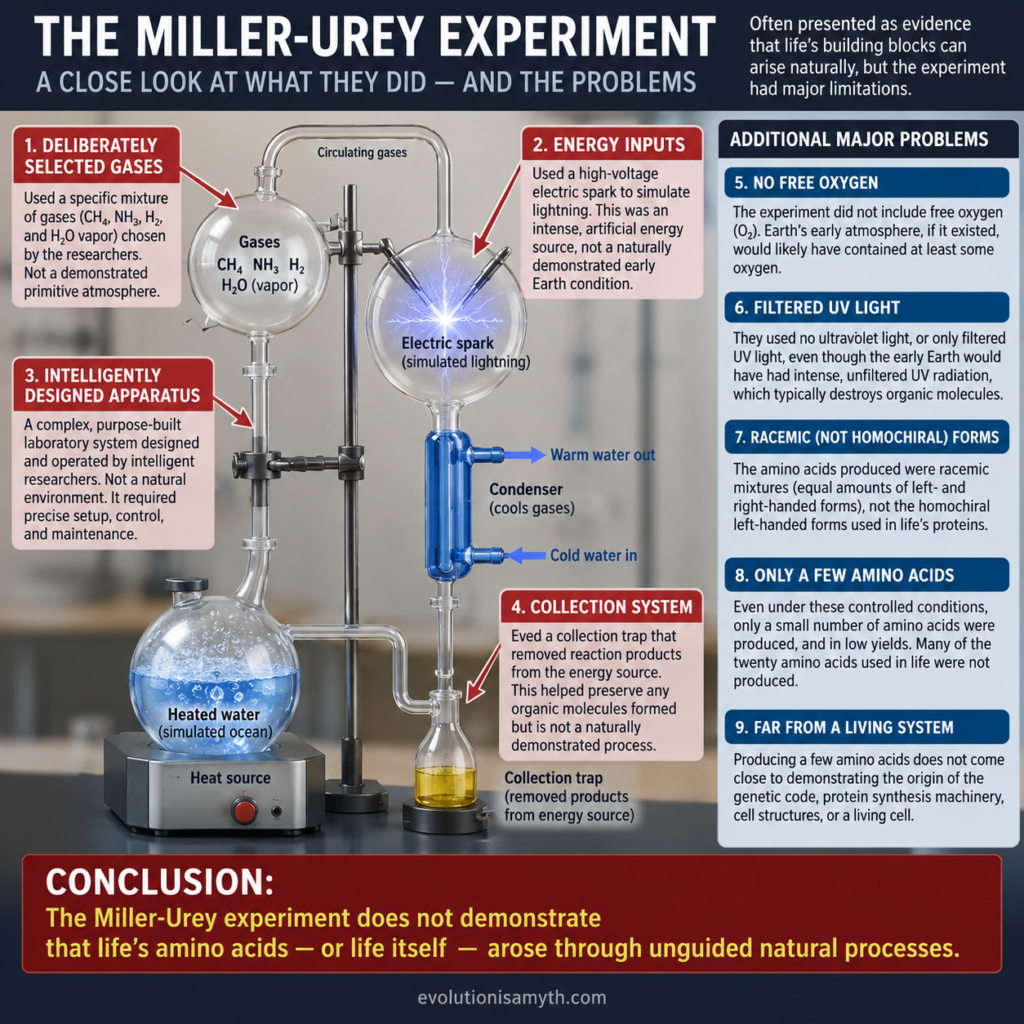
This distinction is critical. Finding or experimentally producing individual amino acids does not explain the origin of the genetic code, the selection of the amino acids used by life, biological homochirality, transfer RNA, aminoacyl-tRNA synthetases, ribosomes, or the information required to arrange amino acids into functional protein sequences. Therefore, the existence of amino acids outside an organism should not be confused with a demonstrated naturalistic origin for the amino-acid system used by life. Regardless, we do not observe amino acids with left-handed chirality like those in life forming randomly anywhere in nature– even the Miller-Urey device had to be carefully calibrated to accomplish this delicate task although only with highly racemic results.
The Twenty “letter” Amino Acids
The twenty amino acids each have assigned to them both three-letter (can be upper or lower case) and one-letter codes (upper case). This makes it quicker and easier for notation purposes and are worth learning.

The format of the list is: amino acid name – 3 letter code – 1 letter code
alanine – ala – A
arginine – arg – R
asparagine – asn – N
aspartic acid – asp – D
cysteine – cys – C
glutamine – gln – Q
glutamic acid – glu – E
glycine – gly – G
histidine – his – H
isoleucine – ile – I
leucine – leu – L
lysine – lys – K
methionine – met – M
phenylalanine – phe – F
proline – pro – P
serine – ser – S
threonine – thr – T
tryptophan – trp – W
tyrosine – tyr – Y
valine – val – V
http://www.cryst.bbk.ac.uk/education/AminoAcid/the_twenty.html