Information Requires an Intelligent Sender
updated 09/16/2026
What Is Information?

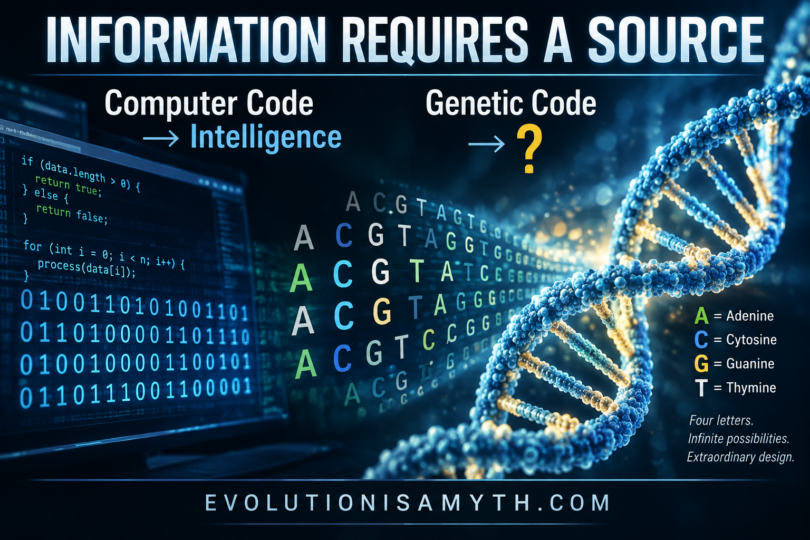
Information is fundamental to every living organism. DNA does not merely consist of chemicals arranged randomly. It stores biological information in sequences composed of four nucleotide bases: adenine (A), cytosine (C), guanine (G), and thymine (T). These bases form the genetic alphabet used by living organisms. The human genome contains approximately 3 billion base pairs of DNA.¹
DNA therefore raises an important question: Where did the information necessary for life originate?
Information and Code
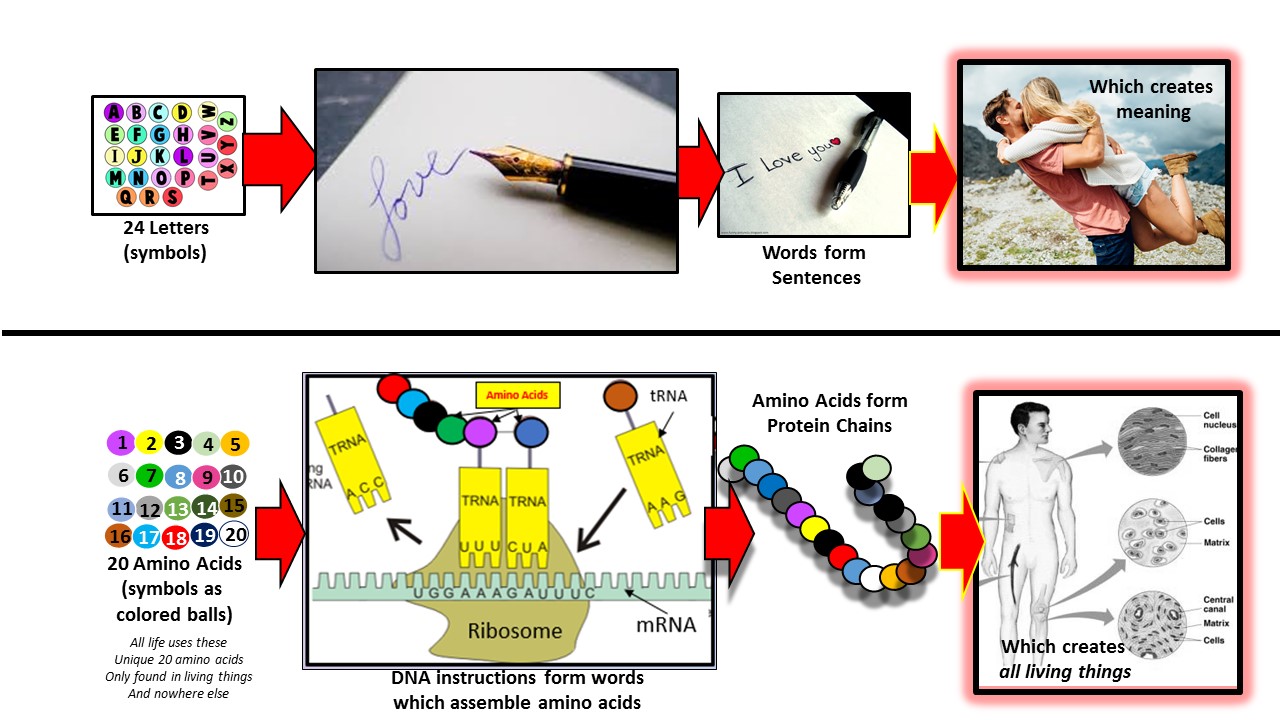
Information can be represented through symbols arranged according to a system. Computers, for example, commonly represent information using binary states, 0 and 1. DNA uses four nucleotide bases, A, C, G, and T. Groups of three bases, called codons, are used through RNA intermediates to specify amino acids during protein synthesis.
In every known example of human language or computer programming, meaningful coded instructions originate from intelligence. Letters do not write books by themselves, and computer code does not write itself. The symbols are physical, but their particular arrangement conveys information.
DNA presents something even more remarkable. Its nucleotide sequences contain biological information used by cells to develop, function, maintain themselves, and reproduce.
From a design perspective, several characteristics stand out:
1. Information requires a physical means of storage or transmission.
DNA stores genetic information in sequences of nucleotide bases.
2. DNA operates through an organized coding system.
Specific nucleotide sequences have biological consequences, and codons correspond to particular amino acids during protein synthesis.
3. The information is functional.
The sequence is not simply complex. Particular arrangements perform specific biological functions.
4. Information is processed by molecular machinery.
Cells contain elaborate systems for reading, copying, translating, regulating, and repairing genetic information.
5. The system exhibits coordinated function.
DNA, RNA, proteins, ribosomes, enzymes, and other cellular components work together as an integrated biological system.
These biological observations should be distinguished from the conclusion drawn from them. The conclusion that functional biological information ultimately points to intelligence is a design inference.

Can Information Arise Without Intelligence?
This is where creation and naturalistic origin-of-life models reach very different conclusions.
Information theory can mathematically measure information without requiring an intelligent sender. But mathematical information alone does not answer the deeper question concerning the origin of biologically functional information.
It is not enough to produce organic molecules. An origin-of-life explanation ultimately must account for the emergence of systems capable of storing information, reproducing it, using it to perform biological functions, and passing that information to subsequent generations.
Researchers have proposed several naturalistic explanations. The best known is the RNA-world hypothesis, which proposes that RNA or RNA-like molecules preceded today’s DNA-and-protein system. RNA may once have served both as an information carrier and as a chemical catalyst.²
Laboratory research has demonstrated important catalytic properties of RNA and has produced experimental results relevant to possible RNA-based precursor systems. However, the RNA world remains a proposed model for the early development of life rather than an observed historical event. Researchers continue investigating major questions concerning how such a system could have originated, replicated, and developed into the DNA-RNA-protein system found in living organisms today.² ³
Therefore, the scientific observation and the inference drawn from it should be distinguished. Science observes extraordinarily complex systems of biological information processing. Creationists argue that intelligence provides the better explanation for the ultimate origin of that functional information.
The Information Inside DNA
The scale of biological information is extraordinary. One copy of the human genome contains approximately 3 billion DNA base pairs, distributed across 23 chromosomes.¹ DNA is also part of a remarkable information-processing network. Before cells divide, DNA must be copied. Cells employ proofreading and repair mechanisms that correct many replication errors, although they cannot prevent every mutation.
The consequences of replication errors can be significant. A 2017 study published in Science estimated that approximately two-thirds of the mutations found in human cancers resulted from random DNA replication errors, with the remainder attributable to environmental and inherited factors.⁴ This is significant because the cell is not simply storing information. It must preserve, copy, interpret, regulate, and use that information while maintaining the molecular machinery necessary to perform those operations.
The DNA-Protein Problem
Modern cells also present an intriguing origin-of-life problem. DNA carries information used to produce proteins, yet proteins and other molecular components are required to copy, maintain, interpret, and express DNA. Neither operates independently in modern living cells. This creates a classic chicken-and-egg question:
How did an integrated system of genetic information and the molecular machinery necessary to use that information originate?
Origin-of-life researchers recognize this difficulty. The RNA-world hypothesis was proposed in part because RNA can both carry genetic information and perform certain catalytic functions. More recent experiments have also investigated possible RNA-peptide systems that could have preceded the modern relationship between nucleic acids and proteins.⁵ These experiments are important scientific research. However, demonstrating that individual chemical steps are possible is different from demonstrating the historical origin of the first self-sustaining living information system.
The fundamental question therefore remains:
What is the ultimate source of the functional information upon which life depends?
From the creationist perspective, DNA’s coded information, coordinated molecular machinery, information-processing systems, and integrated biological functions are consistent with what we observe when information possesses functional meaning and purpose: information points back to intelligence.
Sources
1. National Human Genome Research Institute, “Base Pair.”
The NHGRI states that one copy of the human genome contains approximately 3 billion DNA base pairs distributed across 23 chromosomes.
https://www.genome.gov/genetics-glossary/Base-Pair
2. Gerald F. Joyce, “The Antiquity of RNA-Based Evolution,” Nature 418 (2002): 214–221.
Review of the RNA-world hypothesis and the proposal that RNA once served both informational and catalytic functions.
https://www.nature.com/articles/418214a
3. Paul G. Higgs and Niles Lehman, “The RNA World: Molecular Cooperation at the Origins of Life,” Nature Reviews Genetics 16 (2015): 7–17.
Review of RNA-world research, including unresolved questions surrounding replication and the emergence of early molecular systems.
https://www.nature.com/articles/nrg3841
4. Cristian Tomasetti, Lu Li, and Bert Vogelstein, “Stem Cell Divisions, Somatic Mutations, Cancer Etiology, and Cancer Prevention,” Science 355 (2017): 1330–1334.
The researchers estimated that DNA replication errors account for approximately two-thirds of the mutations found in human cancers.
https://pubmed.ncbi.nlm.nih.gov/28336671/
5. Felix Müller et al., “A Prebiotically Plausible Scenario of an RNA-Peptide World,” Nature 605 (2022): 279–284.
Experimental investigation of a possible RNA-peptide stage preceding the modern nucleic-acid/protein system.
https://www.nature.com/articles/s41586-022-04676-3