09/2019- updated 09/29/2026
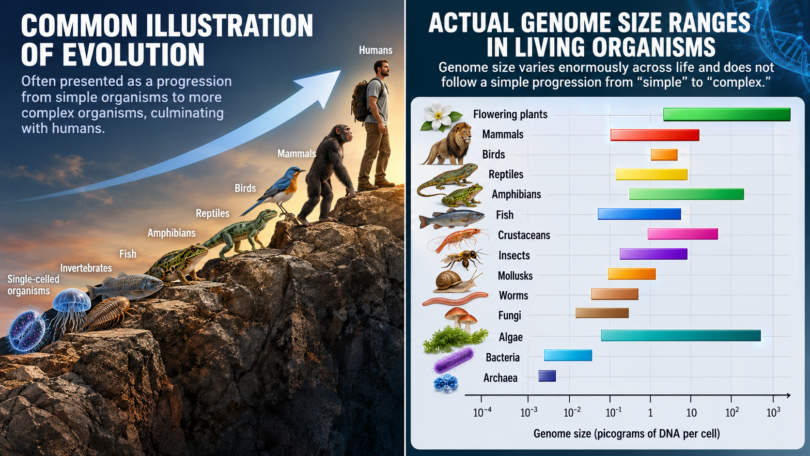
Popular illustrations of evolution have often portrayed the history of life as though organisms progressed from simple forms toward increasingly complex forms, with humans positioned at the top. Genome-size measurements do not follow such a ladder.
If increasing organismal complexity required a corresponding increase in the amount of DNA, humans might be expected to possess among the largest genomes. They do not. Genome sizes vary enormously among living organisms, and some plants, salamanders, lungfish, and other organisms contain many times more DNA per cell than humans. Scientists recognized this surprising lack of correlation decades ago and historically called it the C-value paradox.¹
MORE DNA DOES NOT MEAN A “MORE ADVANCED” ORGANISM

Research has established that total genome size bears little relationship to what scientists ordinarily describe as organismal complexity. Eukaryotic genome sizes vary by tens of thousands of times, yet this variation is not explained simply by differences in gene number.² A large genome can contain enormous quantities of repetitive DNA, transposable elements, introns, duplicated sequences, and other noncoding DNA. Consequently, the amount of DNA within an organism cannot simply be read as a measure of how anatomically or behaviorally complex that organism is.
The human haploid genome contains roughly 3.2 billion DNA base pairs, yet substantially larger genomes occur elsewhere in nature.
Plants and some amphibians and fishes possess genomes many times larger than ours. Genome-size research therefore produces a biological landscape very different from the familiar ascending illustrations of organisms arranged from “simple” to “complex.”²
THE C-VALUE ENIGMA
The discovery that much of the eukaryotic genome does not directly encode proteins helped resolve the original assumption that more DNA should necessarily mean more genes. But it opened a broader collection of questions now called the C-value enigma: Why do genome sizes differ so greatly? Why do some lineages accumulate enormous quantities of repetitive DNA while others maintain compact genomes? What effects do these differences have on cell size, development, metabolism, and reproduction?¹ ³
Researchers have identified mechanisms that can increase or decrease genome size, including transposable-element expansion, DNA deletion, duplication, and whole-genome duplication. Genome size also correlates with some biological characteristics such as cell size and cell-division rate. Nevertheless, there is no universal progression in which organisms acquire progressively larger genomes as they become supposedly more complex.² ³
GENOMES DO NOT RESEMBLE A SIMPLE ASCENDING SCALE
Genome-size data therefore provide a useful caution against presenting the history of life as a simple upward progression culminating in humans. Nature does not display a genome-size ladder with bacteria at the bottom and humans at the top. Instead, it displays extraordinary genomic diversity, with very large and very small genomes scattered throughout widely different groups of organisms.

please do not construe this figure as an endorsement of a progressionist view of evolution!
From a creation perspective, this lack of a simple genomic hierarchy is consistent with organisms possessing different amounts and arrangements of genetic material suited to their particular biology rather than occupying successive positions on an ascending scale of life. Genome size by itself does not establish creation or disprove common ancestry, but it does demonstrate that “more evolved” cannot legitimately be equated with “more DNA.”
SOURCES
¹ T. Ryan Gregory, “The C-value Enigma in Plants and Animals,” Annals of Botany 95 (2005): 133–146. PubMed Central (PMC)
² Tyler A. Elliott and T. Ryan Gregory, “What’s in a Genome? The C-value Enigma and the Evolution of Eukaryotic Genome Content,” Philosophical Transactions of the Royal Society B 370 (2015). Their analysis emphasizes that eukaryotic genome size varies enormously and is not explained by gene number or intuitive organismal complexity. PubMed Central (PMC)
³ Modern reviews continue to describe massive genome-size variation across eukaryotes and identify repetitive and other noncoding DNA as major contributors to these differences.