Horseshoe crabs are “living fossils” meaning they have existed nearly unchanged…nearly identical to their ancient relatives…for at least 445 million years, well before even dinosaurs existed. Horseshoe crabs are not actually crabs at all, they are much more closely related to spiders and other arachnids than they are to crabs or lobsters!”
https://myfwc.com/research/saltwater/crustaceans/horseshoe-crabs/facts/#:~:text=Horseshoe%20crabs%20are%20%E2%80%9Cliving%20fossils,are%20to%20crabs%20or%20lobsters!
Published 09/2016- updated 09/28/2026
Evolution is commonly associated with change, yet one striking feature of the fossil record is the persistence of recognizable anatomical forms over enormous spans of conventional geologic time. Horseshoe crabs, coelacanths, nautiluses, crocodilians, sharks, turtles, ginkgo trees, tadpole shrimp, and numerous other organisms possess body plans that can be readily compared with remarkably ancient fossil relatives.
Scientists often call particularly conspicuous examples “living fossils.” The term is informal and somewhat controversial because no organism remains genetically or anatomically unchanged over time. Nevertheless, the phenomenon it describes, prolonged morphological stasis, is real and widely recognized within paleontology.
A review published in BioScience noted that organisms such as horseshoe crabs, coelacanths, and ginkgo trees exhibit extraordinary levels of morphological stasis and stated that these patterns have required explanation since Darwin. Even more significantly, the authors noted that quantitative paleontological studies indicate that “most fossil species exhibit stasis.” Studies comparing different evolutionary patterns have found stasis and nondirectional variation to be common, while sustained gradual morphological change is comparatively uncommon.¹
That is an important observation. It does not by itself disprove evolutionary common ancestry, because evolutionary theory includes mechanisms intended to explain why successful anatomical forms may remain relatively stable. But it does raise an obvious question:
If immense spans of time and continual evolutionary processes have acted upon organisms, why do so many successful body plans appear so remarkably persistent?
HORSESHOE CRABS: HUNDREDS OF MILLIONS OF YEARS OF SIMILARITY

Horseshoe crabs provide one of the most familiar examples.
The Florida Fish and Wildlife Conservation Commission describes horseshoe crabs as “living fossils,” with ancestors dating back about 445 million years by conventional dating. It states that modern horseshoe crabs remain nearly identical in general anatomy to their ancient relatives.²
Modern horseshoe crabs retain the characteristic broad carapace, segmented rear body, multiple walking appendages, book gills, and long telson recognizable in fossil forms.
This does not mean that every fossil horseshoe crab is the same species as a modern horseshoe crab. Paleontologists have documented differences among extinct and living members of the group. The broader observation is this: the fundamental horseshoe-crab body plan has persisted with comparatively modest morphological alteration through what the conventional timescale calls hundreds of millions of years.
If morphological transformation is expected to accumulate through enormous spans of evolutionary time, such persistence deserves attention.
THE HORSESHOE CRAB IS NOT AN ISOLATED EXCEPTION
The phenomenon extends well beyond one or two celebrated examples.
Researchers studying “living fossils” discuss long-term morphological conservation in organisms including horseshoe crabs, coelacanths, ginkgo trees, tuataras, tadpole shrimp, brachiopods, and others.¹ Many broader categories familiar today also have representatives deep within the fossil record: sharks, rays, bony fishes, turtles, crocodilian forms, clams, gastropods, crustaceans, echinoderms, cephalopods, insects, and numerous plant groups.
These ancient representatives are generally not classified as the same modern species. Differences certainly exist, sometimes substantial ones. But many belong to immediately recognizable anatomical groups.
When this article discusses persistence, it is not claiming that a modern species of crab, turtle, shark, or clam necessarily existed unchanged hundreds of millions of conventional years ago. The observation concerns persistence of recognizable anatomical architectures and major organismal forms.
NAUTILUS AND AMMONITES: SIMILAR, BUT NOT THE SAME
The chambered Nautilus is especially interesting because it resembles the extinct ammonites that dominate many fossil collections.
Both are cephalopod mollusks with chambered external shells, but they are not classified as the same lineage. Ammonites differed in shell sutures and internal anatomy, and current phylogenetic interpretations generally place them closer to the coleoid branch containing squid, cuttlefish, and octopuses than to modern Nautilus.⁴
Their outward similarity therefore should not be overstated.
Yet the comparison remains interesting because the nautiloid body plan itself is extraordinarily ancient. Modern genomic research places the divergence between nautiloids and coleoids hundreds of millions of conventional years ago, while externally shelled nautiloid cephalopods persisted through repeated extinction events that eliminated the ammonites.⁵
Once again, the larger point is not that nautiluses are secretly ammonites. It is that remarkably ancient biological architectures can persist for enormous portions of the conventional geologic record.

Nautiluses are a living link to the ancient past. They’ve been around over 480 million years, cruising deep ocean reefs even before the time of dinosaurs.”
https://www.montereybayaquarium.org/animals/animals-a-to-z/chambered-nautilus

STASIS IS NOT A CREATIONIST INVENTION
Perhaps the most important point is that morphological stasis is not something creationists invented by selectively examining fossils. Paleontologists themselves study it.
The 2018 BioScience review explained that prolonged stasis occurs at numerous biological levels and specifically discussed the problem of explaining why particular constellations of anatomical characteristics remain stable over extraordinarily long intervals.¹ The authors summarized research showing that sustained directional morphological evolution is relatively uncommon compared with stasis and nondirectional variation within studied fossil sequences.¹
Evolutionary biologists propose several explanations. Stable environments may favor already successful forms. Developmental constraints may restrict possible anatomical changes. Stabilizing selection may eliminate departures from an established morphology. Evolution may also occur rapidly in comparatively short episodes separated by long periods of little net morphological change, an idea incorporated into punctuated equilibrium.
Those explanations deserve to be considered rather than ignored. But explanation should not obscure observation. The fossil record contains enormous amounts of stasis.
WHAT DO “LIVING FOSSILS” ACTUALLY SHOW?
Living fossils do not demonstrate that absolutely no evolution or genetic change has occurred. Nor does a fossil resembling a living organism prove that both are the same species.
What they demonstrate is something more limited, but nevertheless remarkable:
Some biological forms are extraordinarily stable.
According to the conventional geological chronology, certain recognizable body architectures have persisted through continental movements, climate changes, mass extinctions, ecological upheavals, and hundreds of millions of years of supposed evolutionary opportunity.
From a creation perspective, this is consistent with the expectation that organisms reproduce within persistent created biological groups while undergoing variation and specialization. Evolutionary biologists interpret the same evidence through stabilizing selection, developmental constraints, ecological stability, phylogenetic history, and punctuated evolutionary change. The fossils themselves establish the observation. Long-term morphological stasis is widespread and real. The question is which historical interpretation best explains it.
Our claim that 99% of all “organisms” remain alive today as “living fossils” does not match consensus demarcations of Naturalists (as defined above) within modern evolutionary presumptions. We are talking about animal “kinds,” not species!
Complicated scientific names for ordinary animal kinds
The names for various fossilized animals, like the taxonomic categories from Kingdom to Species, are Latin. Unfortunately, most people do not speak or read Latin, so these names sound mysterious and complicated. Still, they are just exotic-sounding compound names for ordinary animals a kindergartner could name.

Source: Greengill (Lepomis cyanellus x Lepomis macrochirus) — Koaw Nature
ANCIENT ECOSYSTEMS ALSO CONTAINED FAMILIAR ORGANISMS
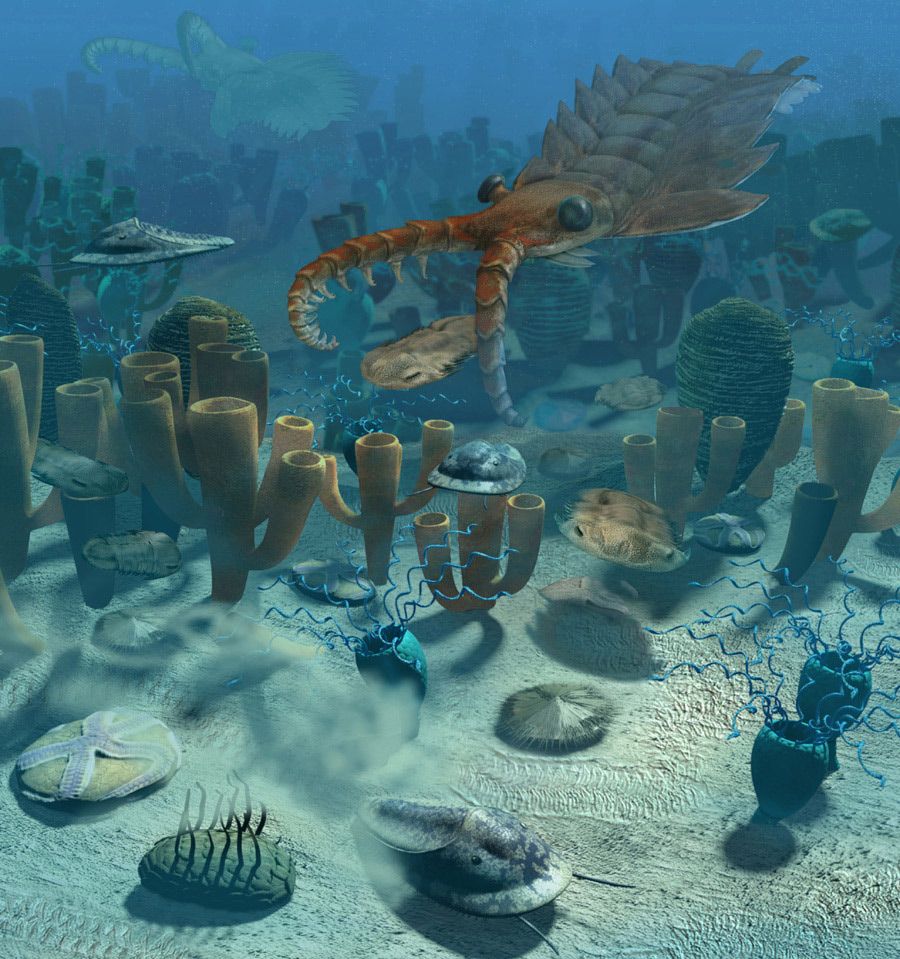
Museum illustrations understandably emphasize unusual extinct animals because they make prehistoric scenes visually interesting. Yet this can unintentionally suggest that ancient ecosystems consisted almost entirely of bizarre organisms unlike anything alive today. They did not.
Ancient marine deposits contain many recognizable representatives of groups that remain abundant today, alongside extinct forms. Fossil ecosystems included fishes, sharks, bivalves, gastropods, crustaceans, echinoderms, cephalopods, corals, worms, and many other familiar organisms.
The ancient world, even using conventional dating, therefore contained an interesting mixture of extinct organisms and remarkably persistent biological forms. The ocean’s landscapes would look remarkably familiar to us. That deserves more attention and illustrates an important point.
LUMPERS AND SPLITTERS

Notice how detailed scientists are about the delicate arrangements and subtleties of the shape and size of fins, jaw, head, and patterns, all used to distinguish not that it is just a sunfish, but that it is a “hybrid” species. Such delicate differences are used to claim discoveries of new species in fossils. This means the total number of living species in the fossil record is likely exaggerated. (See image of Lumpers and Splitters). However, if this animal turned out to be a sunfish, it would be just a sunfish. If a paleontologist found it, they might examine it under a microscope or X-ray machine to spot subtle differences, and they might find a new, undiscovered species within the Centrarchidae family. New species discoveries ensure future funding, a book deal, revenue, and potential fame, especially for humans, apes (considered “pre-humans”), and dinosaurs.

Naturalists will argue that the fossilized sunfish pictured above is today completely extinct at the species level –but clearly, we still have sunfish! These examples persist across organisms found both as fossils and alive today. So, next time you read a long scientific name of a seemingly mysterious fossil like a marine shell named “Inoceramus,” Google it because it is just a clam.
The "Lepomis macrochirus x Lepomis cyanellus" was a sunfish.
There is nothing wrong with using specific naming criteria or Latin, because scientific accuracy is vital. However, simply mentioning a common name would clarify. Try looking up fossil names sometime and find long, mysterious-sounding Latin names for seemingly ordinary organisms and animals. Perhaps the museum would rather not say the fossil is a sunfish —it sounds too ordinary and doesn’t align with the theme of millions of years of evolution.
“Living fossils” (the way we mean it here) is by the animal –not the species!
Here is how to determine a “living fossil” based on “kind” or “type.”
Look at the image of the fossil– does it look familiar? If not, look up its scientific name. Now, is that kind of animal still alive today? Outside the handful of favorites mentioned earlier, like trilobites, ammonites, and dinosaurs — I bet it is! Also, arguably exceedingly similar animal kinds to these are still alive too!
Sure, the delicate modifications scientists carefully examine to determine species come from normal gamete reproduction, not mutations. Is the animal alive: yes or no? I have found that with only a few exceptions of extinct species, the answer is probably yes- they are still alive!
Naturalists point out that trilobites are extinct (which perhaps they are) but find different species emerging and then going extinct throughout the fossil record. But they are still trilobites!

Like most all fossils, trilobites are found through many layers with very minor differences that caused them to be categorized as different species--but they are still trilobites.
One reason that this claim sounds foreign (and probably wrong) is partly because of presentation. Naturalists focus on defending their theory at all times —especially in how they produce and categorize data. They know that pointing out that almost all animals remain in stasis for millions of years does not reflect well on evolution.

Organisms are categorized today in various ways; one method is called cladistics. For fossils, this leaves researchers with potentially three bodies of physical evidence: {1} the anatomical form, {2} the sedimentary layer it was found in, and {3} perhaps some fragments of DNA. DNA was shockingly found within fossils. Any fossil presumed to be over 100,000 years old has nothing close to fully mapped DNA —only fragments. This is because of DNA’s vast fragility, with only a 521-year half-life, four times younger than carbon-14! -1.

One reported radiocarbon in a supposedly 70 million-year-old mosasaur fossil from Belgium, and the other reported radiocarbon in a supposedly 505 million-year-old sponge from Canada’s famous Burgess Shale. Their authors suggested contamination, but neither study presented scientific evidence to support this assertion.”
https://www.icr.org/article/carbon-dating-fossils
Determining that rate (of genetic change) has been difficult because it is rare to find large sets of DNA-containing fossils with which to make meaningful comparisons (comparisions to modern DNA). To make matters worse, variable environmental conditions such as temperature, degree of microbial attack and oxygenation alter the speed of the decay process (make for an even a quicker decay rate).”
DNA has a 521-year half-life | Nature Paranthesis and bold are mine.
The internet and textbooks are filled with drawings of a supposed ancient past when seemingly only mysterious (and now extinct) creatures lived. They do this despite physical evidence that many of these strata of marine and tropical environments are also filled with ordinary creatures. Why leave those out? Notice that this Jurassic image does not include fish, crabs, shrimp, clams, squid, starfish, sea lilies, turtles, or sharks– and they all had “evolved” by then. These greatly exaggerated ancient oceans were perhaps not unlike our oceans today. Yet, evolutionary textbooks and websites focus on only extinct organisms–why?

The term “living fossil” is an imperfect concept, which has caused much consternation among paleontologists and biologists as they have sifted through the fossil record over time. It is meant to describe an organism that has remained relatively unchanged over millions of years, or one that has no, or very few, close surviving relatives. The concept is an informal window into the past, a way for us to consider species as they may have been millions of years ago by observing their modern descendents.”
Living Fossils | Popular Science (popsci.com)
Many such life forms, as the fossil record shows, have remained virtually unchanged for millions of years. A few include (many fishes such as) The Coelacanth, Sharks, Crocodiles, Horseshoe Crabs, Fig Wasps, Ginkgo Biloba, Palau Cave Eels, and Nautilus.-2 The Coelacanth fish was thought to be long extinct but was later found alive. Look at the horseshoe crab —back to the distant Cambrian layer (541 million years ago), yet it is still in stasis. Isn’t the concept of the descent of life by evolution the opposite of what we observe within the preponderance of the evidence?
Ordinary extant animals and organisms also found as fossils remain a significant challenge for the theory of evolution. Evolution holds that the needs of living things change for countless reasons, and therefore living organisms must change (evolve) to survive. But this is not what we observe. Why are fossilized lifeforms still alive today, essentially unchanged in stasis?
Living fossils are a problem for evolution despite claims or saves to the contrary. Many Naturalists do not like this concept, let alone the evidence presented herein. The evidence and inferences discussed and illustrated within this article illustrate a minimization and even some outright omissions within most naturalistic publications relating fossil types to modern living species.
“Evolutionists like to call it ‘evolutionary stasis’ (when one organism does not change for millions of years). But evolution is about change, and putting ‘evolutionary’ in front of ‘stasis’ does not explain stasis in terms of evolution.” These are contradictions.
Dodging living fossils (creation.com)
The naturalistic categorization is carefully organized so as NOT to find many “living fossils”. Why? Evidence of fossils and life today reveals a remarkable stasis in all life forms. While stasis alone does not disprove the theory of universal common ancestry (“evolution”), the physical evidence weakens it.
We have found that “living fossils” are deemphasized by a laundry list of criteria needed to qualify within their preset demarcations and assumptions to earn the categorization of being a “living fossil.” Also, these fossils are often identified by complicated Latin scientific names, making it harder to identify the organism. Finally, fossils illustrated in artistic renderings often depict extinct or mysterious life forms, which can lead viewers to believe ancient oceans and terrestrial landscapes were much different than today. These renderings purposely leave out ordinary animals, regardless of a species’ predominance or abundance.
Living fossils: contentious but necessary? Whether it is horseshoe crabs, coelacanths, or gingko trees, taxa that allegedly display extraordinary levels of morphological stasis over geological time have called out for a special explanation since Darwin (Lidgard and Hopkins 2015).
https://academic.oup.com/bioscience/article/68/10/760/5065827


The Ginkgo biloba is a living fossil whose arboreal ancestors date back to the Jurassic period. Yale University paleobotanist Peter Crane said: “It is hard to imagine that these [ginkgo] trees, now towering above cars and commuters, grew up with the dinosaurs and have come down to us almost unchanged for 200 million years.”
https://creation.com/ginkgo-living-fossil

Shrimp found in the Carboniferous Oil Shales of Edinburgh, Scotland.-5
Viewing extinct and extant representatives of these lineages side by side provokes an immediate judgment of similarity…Why have these constellations of characters persisted for so long?”
https://academic.oup.com/bioscience/article/68/10/760/5065827


Many seemingly mysterious-looking marine animals found fossilized are also alive today in stasis — nearly identical to those thought to be hundreds of millions of years old.
Are birds the ancestors of dinosaurs? Strange, because many birds lived alongside dinosaurs, including chickens and ducks!

Our aim…is to rethink the concept of a living fossils in a way that takes seriously both its routine use across disparate research questions in biology and the worries about its misleading inferences (such as creationists use of such data) in order to create new paths for productive research that yield a more unified theoretical outlook. We first highlight the value of thinking in terms of parts (characters) and wholes (typically, organisms or lineages) to better understand stasis. Then, we move beyond concerns that concentrate on categorizing living fossils.” Parentheis in orginal.
https://academic.oup.com/bioscience/article/68/10/760/5065827


Yet, Stephen J Gould—the now-deceased professor of paleontology from Harvard University and the American Museum, is hard to contradict when they say there are no transitional fossils. … “You say I should at least show a photo of the fossil from which each type of organism was derived. I will lay it on the line—there is no such fossil for which one could make a watertight argument.” [Italics and bold added]. -3
What needs to be specified (is) to understand how the living fossil concept plays the role of delineating what is in need of explanation and structuring a research program around different factors that are associated with long-term stasis“
https://academic.oup.com/bioscience/article/68/10/760/5065827


Should we expect very long-lived lineages to be common or rare, morphologically distant or average compared to related lineages?”
https://academic.oup.com/bioscience/article/68/10/760/5065827


In summary, different disciplinary perspectives, data, and methods can be integrated within an organized structure of problems to achieve more comprehensive and unified answers to questions about slow or negligible rates of evolutionary change—stasis—for diverse kinds of parts and wholes in living systems.”
https://academic.oup.com/bioscience/article/68/10/760/5065827
SOURCES
Huang et al., “The Genome of Nautilus pompilius Illuminates Eye Evolution and Biomineralization,” Nature Ecology & Evolution 5 (2021). https://www.nature.com/articles/s41559-021-01448-6
Scott Lidgard and Alan C. Love, “Rethinking Living Fossils,” BioScience 68, no. 10 (2018): 760–770. https://academic.oup.com/bioscience/article/68/10/760/5065827
Florida Fish and Wildlife Conservation Commission, “Facts About Horseshoe Crabs and FAQ.” https://myfwc.com/research/saltwater/crustaceans/horseshoe-crabs/facts/
Natural History Museum, “Coelacanths: The Fish That ‘Outdid’ the Loch Ness Monster.” https://www.nhm.ac.uk/discover/coelacanths-the-fish-that-outdid-the-loch-ness-monster.html
Natural History Museum, “What Is an Ammonite?” https://www.nhm.ac.uk/discover/what-is-an-ammonite.html