
09/2019- updated 09/29/2026
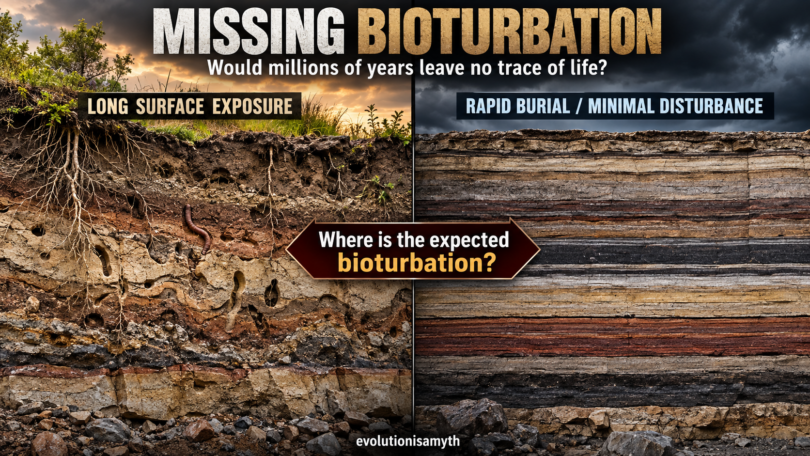
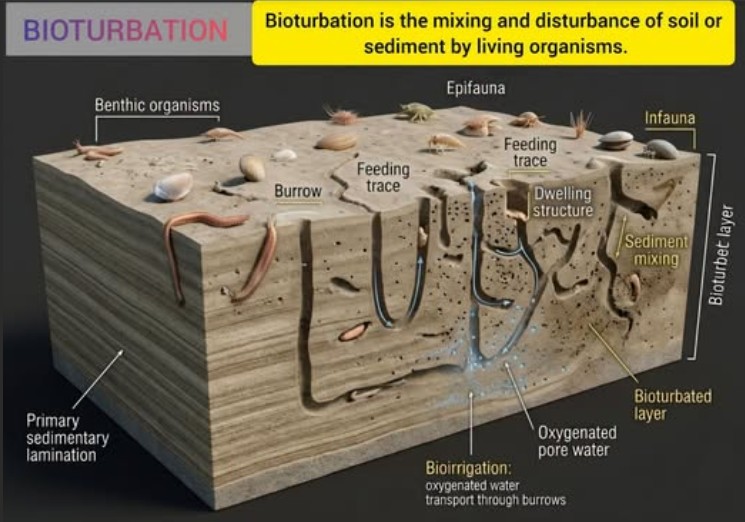
When sediment remains exposed to biological activity, organisms frequently disturb it. Worms and other animals construct burrows, plants send roots through soils, and microorganisms and bottom-dwelling organisms mix sediments. This disturbance is known as bioturbation. In terrestrial environments, long-term surface exposure may also produce recognizable soils, root traces, weathering features, and erosion. These structures are important enough that geologists routinely use them when interpreting ancient environments.¹
For this reason, contacts between sedimentary layers deserve careful examination when they are interpreted as representing enormous intervals of tens of millions of years of supposed missing time.
Where is the bioturbation?
WHAT SHOULD LONG SURFACE EXPOSURE LEAVE BEHIND?
The longer sediment remains exposed under conditions favorable to life, the greater the opportunity for biological and physical modification. Ancient soils, or paleosols, can preserve soil horizons, root traces, burrows, mineral alteration, weathering, and other evidence of prolonged interaction between the sediment and the environment. Researchers studying paleosols specifically identify root traces and burrows as important indicators of biological activity.¹

Marine sediments can likewise become heavily disturbed by organisms. Modern studies of seafloor sediments show that burrowing organisms can substantially rework sediment after deposition, sometimes destroying the original sedimentary structures.²
This does not mean that every old surface must be heavily bioturbated. Conditions such as rapid burial, oxygen deficiency, strong currents, unsuitable substrate, salinity, or absence of appropriate organisms can suppress biological activity. Nevertheless, when a surface is interpreted as having remained exposed or available for colonization for an extremely long period, the degree of physical and biological alteration is a legitimate question.
THE PROBLEM OF NEARLY FLAT GAPS
Geologists call breaks in the rock record unconformities. Some unconformities show unmistakable evidence of erosion, including channels, truncated beds, conglomerates, or angular relationships between the rocks above and below. Others are far less obvious.
A paraconformity is especially interesting because the sedimentary layers above and below remain parallel and the contact may resemble an ordinary bedding plane. The missing interval is commonly recognized primarily through fossils, regional correlations, or age determinations rather than by dramatic erosion visible at the contact.
Grand Canyon provides notable examples of these relationships. The National Park Service describes a major disconformity beneath the Redwall Limestone where approximately 150 million years of conventional geologic history are considered absent. Yet the NPS acknowledges that without fossil evidence this missing interval would be difficult to recognize simply by looking at the flat-lying contact.³
That observation is significant. If such a vast period of time occurred between deposition of the two units, the duration itself is not necessarily obvious from the physical appearance of the boundary.
NOT ALL GRAND CANYON GAPS ARE FLAT
Some Grand Canyon unconformities contain substantial evidence of erosion. At the contact involving the Cambrian rocks and the overlying Devonian Temple Butte Formation, for example, erosional channels locally cut more than 100 feet into underlying strata.⁴ These locations clearly record erosion between depositional episodes.
The issue is therefore not whether erosion ever occurred. It plainly did. The more interesting question concerns those locations where enormous spans of conventional geologic time are assigned to contacts that display comparatively little erosion, weathering, soil formation, or biological disturbance.
Creationist geologists have particularly emphasized the contact between the Muav and Redwall Limestones. At some Grand Canyon localities, the Temple Butte Formation occurs between them in erosional channels. At other locations, however, the Redwall rests directly upon the Muav and the contact can be difficult to recognize physically.⁵
Conventional geology interprets the difference using regional stratigraphic correlation and fossils. Creationist interpretations instead question whether such subtle contacts necessarily require the immense intervals assigned to them.
BIOTURBATION PROVIDES AN ADDITIONAL TEST
Bioturbation provides another observational feature that should be considered. If sediment remained accessible to organisms for prolonged periods under habitable conditions, burrows, tracks, root structures, soil development, or disruption of the sediment might reasonably be expected. Where such evidence is abundant, it demonstrates biological activity between depositional events.
Where it is absent or exceptionally limited, however, rapid deposition or environmental conditions preventing colonization become possible explanations. This is especially relevant because rapid sedimentation can preserve remarkably sharp bedding. If one deposit is buried quickly by another, organisms have little opportunity to disturb the surface before additional sediment covers it. Thus, lack of bioturbation does not prove that little time passed. But neither should a physically undisturbed contact automatically be treated as visible evidence of millions of years.
THE ROCKS SHOULD BE ALLOWED TO SPEAK
The National Park Service explains that the numerical duration assigned to Grand Canyon unconformities is derived largely by comparing the conventional ages of the rocks above and below the missing interval.⁶ In other words, the amount of time assigned to the gap may greatly exceed what can be recognized directly from the physical surface itself.
A contact between two rock formations can demonstrate that deposition stopped, erosion occurred, conditions changed, or sediment was later removed. Determining whether that interruption lasted days, thousands of years, or millions of years requires additional interpretation.

Where immense periods of time are proposed yet the boundary remains remarkably planar and contains little evidence of erosion, soil formation, weathering, or bioturbation, those features deserve careful consideration.
Rather than proving that millions of years passed, some apparently quiet contacts may be consistent with short interruptions followed by rapid burial and renewed deposition.
SOURCES
¹ McCarthy et al., “A Review and Field Guide for the Standardized Description and Sampling of Paleosols,” Earth-Science Reviews, 2024.
https://doi.org/10.1016/j.earscirev.2024.104788
² Mángano and Buatois, “The Rise and Early Evolution of Animals: Where Do We Stand from a Trace-Fossil Perspective?” Frontiers in Earth Science, 2020.
https://pubmed.ncbi.nlm.nih.gov/32642049/
³ National Park Service, “Missing Time at Grand Canyon National Park.”
https://www.nps.gov/articles/000/grcatime-missing-time.htm
⁴ U.S. Geological Survey, Geological Survey Professional Paper 669-B, discussion of Grand Canyon unconformities.
https://npshistory.com/publications/geology/pp/669/secb6c.htm
⁵ Andrew A. Snelling, “The Case of the ‘Missing’ Geologic Time,” Creation, 1992. This source presents the creationist interpretation of the Muav-Redwall contact.
https://answersingenesis.org/geology/rock-layers/the-case-of-the-missing-geologic-time/
⁶ National Park Service, “Missing Time at Grand Canyon National Park.”
https://www.nps.gov/articles/000/grcatime-missing-time.htm