updated 09/16/2026
“In the beginning God created the heavens and the earth.”
Genesis 1:1
For the Christian who holds to Sola Scriptura, the primary question concerning creation should not be, “How can Genesis be reconciled with current scientific theories?” The first question should be much simpler: What does the Bible actually say?
Creation was a supernatural act of God. Christians do not attempt to explain scientifically how Jesus raised Lazarus from the dead, walked on water, healed the blind, or rose from the dead Himself. These were miracles. In the same way, Scripture presents creation as the miraculous work of God.
The issue, therefore, is not whether God could have created through billions of years. God is sovereign and could have created however He chose. The question is how God says He created.
What Does Genesis 1 Say?
A straightforward reading of Genesis 1 describes God’s creative work occurring during six successive days.
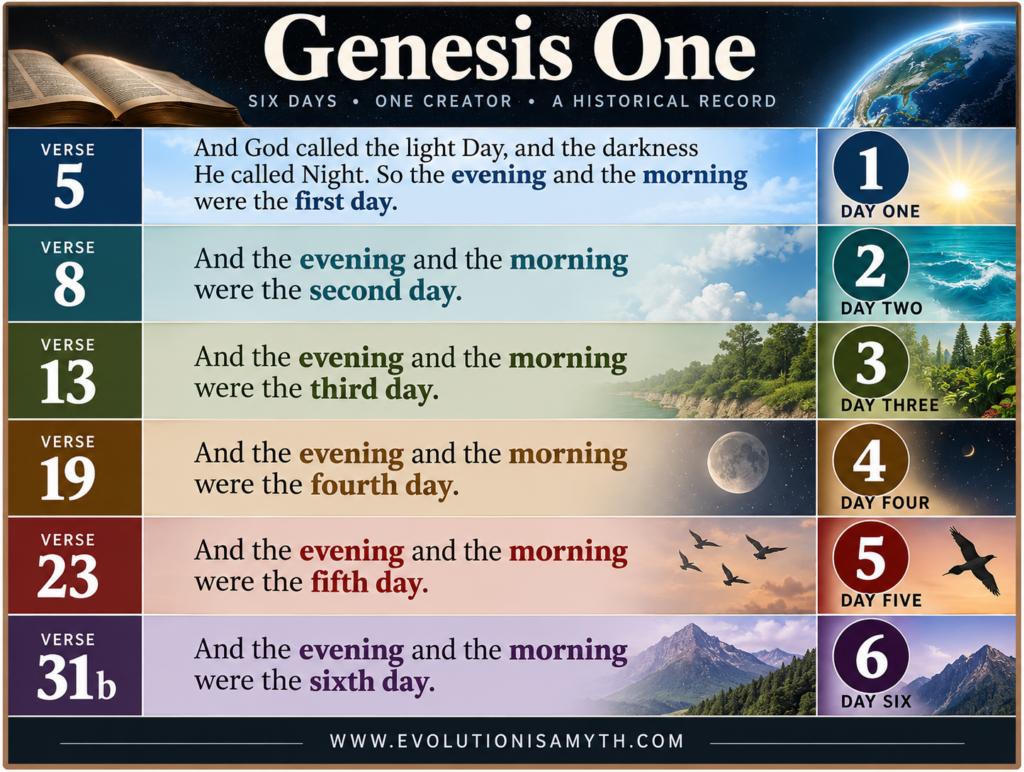
Each creation day is numbered. Scripture speaks of the first day, second day, third day, and so forth. Each of the first six days is also described using the recurring phrase “evening and morning.”
“So the evening and the morning were the first day.”
Genesis 1:5
The Hebrew word translated “day” is yom. Like the English word day, yom can have different meanings depending upon context. Scripture can use “day” for daylight, an ordinary day, or a broader period of time.
Therefore, the argument should not simply be that yom always means a 24-hour day. It does not.
Instead, we should allow the context of Genesis itself to tell us what is meant.
In Genesis 1, the days are sequentially numbered and repeatedly associated with evening and morning. Nothing in the text tells the reader that these numbered days represent millions or billions of years.
The natural reading is exactly what the passage appears to describe: six ordinary days of God’s creative work followed by a seventh day of rest.
Exodus 20 Confirms the Creation Week
Perhaps the strongest biblical confirmation of this interpretation comes not from Genesis, but from the Ten Commandments.
God commanded Israel:
“Six days you shall labor and do all your work, but the seventh day is the Sabbath of the LORD your God.”
Exodus 20:9–10
God then explains why:
“For in six days the LORD made the heavens and the earth, the sea, and all that is in them, and rested the seventh day.”
Exodus 20:11
Notice the comparison.
Man is commanded to work six days and rest on the seventh day because God created in six days and rested on the seventh day.
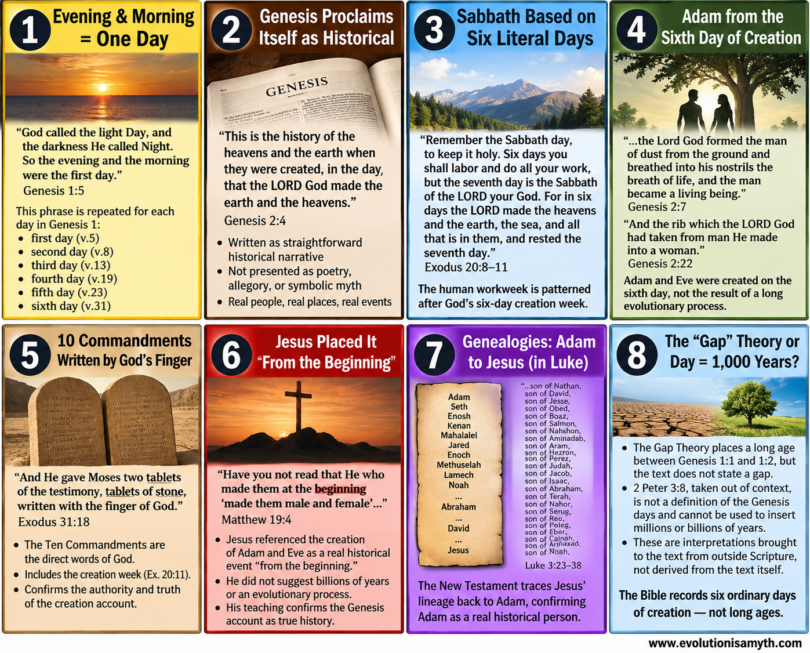
The human workweek is patterned directly after God’s creation week.
If the six creation days represented millions or billions of years, the comparison becomes extremely difficult to understand from the text alone. Nothing in Exodus indicates that “six days” means ordinary days when referring to man’s workweek but enormous ages when referring to God’s creation week within the very same explanation.
Scripture interprets Scripture.
God Finished His Creation
Genesis 2 reinforces this conclusion:
“Thus the heavens and the earth, and all the host of them, were finished.”
Genesis 2:1
Then:
“And on the seventh day God ended His work which He had done.”
Genesis 2:2
God’s creative work is presented as finished.
Genesis does not describe God beginning a process that would continue creating increasingly complex forms of life over enormous periods of time. It describes God speaking things into existence and completing His creative work.
Adam likewise is not described as descending from an earlier population of creatures. Scripture says:
“And the LORD God formed man of the dust of the ground, and breathed into his nostrils the breath of life; and man became a living being.”
Genesis 2:7
Eve is then described as being formed from Adam:
“Then the rib which the LORD God had taken from man He made into a woman.”
Genesis 2:22
Whatever conclusions someone might reach from outside Genesis, this is the account Genesis itself gives us.
What About the Gap Theory?
One attempt to reconcile Genesis with a very old earth is commonly called the Gap Theory.
The Gap Theory proposes an extended period of time between Genesis 1:1 and Genesis 1:2:
“In the beginning God created the heavens and the earth.”
“The earth was without form, and void…”
Under various versions of this interpretation, enormous periods of time, and sometimes an earlier creation and destruction, are placed into this proposed gap. But where does Genesis actually describe such a gap? It doesn’t. There is no statement in Genesis 1 telling us that millions or billions of years passed between verses 1 and 2. There is no description there of previous generations of life flourishing and dying before the six creation days began.
Such a period must therefore be inserted between the verses rather than derived from them.
This is where Sola Scriptura becomes especially important. We should be very cautious about inserting an enormous period of unrecorded history into Scripture when the text itself never tells us that such a period occurred.
“One Day Is as a Thousand Years”
Another argument sometimes used to allow long ages in Genesis comes from 2 Peter:
“But, beloved, do not forget this one thing, that with the Lord one day is as a thousand years, and a thousand years as one day.”
2 Peter 3:8
But notice what Peter does not say. He does not say that one day equals one thousand years. He says one day “is as” a thousand years and a thousand years “as” one day. More importantly, the context has nothing to do with defining the length of the creation days. Peter is addressing people questioning the apparent delay of Christ’s return:
“The Lord is not slack concerning His promise, as some count slackness, but is longsuffering toward us, not willing that any should perish but that all should come to repentance.”
2 Peter 3:9
Peter’s point concerns God’s relationship to time and His patience regarding the fulfillment of His promise. It is not a mathematical formula telling us to multiply the days of Genesis by one thousand, much less by millions or billions. And even if someone incorrectly substituted one thousand years for each creation day, six thousand years would still come nowhere close to the billions of years required by modern evolutionary timelines. Using 2 Peter 3:8 to redefine the creation days therefore does not come from the context of either Genesis 1 or 2 Peter 3.
What About the Genealogies?
The Bible also presents Adam as a real historical person connected genealogically with later people. Luke traces Jesus’ genealogy backward through historical individuals until reaching:
“the son of Enosh, the son of Seth, the son of Adam, the son of God.”
Luke 3:38
Genesis 5 and Genesis 11 provide ages associated with generations from Adam through Abraham’s ancestry. When biblical chronologies are constructed from these genealogies, they produce a human history measured in thousands of years, not millions of years. There are legitimate discussions among Bible scholars concerning precise biblical chronology and whether genealogical structures contain omissions. Therefore, Scripture should not be made to provide a precise creation date that it does not explicitly state. But neither do these genealogies naturally provide the millions of years necessary to place evolutionary history between Adam and the biblical patriarchs.
Let Scripture Speak for Itself
The age of the earth is not a salvation issue. Scripture is clear that salvation is by God’s grace through faith:
“For by grace you have been saved through faith, and that not of yourselves; it is the gift of God.”
Ephesians 2:8
Christians can disagree about the age of the earth without questioning one another’s salvation. But that does not mean the interpretation of Genesis is unimportant. If we claim to follow Sola Scriptura, we should begin with Scripture and allow Scripture to interpret Scripture. We should not begin with a conclusion required by an outside worldview and then search for a place to insert that conclusion into the biblical text.
Genesis describes six numbered days, each marked by evening and morning. Exodus 20 directly compares those six creation days and God’s seventh-day rest with man’s six-day workweek and seventh-day Sabbath. Genesis says God’s creative work was finished. Adam is presented as specially created by God, and later Scripture treats him as part of the historical genealogy of mankind.
None of this requires us to deny legitimate scientific observations. It simply requires us to distinguish between what Scripture actually says and interpretations brought to Scripture from outside it.
For the Christian, our confidence ultimately rests not in our ability to make God’s Word conform to every changing human theory, but in allowing God’s Word to speak for itself.
Doubt man’s changing interpretations. Believe God.