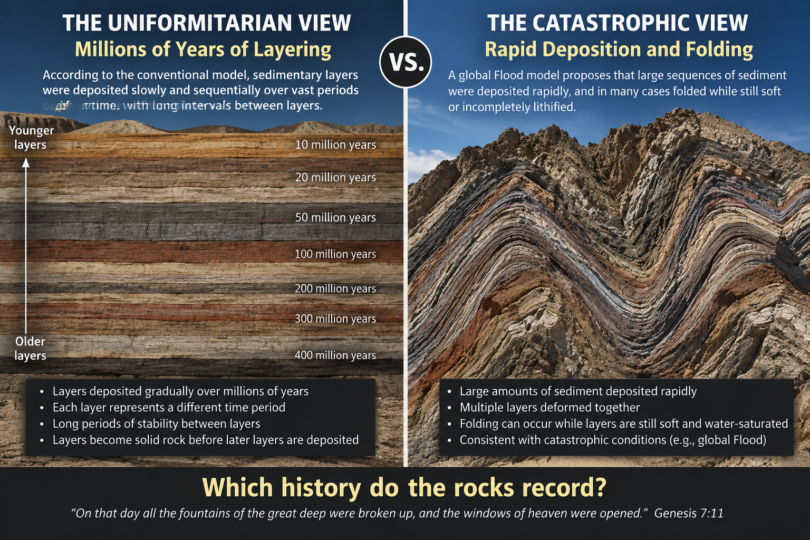

Look closely at folded mountains and canyon walls around the world and an obvious question emerges:
How did all of these rock layers bend together?
Conventional geology interprets many sequences of sedimentary strata as representing immense periods of time. Layer after layer was deposited, buried, compacted, cemented, and eventually transformed into sedimentary rock. Different portions of a thick sequence may be assigned ages separated by millions or even tens of millions of years.
Yet today, entire sequences can be found dramatically bent and folded together.
That deserves a closer look.
THE LAYERS ARE SAID TO REPRESENT VAST AMOUNTS OF TIME
According to the conventional geologic timescale, sedimentary formations can accumulate over immense periods. Consequently, a sequence of strata exposed in a mountain or canyon may be interpreted as representing millions of years of Earth history. But when those same layers are folded together, we are looking at something remarkable. Layers assigned widely separated ages can form sweeping curves, with the entire sequence deformed together.
How did supposedly ancient rock bend without simply shattering?
Conventional geology has an answer. Geologists recognize that solid rock is not necessarily perfectly rigid. Under appropriate combinations of pressure, temperature, pore-fluid pressure, burial, and tectonic stress, lithified sedimentary rocks can undergo ductile deformation and fold.¹ Therefore, the mere existence of a fold does not prove that the layers were soft when folded.
But neither should the assumption be made without evidence that every spectacular fold occurred only after the sediments had completely hardened. The critical question is the physical condition of the layers when they were folded.
SEDIMENT REALLY CAN FOLD BEFORE IT BECOMES SOLID ROCK

This is not merely a creationist proposal.
Conventional geology recognizes soft-sediment deformation, in which recently deposited, water-saturated sediment folds, contorts, faults, or otherwise deforms before complete lithification.
Geological literature describes soft-sediment deformation occurring:
“before significant diagenesis or lithification”²
Such deformation can result from earthquakes, slumping, rapid loading, liquefaction, water movement, and mass movement of sediment.
Even more strikingly, researchers studying Turnagain Arm, Alaska, documented deformation structures that formed during extremely short periods:
“soft-sediment deformation structures were recorded that formed during one day’s tide”³
In other words, folded sediment does not inherently require millions of years to form.
Under the right conditions, wet sediment can be deposited and subsequently deformed while it remains pliable.
THAT CHANGES THE QUESTION
The question is therefore not:
Can solid rock ever fold?
It can.
The more important question is:
Were particular sedimentary layers already fully hardened when they were folded?
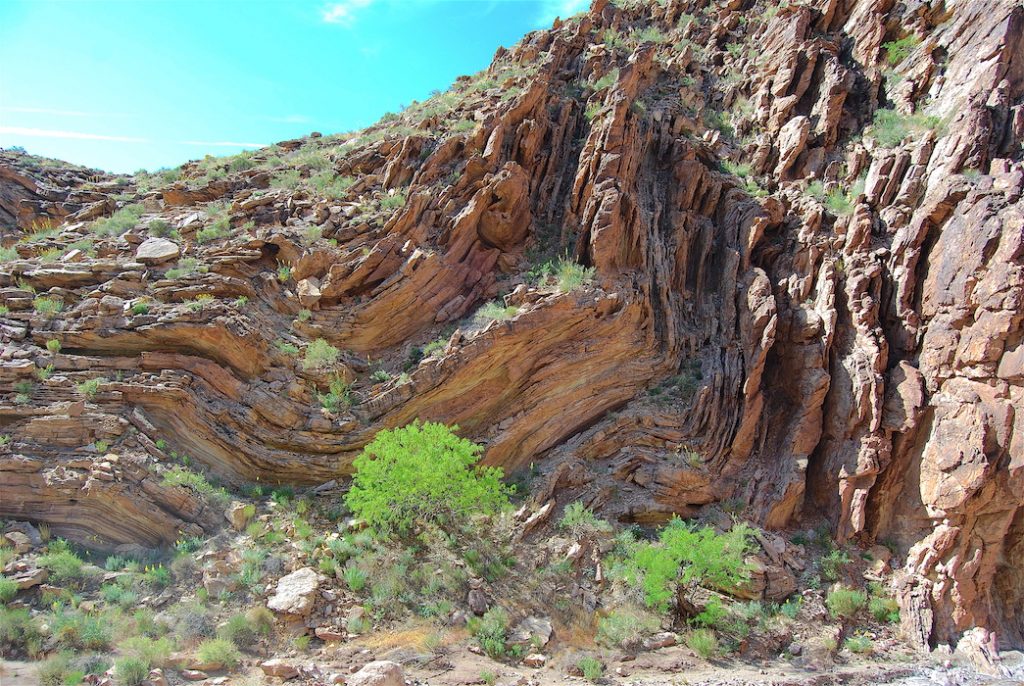
If a sequence was folded while its sediments remained soft or incompletely lithified, then deposition and deformation must have occurred close enough together for the sediments to retain those properties. That becomes particularly interesting where a thick sequence is conventionally interpreted as representing a vast span of geological time.
If evidence in a particular formation demonstrates that multiple layers were still poorly consolidated when they were folded together, then the physical evidence places an important constraint on how much time could have separated their deposition from their deformation.
ONE FOLD, MANY SUPPOSED AGES
This is where bent rock layers become particularly relevant to the creation-and-Flood debate.
Imagine hundreds or thousands of feet of sedimentary layers stacked upon one another. Conventional geological interpretation may assign substantial time spans to the deposition represented by that sequence.
Then the entire package is folded.
If those layers were already lithified, conventional tectonic mechanisms can explain their deformation. But if geological evidence demonstrates that the layers were still soft or incompletely lithified when they folded, the interpretation changes dramatically. The relevant period between deposition and deformation must then allow the sediments to remain deformable.
That is the key issue: The fold itself does not automatically tell us how old the rocks are. But evidence concerning when lithification occurred relative to folding can tell us something important about the history of the strata.
CATASTROPHIC CONDITIONS CAN PRODUCE RAPID DEPOSITION AND DEFORMATION
Modern geology has repeatedly demonstrated that enormous geological changes do not always require enormous amounts of time.
Water-saturated sediments can slump.
Earthquakes can deform recently deposited sediments.
Rapid sediment loading can produce liquefaction and deformation.
Underwater sediment can move in enormous mass flows.
Sedimentary layers can be folded before they harden into rock.
These observations are particularly significant within a global Flood model.
Genesis describes an extraordinary catastrophe involving enormous quantities of moving water and geological disruption:
“On that day all the fountains of the great deep were broken up, and the windows of heaven were opened.” Genesis 7:11
Such an event would be expected to produce tremendous erosion, transportation, deposition, burial, water-saturated sediment, tectonic activity, and deformation.
Rather than requiring every sedimentary layer to represent a separate chapter separated by immense periods of time, the Flood model proposes that enormous sediment sequences could have accumulated rapidly under catastrophic conditions, with some sequences subsequently folded while still wet, poorly consolidated, or incompletely lithified.
THE ROCKS ARE HARD TODAY. WERE THEY HARD THEN?
That is ultimately the question raised by spectacular folded strata. Nobody disputes that these layers are solid rock today. But their present condition does not establish their condition when they were folded. Some folds were unquestionably formed by deforming lithified rock. Others are recognized by conventional geologists themselves as soft-sediment deformation.
Therefore, each formation must be examined for the physical evidence it contains.
Were the grains already cemented?
Is there evidence of recrystallization?
Are there fractures associated with folding?
Is there cleavage or microscopic grain deformation?
Or are there structures indicating deformation before complete lithification?
Those observations matter because the folded rocks themselves must ultimately determine which history is physically possible. If layers interpreted as representing vast periods of geological time can be shown to have been deposited and folded while still soft, then the conventional timescale assigned to that sequence deserves careful scrutiny. The bent rocks are not merely scenery. They are physical evidence of what happened to the sediments, and potentially, how quickly it happened.
Sources
- Johnson, A. M., “Folding and Faulting of Strain-Hardening Sedimentary Rocks,” Tectonophysics 62 (1980). U.S. Geological Survey.
https://pubs.usgs.gov/publication/70012301 - Journal of Structural Geology, “Microstructures and deformation mechanisms of mass transport-related, soft-sediment folds,” Vol. 198 (2025), 105456.
https://www.sciencedirect.com/science/article/pii/S0191814125001312 - Greb, S. F. and Archer, A. W., “Soft-sediment deformation produced by tides in a meizoseismic area, Turnagain Arm, Alaska,” Geology 35 (2007): 435–438.
https://pubs.usgs.gov/publication/70029864