
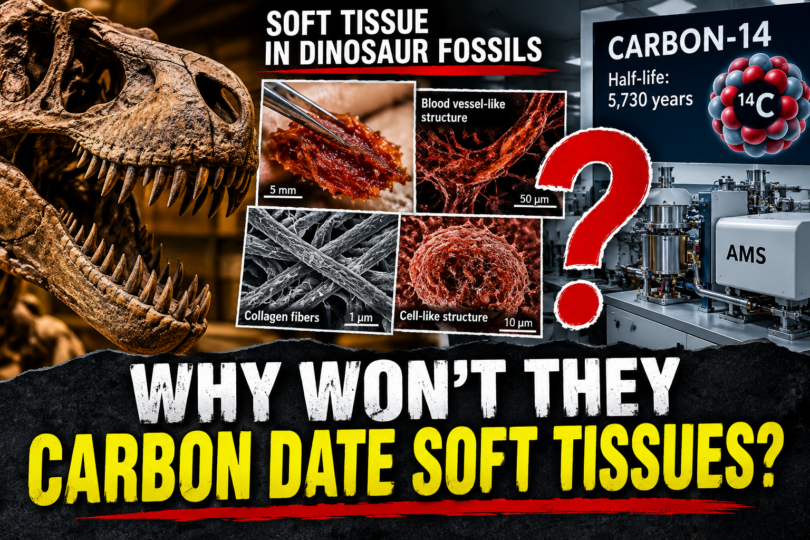
Jack Horner is one of the world’s best-known dinosaur paleontologists. As curator of paleontology at the Museum of the Rockies, Horner was closely associated with discoveries that transformed scientific thinking about what might survive inside dinosaur fossils. One of the most remarkable discoveries he was involved with was with molecular paleontologist Mary Schweitzer. Her work on Tyrannosaurus rex fossils produced flexible soft-tissue structures resembling blood vessels and other microscopic structures after researchers removed the bone’s mineral. Subsequent research reported molecular evidence consistent with endogenous dinosaur collagen.¹ ²
The discoveries raised an obvious question: If dinosaur fossils can preserve original organic material, could that material be tested for Carbon-14?
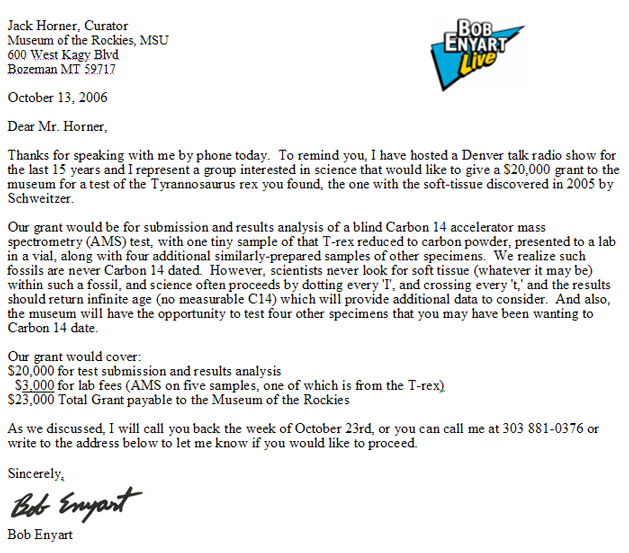
Radio host Bob Enyart and Fred Williams offered Jack Horner $23,000 to perform the carbon-14 test. He declined.
Recording link here: https://kgov.com/jack-horner-declines-grant-to-carbon-14-date-t-rex?utm_source=chatgpt.com
A $23,000 OFFER TO CARBON-14 TEST DINOSAUR MATERIAL
During a recorded telephone conversation, Christian radio host Bob Enyart pressed Horner about Carbon-14 testing dinosaur remains and offered $23,000 toward the research if suitable dinosaur material would be submitted for radiocarbon analysis.³
The proposed specimens included dinosaur material associated with the Museum of the Rockies. Horner declined.
During the conversation, Horner expressed concern about how creationists might use the results, saying:
“The spin you guys could get out of this … would not help us.”³
That statement is revealing, but it is important not to claim more than the conversation establishes. It does not prove that Horner believed Carbon-14 testing would demonstrate that dinosaurs were thousands rather than millions of years old. His stated concern was how the results could be interpreted or publicized. Nevertheless, it raises a legitimate scientific question: Why not perform the experiment?
DINOSAUR SOFT TISSUE CHANGED THE QUESTION
For decades, dinosaur fossils were generally pictured as mineralized replicas of once-living bone, with original biological material presumed incapable of surviving for tens of millions of years. Research beginning with Schweitzer and colleagues complicated that picture.
In 2005, Schweitzer and colleagues reported flexible structures recovered from a Tyrannosaurus rex femur conventionally dated to approximately 68 million years ago.¹ Subsequent research reported peptide sequences consistent with collagen from the T. rex material.² Other researchers have since reported microscopic soft-tissue-like structures and evidence consistent with collagen in additional Cretaceous dinosaur fossils.⁴ These discoveries do not by themselves establish a young age for dinosaurs. Researchers have proposed chemical mechanisms that could contribute to exceptional preservation of proteins and tissue structures over geological time. But they create an important opportunity for another experiment.
WHY NOT TEST THE ENDOGENOUS MATERIAL ITSELF?
Carbon-14 has a half-life of approximately 5,730 years. After sufficient half-lives, the amount remaining from an organism becomes too small for conventional radiocarbon dating.
Consequently, no measurable original Carbon-14 should remain from an animal that died approximately 68 million years ago.
However, testing an entire fossilized dinosaur bone does not resolve the issue. Fossil bone can exchange material with groundwater, microorganisms, and surrounding sediment. Younger carbon can therefore enter an ancient fossil and produce a measurable Carbon-14 signal. That is precisely the explanation mainstream researchers give when they detect Carbon-14 in dinosaur fossils.
The much more interesting experiment would be to identify dinosaur material independently demonstrated to be endogenous, isolate and rigorously purify a molecular component such as collagen-specific hydroxyproline, and then submit that purified fraction for accelerator mass spectrometry Carbon-14 analysis. This would address one of the most important objections to Carbon-14 measurements from dinosaur bones: contamination by younger environmental carbon.
Where is the scientific curiosity?
MAINSTREAM RESEARCH HAS ALREADY FOUND CARBON-14 IN DINOSAUR BONE
This question became even more interesting after a 2019 study published in the peer-reviewed journal eLife.
Evan Saitta and colleagues freshly excavated Cretaceous Centrosaurus bones from Dinosaur Provincial Park in Alberta, Canada. The researchers used aseptic excavation procedures and analyzed the fossils with multiple techniques, including accelerator mass spectrometry radiocarbon analysis.⁵
They detected measurable Carbon-14. The authors explicitly reported that the carbon within the dinosaur bone was “not radiocarbon dead.”⁵
They did not conclude that the dinosaur was young. Instead, they found evidence of microbial communities within the fossil and interpreted the Carbon-14 as younger carbon that had entered the ancient bone.
This distinction is essential.
The empirical observation was measurable Carbon-14 in Cretaceous dinosaur bone. The interpretation was that the Carbon-14 was not original to the dinosaur.
SO TEST MATERIAL THAT CAN BE IDENTIFIED AS ORIGINAL
This brings the discussion back to dinosaur soft tissue and collagen.
If the objection to Carbon-14 measurements from whole dinosaur bone is that younger carbon has entered the fossil, then the logical next experiment is not simply to test more untreated dinosaur bones. Instead, isolate material that can independently be demonstrated to be endogenous to the dinosaur.
Collagen provides a particularly interesting possibility. Researchers can use molecular techniques to characterize proteins, and compounds such as hydroxyproline are strongly associated with collagen. Purification techniques used in radiocarbon science can attempt to separate such compounds from other carbon sources before AMS measurement.
Paleontologist Philip Senter, writing specifically against Young Earth Creationist interpretations of dinosaur Carbon-14 results, made essentially this point in a 2022 paper. He argued that purported dinosaur “collagen fractions” used in some radiocarbon claims may contain other organic material and contamination, and identified isolating hydroxyproline as a more rigorous approach.⁶ That is a reasonable criticism, but it also suggests the experiment that should be performed.
Isolate it. Purify it. Verify what it is. Then test it.
LET THE EXPERIMENT ANSWER THE QUESTION
Jack Horner’s refusal of Bob Enyart’s $23,000 offer does not demonstrate that Horner believed dinosaurs were young. Nor would a positive Carbon-14 measurement from an untreated dinosaur bone establish that conclusion, because contamination and post-burial carbon exchange must be considered. But science advances by testing competing explanations.
We now know that remarkable organic structures and proteins can be recovered from dinosaur fossils. Mainstream peer-reviewed research also shows that measurable Carbon-14 can occur in Cretaceous dinosaur bone.
The crucial question is therefore more specific:
Can material independently demonstrated to be endogenous dinosaur collagen be sufficiently isolated and purified for Carbon-14 testing, and if so, what would the measurement show?
Rather than debating what the result might be, why not perform the experiment? Now, that is the right question!
SOURCES
¹ Schweitzer, M. H., et al. (2005). “Soft-Tissue Vessels and Cellular Preservation in Tyrannosaurus rex.” Science 307(5717):1952–1955.
https://doi.org/10.1126/science.1108397
² Asara, J. M., et al. (2007). “Protein Sequences from Mastodon and Tyrannosaurus rex Revealed by Mass Spectrometry.” Science 316(5822):280–285.
https://doi.org/10.1126/science.1137614
³ Real Science Radio. “Carbon-14 and Dinosaur Bones.” Recorded discussion with Jack Horner concerning an offer to fund Carbon-14 testing of dinosaur material.
https://kgov.com/carbon-14-and-dinosaur-bones
⁴ Bertazzo, S., et al. (2015). “Fibres and cellular structures preserved in 75-million-year-old dinosaur specimens.” Nature Communications 6:7352.
https://doi.org/10.1038/ncomms8352
⁵ Saitta, E. T., et al. (2019). “Cretaceous dinosaur bone contains recent organic material and provides an environment conducive to microbial communities.” eLife 8.
https://doi.org/10.7554/eLife.46205
⁶ Senter, P. J. (2022). “Radiocarbon in Dinosaur Bones Revisited: Problems with Collagen.” The American Biology Teacher 84(6):336–341.
https://doi.org/10.1525/abt.2022.84.6.336
