
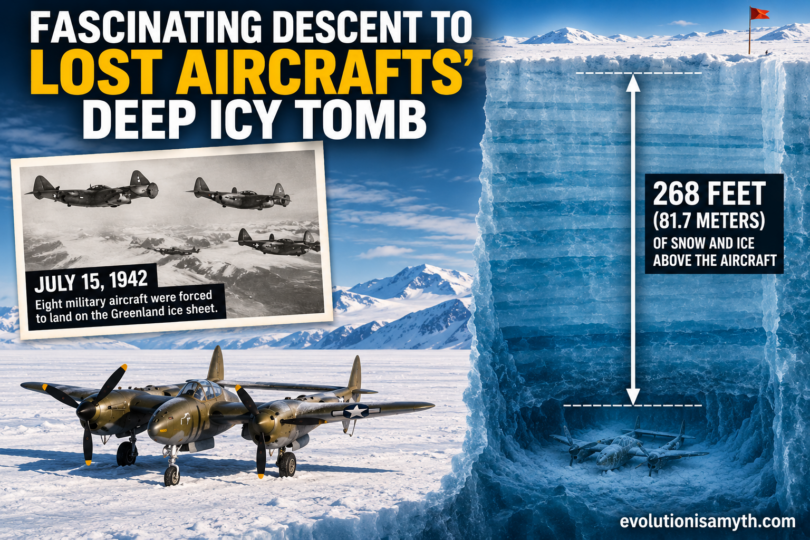
On July 15, 1942, six P-38 Lightning fighters and two B-17 bombers were forced to land on Greenland’s ice sheet after severe weather forced them to divert during a flight to Europe. The crews were rescued, but they abandoned the aircraft on the ice.
Fifty years later, recovery teams discovered something remarkable. The airplanes were no longer sitting near the surface. One of the P-38s, subsequently named “Glacier Girl,” was eventually recovered in 1992 from approximately 268 feet beneath the Greenland ice.¹
In only about half a century, an enormous thickness of snow and ice had accumulated above an aircraft whose exact historical age was known.
ICE DEPTH DOES NOT EQUAL AGE
The Lost Squadron provides a dramatic demonstration of an important principle: the thickness of ice above an object does not by itself tell us how old that object is.
Accumulation rates across Greenland vary substantially with geography, elevation, precipitation, wind, temperature, and other conditions. A U.S. Geological Survey study examining hundreds of observations across Greenland found significant geographical differences in annual accumulation, particularly in coastal regions.²
Consequently, hundreds of feet of ice do not necessarily require thousands of years to accumulate. Under sufficiently high accumulation conditions, enormous quantities of snow and ice can accumulate within decades. Glacier Girl provides an unusually useful calibration point because we know precisely when the aircraft arrived on the ice.
BUT ICE CORES ARE NOT DATED BY DEPTH ALONE
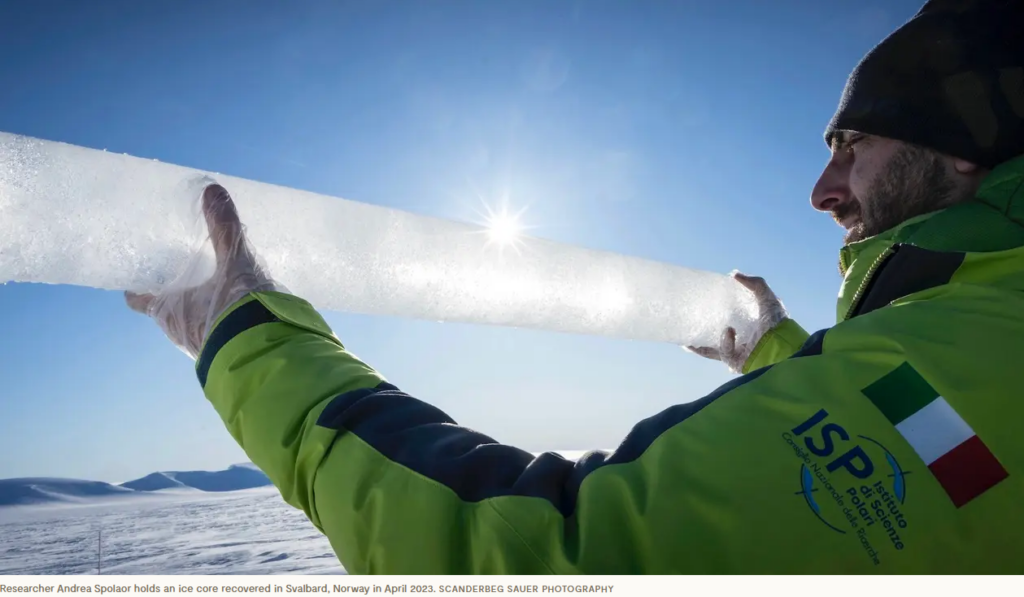
It would be incorrect, however, to argue that conventional ice-core scientists would simply count every visible band above Glacier Girl as an individual year and therefore date the aircraft thousands of years too old. Modern Greenland ice-core chronologies are considerably more sophisticated.
Researchers examine seasonal variations in oxygen and hydrogen isotopes, dust, sodium, calcium, ammonium, black carbon, electrical conductivity, and other chemical indicators. They can also identify distinctive volcanic deposits and use historically dated eruptions as chronological markers.³
For example, researchers working with the Greenland RECAP ice core constructed its recent chronology using numerous chemical and physical measurements and checked the chronology against volcanic events including Hekla (1947), Katmai (1912), Tambora (1815–1816), and Laki (1783).³
This means Glacier Girl does not show that scientists would necessarily mistake 50 years of accumulation for thousands of annual layers, but it does reveal that modern calculations are objectively wrong.
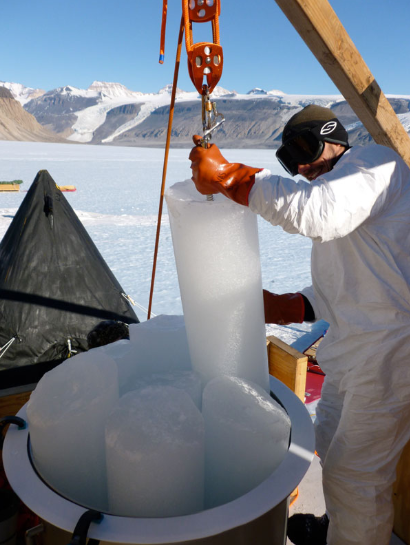
https://www.sas.rochester.edu/ees/petrenko photo by P. Neff
Using a modern Greenland accumulation rate of about 0.11 meters of ice per year, 268 feet (81.7 meters) of ice represents 743 years of accumulation— nearly a fifteen-fold error!
Yet the WWII aircraft buried beneath that much ice had been there for only 50 years. This remarkable real-world example demonstrates how dramatically ice accumulation rates can vary and why ice depth alone cannot be assumed to represent a specific passage of time.
ACCUMULATION RATES CAN BE EXTRAORDINARILY DIFFERENT
The aircraft provides a spectacular observed example of how rapidly large quantities of snow and ice can accumulate under particular Greenland conditions. This matters when interpreting ancient ice because annual layers do not remain equally thick throughout an ice sheet. They become compressed and distorted with increasing depth, and eventually individual annual signals can become increasingly difficult to resolve. Researchers acknowledge these complications and employ additional chronological methods and ice-flow models as they move deeper into cores.⁴
Some locations also have deepest ice that has folded and been stratigraphically disturbed. Research on the NEEM Greenland core, for example, reports “clear stratigraphic disturbances in the bottom part due to folds in the ice.”⁵ None of this means that ice-core chronology is arbitrary.
It does mean that the simple picture sometimes presented to the public, in which scientists merely drill through perfectly preserved annual layers and count backward year by year like tree rings, is incomplete.
A REAL-WORLD WARNING AGAINST SIMPLE ASSUMPTIONS
Glacier Girl gives us something unusually valuable: an ice deposit containing an object with a precisely known historical date.
In 1942, the aircraft were sitting on the surface.
By 1992, one was approximately 268 feet below it.
That does not invalidate ice-core dating, but it vividly shows that depth is not time, accumulation rates vary widely, and large ice thicknesses can form surprisingly quickly under the right conditions.
Any reconstruction of Greenland’s distant past therefore depends not merely on how much ice exists, but on correctly identifying annual signals, accounting for changing accumulation and compression, correlating independent markers, and modeling what has happened to the ice since it originally fell as snow.
Glacier Girl is a dramatic reminder that we should examine those assumptions and methods rather than treating ice thickness itself as a clock.
MODERN ACCUMULATION RATES CANNOT SIMPLY BE PROJECTED INTO THE PAST
The Lost Squadron provides a remarkable demonstration of how dramatically ice accumulation rates can vary. Approximately 268 feet of snow and ice accumulated above the aircraft in only 50 years. Yet applying an accumulation rate measured at another Greenland location could make that same thickness represent hundreds of years.
This demonstrates an important limitation of using present conditions to reconstruct the distant past: there is no single, constant “Greenland accumulation rate.” Accumulation varies substantially from one region to another and can also change through time as precipitation, temperature, atmospheric circulation, and other climatic conditions change.
Ice-core researchers recognize this problem and do not simply extrapolate a modern accumulation rate backward through an entire core. They instead use presumed annual chemical and isotopic cycles, volcanic markers, correlations between cores and, particularly at greater depths, models incorporating ice flow, compression and changing accumulation.
But that raises the more fundamental question: if accumulation rates observed today can differ dramatically across the same ice sheet, how confidently can accumulation conditions thousands of years into the past be reconstructed?
The aircraft does not answer that question on its own. What it does provide is an extraordinary historical control demonstrating that hundreds of feet of ice can accumulate in only decades and that thickness cannot simply be equated with age. Any ancient ice chronology must therefore establish its age through evidence beyond ice depth and assumptions about accumulation.
WHY THIS MATTERS
The significance of the Lost Squadron goes beyond finding an airplane beneath 268 feet of ice. It provides a rare historical control: we know exactly when the aircraft landed, yet the enormous thickness of ice above it might appear far older if we applied accumulation rates measured elsewhere in Greenland to this location.
Scientists recognize that accumulation rates vary considerably across Greenland and do not date ice cores by depth alone. Nevertheless, the aircraft illustrates an important principle: conclusions about the distant past depend upon correctly interpreting processes and conditions that may have changed substantially over time.
If accumulation rates differ dramatically across Greenland today, how confidently can we reconstruct accumulation rates, annual-layer interpretations, compression rates, and ice-flow models thousands of years into the past? The deeper question is not whether 268 feet of ice can form rapidly, because Glacier Girl demonstrates that it can. The question is how reliably we can use processes observed today to reconstruct conditions in a past no one directly observed.
SOURCES
Schüpbach et al., “Greenland records of aerosol source and atmospheric lifetime changes from the Eemian to the Holocene,” Nature Communications 9 (2018). The authors describe stratigraphic disturbances and folding in the deepest portion of the NEEM core.
Prairie Aviation Museum, “Glacier Girl.” The museum recounts the July 15, 1942 forced landing and the recovery of the P-38 from approximately 268 feet beneath the Greenland ice in 1992.
Shen, D., Liu, Y., and Huang, S., “Annual accumulation over the Greenland ice sheet interpolated from historical and newly compiled observation data,” Geografiska Annaler: Series A, Physical Geography 94 (2012): 377–393. U.S. Geological Survey Publications Warehouse.
Legrand et al., “Rapid increase in atmospheric iodine levels in the North Atlantic since the mid-20th century,” Nature Communications 9 (2018). The RECAP chronology incorporated numerous chemical and physical indicators and historically dated volcanic horizons.
Gkinis et al., “A 120,000-year long climate record from a NW-Greenland deep ice core at ultra-high resolution,” Scientific Data 8 (2021). The study describes annual-layer chronology, chronological uncertainty, reference horizons, and age models used for deep Greenland ice.
