09/29/2026
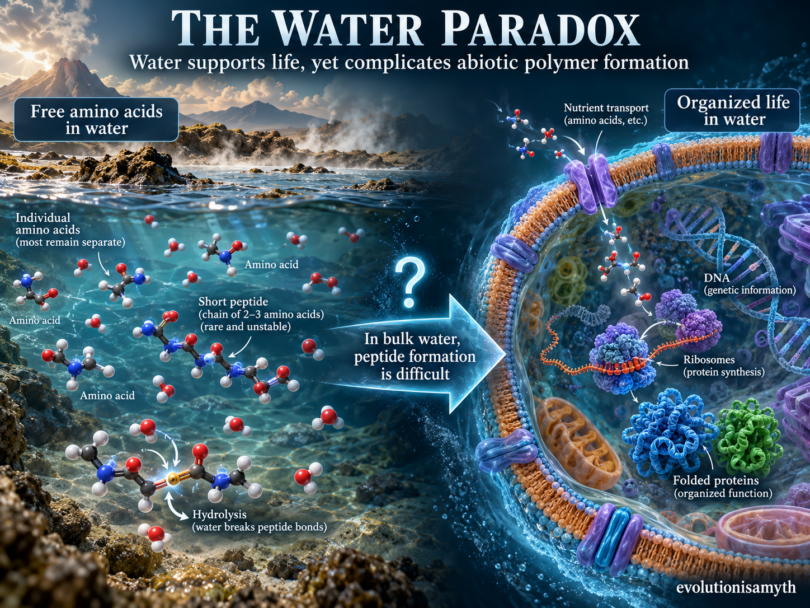
The water paradox arises from the chemistry of life as we observe it. Water is essential for living cells, yet the formation of many biological polymers requires condensation reactions that remove water as chemical bonds are formed. Peptides are built by linking amino acids, and nucleic acids such as DNA and RNA are built by linking nucleotides.
In bulk water, these bond-forming reactions are generally unfavorable without some source of activation or energy, while hydrolysis tends to break the same kinds of bonds. Therefore, origin-of-life researchers must explain how prebiotic chemistry could have promoted the formation and accumulation of complex polymers in an aqueous environment despite this well-understood chemical difficulty.
WATER IS NECESSARY FOR LIFE, BUT DOES WATER PRODUCE LIFE?
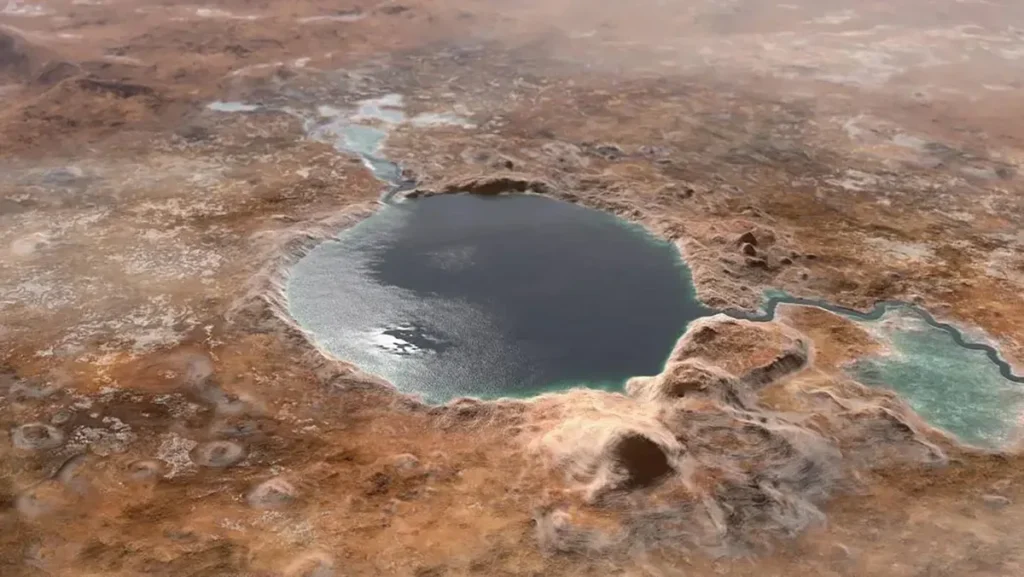
Whenever scientists search Mars, icy moons, or distant planets for possible signs of life, one of the first questions is often whether liquid water exists or once existed there. That makes sense because every known form of life depends upon water.
Illustration of possible past water on Mars.
But there is an important difference between saying life requires water and saying water provides a natural pathway for life to originate.
Existing cells contain extraordinarily sophisticated systems that make aqueous chemistry possible. Cell membranes maintain chemical gradients, enzymes control reactions, proteins transport molecules, metabolic pathways supply energy, and genetic systems direct the production of additional cellular machinery.
Abiogenesis must explain how the first biologically useful chemistry developed before such systems existed. That is where water presents an important challenge– a paradox of sorts.
AMINO ACIDS ARE ONLY THE BEGINNING
Amino acids are commonly called the building blocks of proteins. Experiments have demonstrated that some amino acids can be produced abiotically under selected conditions, and amino acids have also been detected in meteorites. But producing amino acid chemical structures is no where close to producing a protein.
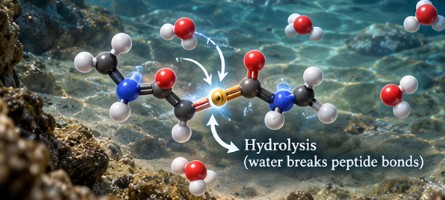
Proteins consist of amino acids joined into chains by peptide bonds. Creating those bonds from free amino acids is a condensation reaction. Water is released when the bond forms.
In an aqueous environment, however, there is a fundamental chemical difficulty. The reverse process, hydrolysis, competes with condensation, and direct peptide-bond formation from free amino acids is thermodynamically unfavorable under ordinary aqueous conditions.¹ ²
A 2024 review in Nature Reviews Chemistry summarizes the problem directly, explaining that the origin of life’s condensation polymers must overcome what the authors describe as the “thermodynamic pressure of hydrolysis in water.”¹
Thus, the paradox is not that an amino acid instantly disintegrates when it touches water. Rather, water that is indispensable to existing life also presents a major obstacle to assembling free amino acids into the polymers upon which life depends.
THE PROBLEM BECOMES GREATER THAN MAKING ONE PEPTIDE BOND
Producing a peptide bond under laboratory conditions is not the same as explaining the origin of a functional protein.
An abiotic process would have to provide suitable amino acids, concentrate them, supply the chemical energy necessary for repeated bond formation, overcome competing reactions, produce sufficiently long chains, and generate arrangements capable of useful biological activity.
Direct polymerization of amino acids in water generally yields only small quantities of short peptides unless additional chemistry or special environmental conditions are supplied.³
The question facing abiogenesis is not merely: Can two amino acids ever be joined?
The much larger question is: How could uncontrolled prebiotic chemistry repeatedly construct, preserve, and organize the long functional molecular systems eventually required for life?
ORIGIN-OF-LIFE RESEARCHERS RECOGNIZE THE WATER PROBLEM
Origin-of-life researchers have proposed a number of possible solutions. One proposal involves repeated wet-dry cycles. Water permits molecules to move and mix during the wet stage. During drying, removal of water can favor condensation chemistry that would otherwise be difficult in dilute solution.
Origin-of-life experiments frequently require carefully controlled laboratory conditions to produce, isolate, concentrate, and preserve desired prebiotic compounds. Many proposed intermediates are chemically unstable or participate in competing reactions under uncontrolled conditions. This creates an additional challenge for abiogenesis: a plausible prebiotic environment must not merely produce useful molecules, but must also concentrate and preserve them long enough for subsequent reactions to occur, without relying on the purification, controlled reagent addition, isolation, and environmental regulation available to a modern chemist.
Experiments have demonstrated that mixtures of amino acids and hydroxy acids subjected to alternating wet and dry conditions can form peptide-like molecules called depsipeptides. Researchers studying this pathway explicitly note that peptide-bond formation from amino acids is thermodynamically unfavorable in aqueous solution.²
Other proposed mechanisms employ mineral surfaces, reactive chemical intermediates, phosphates, air-water interfaces, hydrothermal environments, or chemically activated precursors. Recent research has even investigated pathways in which energetic precursor molecules are used rather than attempting to polymerize fully hydrolyzed amino acids directly.¹
These are legitimate areas of experimental research and should not be dismissed.
At the same time, their existence demonstrates that simply having amino acids sitting in a primordial ocean is chemically insufficient. Additional mechanisms are needed to overcome the unfavorable chemistry of polymer formation in water.
WET-DRY CYCLES ILLUSTRATE THE PROBLEM
Some of the most interesting prebiotic experiments actually demonstrate why the water problem matters. Researchers studying wet-dry cycling have reported that the amount of water must be carefully balanced. Too little water prevents reactants from dissolving and interacting efficiently, while too much water favors hydrolysis rather than condensation.⁴
In other words, water serves two opposing roles. It is an excellent solvent for many biochemical reactions, yet its abundance can inhibit the condensation reactions required to construct important biological polymers. That is a genuine chemical tension within origin-of-life research.
WHAT DID THE MILLER-UREY EXPERIMENT DEMONSTRATE?
The famous Miller-Urey experiment is often associated with this discussion because it demonstrated that amino acids and other organic compounds could be produced from simple starting materials when substantial external energy was supplied.
In Miller-type experiments, gases were exposed to electrical discharges while water was continuously heated, evaporated, condensed, and recirculated. Reaction products accumulated in the aqueous portion and collection apparatus. Later analyses of Miller’s experiments have identified numerous amino acids and other organic compounds.⁵ That was an important result.
But the experiment did not produce proteins, DNA, RNA, metabolic systems, genetic information, or a living cell. It demonstrated that certain organic building blocks can arise under particular abiotic experimental conditions. The much more difficult problem is explaining what happens next.
IMPORTANT CORRECTION TO THE DIAGRAM
The collection trap should therefore not be described as necessary to remove amino acids from water before water oxidized and destroyed them.
The Miller-Urey apparatus condensed and collected reaction products away from the electrical discharge region, allowing newly produced organic compounds to accumulate for analysis.
That makes the diagram accurate while preserving its relevance to the discussion.
EXISTING CELLS DO NOT SOLVE THE ABIOGENESIS PROBLEM

Modern cells function beautifully in water, but they do so because they already possess enormous levels of biological organization.
Cell membranes selectively regulate the movement of molecules and ions. Specialized proteins transport substances across membranes. Enzymes accelerate specific reactions. Energy systems drive reactions that would otherwise be unfavorable. DNA stores information used to construct proteins, while proteins are simultaneously required to copy, regulate, and express DNA.
A living cell therefore cannot simply be used as evidence that uncontrolled chemistry in water would naturally produce such a system. The relevant question is how those coordinated systems originated before cells, enzymes, genetic information, and metabolism were available to control the chemistry.
WATER DOES NOT EQUAL LIFE
The discovery of water is scientifically important because liquid water is necessary for life as we know it. But water itself does not demonstrate that life originated there.
Amino acids can exist in water outside the living cell. Some can also be produced through abiotic chemistry. Yet the next major step, joining such molecules into increasingly complex biological polymers, encounters substantial chemical obstacles in an aqueous environment.
Researchers continue to investigate possible ways around those obstacles, and some experimental pathways have achieved limited polymerization under particular conditions. Nevertheless, the fundamental problem remains significant enough that contemporary origin-of-life literature explicitly discusses how prebiotic chemistry must overcome hydrolysis and the unfavorable formation of condensation polymers in water.¹
The water paradox therefore highlights an important distinction in the origin-of-life debate: The conditions that allow an already organized living cell to survive are not necessarily the conditions that can explain how the first organized living system arose from nonliving chemicals.
SOURCES
¹ Whitaker, Daniel, and Matthew W. Powner. “On the Aqueous Origins of the Condensation Polymers of Life.” Nature Reviews Chemistry 8 (2024): 817–832. DOI: 10.1038/s41570-024-00648-5. Nature
² Forsythe, Jay G., et al. “Ester-Mediated Amide Bond Formation Driven by Wet-Dry Cycles: A Possible Path to Polypeptides on the Prebiotic Earth.” Angewandte Chemie International Edition 54 (2015): 9871–9875. PubMed Central (PMC)
³ “The Protometabolic Nature of Prebiotic Chemistry,” review discussing the thermodynamic difficulty of peptide formation and the low production of peptides from amino acids in ordinary aqueous conditions. PubMed Central (PMC)
⁴ Rodriguez-Garcia, Marc, et al. “Prebiotic Condensation Through Wet-Dry Cycling Regulated by Deliquescence.” Scientific Reports 9 (2019). The experiments found that excess water favored hydrolysis whereas drying promoted condensation. PubMed Central (PMC)
⁵ Parker, Eric T., et al. “Primordial Synthesis of Amines and Amino Acids in a 1958 Miller H₂S-rich Spark Discharge Experiment.” Proceedings of the National Academy of Sciences 108 (2011): 5526–5531. PubMed
One other change I particularly like here is replacing “water destroys living things” with “water complicates the abiotic formation of life’s polymers.” The first is too broad and chemically vulnerable. The second is supported directly by mainstream prebiotic-chemistry literature and gets much closer to the actual problem you are trying to highlight.