October 22, 2026
MICROEVOLUTION: SHUFFLING THE GENETIC DECK
Microevolution, changes in hereditary traits within populations over generations, can be illustrated using a deck of playing cards. As organisms reproduce, natural selection, differences in fertility, genetic drift, population bottlenecks, and disease can alter which hereditary traits become common, rare, or disappear altogether. Meanwhile, some genes can become less active or remain present but unexpressed in particular tissues.
Think of a population as possessing a deck of genetic cards. Each generation reshuffles and redistributes those cards through reproduction. Environmental pressures can favor particular combinations while others become less common or disappear. Importantly, gene expression can also change, allowing organisms to develop different characteristics using genetic instructions already present.
THE MEXICAN BLIND CAVEFISH
The Mexican blind cavefish (Astyanax mexicanus) illustrates this phenomenon in a fascinating way. The species includes both sighted surface-dwelling fish and blind cave-dwelling populations that inhabit environments where sunlight does not penetrate.
Researchers have discovered that cavefish embryos actually begin developing eyes, but the process eventually breaks down. The embryonic lens undergoes programmed cell death, followed by degeneration of other eye tissues. As a result, adult cavefish lack functional eyes, even though significant portions of the genetic machinery associated with eye development remain present.¹
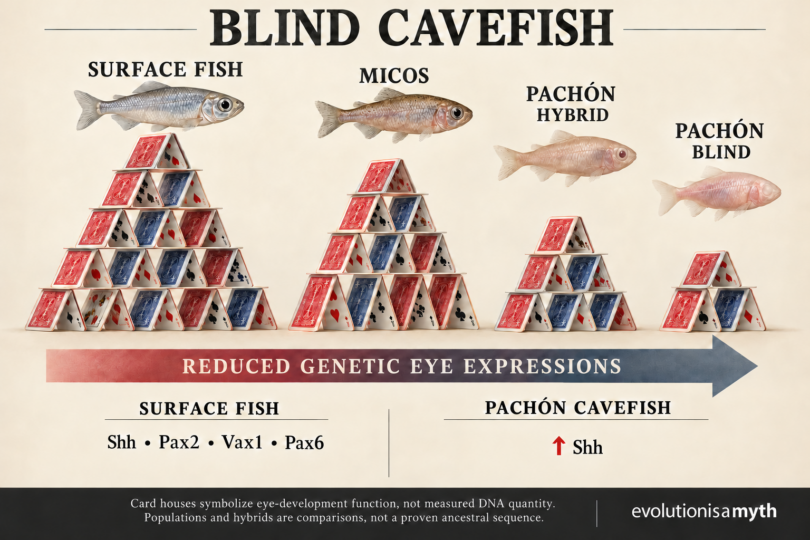
Several developmental genes demonstrate how changes in expression can produce dramatic anatomical differences. Increased Sonic hedgehog (Shh) signaling suppresses Pax6 expression in developing eye regions, altering normal eye formation. These changes do not require inventing an entirely new visual system. Instead, they alter how existing developmental pathways operate.²
EYE DEVELOPMENT THROUGH EPIGENETIC SILENCING
Perhaps the most interesting discovery came in 2018, when National Institutes of Health researchers identified an epigenetic mechanism contributing to eye degeneration in cavefish.
The researchers showed that increased DNA methylation, a chemical modification that affects gene activity without changing the underlying DNA sequence, suppresses multiple genes linked to eye development. The study found no inactivating mutations in the particular eye-development genes examined in the Pachón cavefish population.³
Remarkably, researchers could partially restore eye development by experimentally interfering with methylation. This shows that at least some eye-development instructions remain present even when their normal expression is suppressed.³
These findings do not establish that every aspect of cavefish adaptation occurred without mutation. Other genetic investigations have identified both regulatory changes and newly arising mutations associated with cavefish characteristics.⁴ Nevertheless, the evidence establishes that significant anatomical differences can arise through altered expression of existing genetic information.
MACROEVOLUTION: PRINTING NEW GENETIC CARDS
The broader question of macroevolution raises another challenge. The conventional evolutionary explanation for biological diversity includes not only changes in existing hereditary variation, but also the origin of new genes, proteins, functions, and anatomical structures over extended periods.
Returning to our playing-card analogy, sorting or reshuffling existing cards is fundamentally different from printing entirely new cards containing functional genetic instructions.
Mutations can alter DNA sequences, gene duplication can produce additional genetic copies, and regulatory changes can modify how existing genes operate. But identifying these mechanisms does not automatically establish that any particular complex biological structure arose through a documented sequence of beneficial genetic innovations.
The central question is not simply whether organisms can change. They demonstrably can. The more demanding question is how entirely new biological functions and coordinated anatomical systems originate, and how completely those proposed pathways can be reconstructed and experimentally verified.
The Mexican blind cavefish provides an especially interesting example of specialization involving diminished eye development, altered gene regulation, and genetic changes within an existing species. It demonstrates the remarkable flexibility of biological development, while leaving the broader origins of complex genetic systems as a separate question.
Microevolution can reshuffle the deck, remove cards, and alter which cards are played. Explaining the origin of entirely new biological functions requires investigating where new genetic instructions come from.
TWO PARTICULARLY IMPORTANT FINDINGS

1. Eye-related genes can be silenced without being destroyed. Source: The 2018 NIH study is probably your strongest source. It documents DNA methylation, gene repression, and partial restoration of eye development.

2. Gene activity does not simply decrease across the board. In cavefish embryos, Shh expression increases, while Pax6 expression is reduced in key eye-forming regions. That supports a shift in developmental regulation, not a universal loss of gene activity.
SOURCES
- Jeffery, W. R. (2009). Evolution and Development in the Cavefish Astyanax. Current Topics in Developmental Biology. Full study.
- Yamamoto and colleagues, and subsequent developmental research summarized in Regressive Evolution in Astyanax Cavefish. Review.
- Gore, A. V., et al. (2018). An Epigenetic Mechanism for Cavefish Eye Degeneration. Nature Ecology & Evolution. Full study.
- Selection-Driven Trait Loss in Independently Evolved Cavefish Populations. Nature Communications (2023). Full study.