Published 09/2019–updated 09/25/2026
When we look back into the earliest periods of recorded civilization, we do not find humans who appear intellectually incapable, confused, or only beginning to develop the mental abilities of modern people. Instead, some of the earliest civilizations known from written history produced extraordinary architecture, mathematics, art, transportation systems, organized labor forces, agriculture, government, and complex religious and social institutions.
The archaeological record repeatedly demonstrates that ancient people possessed remarkable ingenuity.
THE GREAT PYRAMID
The Great Pyramid of Giza is one of the clearest examples. Built approximately 4,500 years ago for Pharaoh Khufu, the structure originally stood about 481 feet high and remained the tallest human-made structure in the world for thousands of years. The Smithsonian reports that builders used about 2.3 million limestone blocks, most weighing more than two tons each.¹ PBS similarly estimates an average block weight of about 2.3 metric tons.²
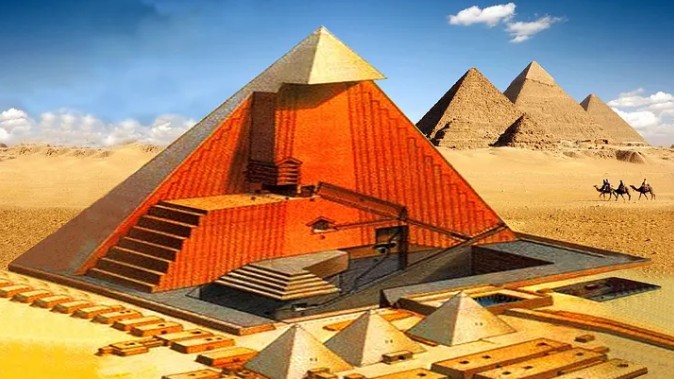
Even more impressive is the planning necessary to create such a structure. Its builders had to quarry enormous quantities of stone, transport them, organize a massive labor force, establish measurements, maintain alignment, and steadily construct a monument rising hundreds of feet into the air.
Modern researchers continue to debate some details of exactly how the pyramid was built. Smithsonian describes its construction as evidence of the remarkable ingenuity of ancient Egyptian civilization.¹ More recent engineering research likewise characterizes the pyramid as the culmination of generations of practical engineering knowledge.³
Whatever techniques were used, the important observation is straightforward: people living thousands of years ago were capable of sophisticated mathematical reasoning, project organization, craftsmanship, and engineering.

EASTER ISLAND
The moai statues of Easter Island provide another remarkable example. Nearly one thousand enormous stone statues were carved by the Rapa Nui people. Some reached more than 30 feet tall, and the largest transported examples weighed many tens of tons. Archaeologists have debated for decades exactly how they transported these monuments from their quarries.⁴

Image by Pexels by Miguel Cuenca
Experiments have shown that surprisingly small groups of people, using ropes and carefully coordinated movements, can move multi-ton replicas by rocking them from side to side. Nature reported an experiment in which 18 people moved a 4.4-ton replica approximately 100 meters using only ropes.⁵
Far from showing that ancient people needed mysterious technology or extraterrestrial help, such experiments demonstrate human ingenuity.
The people who built these monuments understood materials, balance, leverage, teamwork, and organization well enough to accomplish feats that still impress engineers today.
THE MYTH OF THE INCAPABLE ANCIENT HUMAN
Popular descriptions sometimes use terms such as “primitive man” or “brutish” which incorrectly suggest that ancient humans somehow had primitive minds- we have no such evidence.
But technological simplicity is not the same thing as intellectual simplicity.
A person without electricity, steel machinery, computers, or modern transportation is not necessarily less intelligent than a modern person. Ancient builders had fewer technological tools, which makes some of their accomplishments even more remarkable.
Archaeology reveals humans developing sophisticated tools, artwork, navigation, agriculture, architecture, trade networks, cities, writing systems, and mathematics very early in recorded civilization. The evidence does not show people gradually becoming intellectually human during recorded history. By the accounts of written history, humans have always been unmistakably intelligent.
ANCIENT INGENUITY DOES NOT REQUIRE ALIENS
The extraordinary accomplishments of ancient civilizations have sometimes inspired speculation that extraterrestrials must have helped construct structures such as the Egyptian pyramids or the monuments of Easter Island.
There is no credible archaeological evidence that aliens constructed these monuments. The irony is that such explanations underestimate ancient people. Archaeological research increasingly demonstrates that massive stones could be moved using relatively simple materials combined with carefully designed techniques, coordinated labor, ramps, sledges, ropes, leverage, and an understanding of the physical properties involved.
Researchers studying Easter Island, for example, have experimentally demonstrated plausible methods of transporting enormous statues with small teams.⁵ Ancient engineering becomes less mysterious when we stop assuming that ancient people lacked intelligence.
HUMAN INTELLIGENCE APPEARS FULLY DEVELOPED IN RECORDED HISTORY
This is the more interesting question.: How far back into documented human civilization must we travel before we encounter people incapable of mathematics, architecture, engineering, art, abstract thought, language, or complex social organization?
Recorded history does not provide such a period. The earliest civilizations for which extensive records survive already demonstrate sophisticated human intelligence. This observation does not mean that technology has remained unchanged. Human technological knowledge has obviously accumulated dramatically. Modern societies possess tools and scientific knowledge unavailable to ancient civilizations.
But accumulated technology should not be confused with biological intelligence.
A modern engineer has access to computers, precision instruments, heavy machinery, and thousands of years of accumulated knowledge. The Egyptian engineer had none of these advantages.
Yet the Great Pyramid still stands. Ancient monuments therefore remind us that technological simplicity does not equal intellectual inferiority. Wherever documented civilization appears, mankind already demonstrates the creativity, planning ability, craftsmanship, mathematics, organization, and abstract reasoning we associate with human intelligence today. That observation fits naturally with a view of humanity as intelligent from the beginning.
Sources
¹ Smithsonian Magazine, “Ponder the Pyramids of Giza.” The Great Pyramid contained approximately 2.3 million stone blocks averaging more than two tons each.
https://www.smithsonianmag.com/travel/ponder-the-pyramids-of-giza-11138893/
² PBS NOVA, “How Heavy?” Estimates more than 2.3 million limestone and granite blocks averaging approximately 2.3 metric tons.
https://www.pbs.org/wgbh/nova/pyramid/geometry/blocks.html
³ Smithsonian Magazine, “Ancient Egyptian Engineering Choices Helped the Great Pyramid of Giza Survive Earthquakes.” Researchers describe the pyramid as the culmination of generations of successful empirical engineering.
https://www.smithsonianmag.com/smart-news/ancient-egyptian-engineering-choices-helped-the-great-pyramid-of-giza-survive-earthquakes-new-research-finds-180988790/
⁴ Smithsonian Magazine, “The Statues of Easter Island.” Archaeologists continue studying how the massive moai were carved and transported.
https://www.smithsonianmag.com/travel/the-statues-of-easter-island-11248888/
⁵ Nature, “Easter Island Statues ‘Walked’ Out of Quarry.” Researchers demonstrated transportation of a multi-ton replica using coordinated ropes and a small group of people.
https://doi.org/10.1038/nature.2012.11613