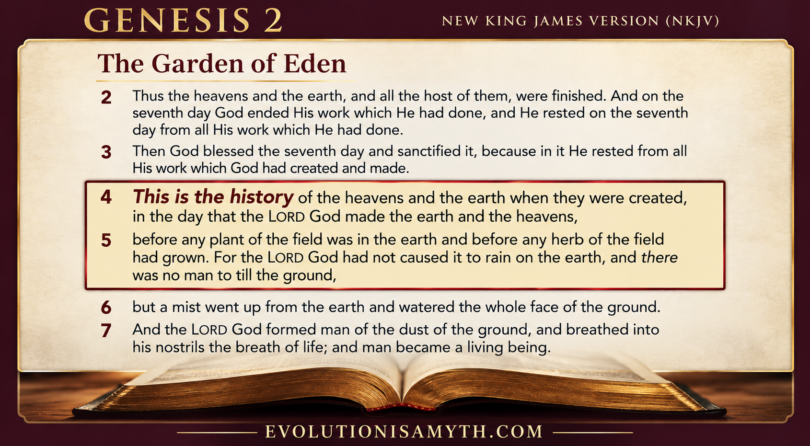
“This is the history of the heavens and the earth when they were created, in the day that the LORD God made the earth and the heavens.”
Genesis 2:4
Updated 09/16/26
Genesis does not introduce the creation account as mythology, allegory, or poetry. It presents the creation of the heavens and the earth as history. Yet Christians are frequently encouraged to reinterpret Genesis in light of modern scientific theories about origins.
One of the most significant attempts at reconciliation involves the Big Bang model and the billions of years associated with modern cosmology and geology. According to the currently accepted scientific chronology, the universe began approximately 13.8 billion years ago, while Earth formed approximately 4.54 billion years ago.

Various Christian interpretations attempt to incorporate these enormous periods of time into Genesis through ideas such as the Day Age Theory, the Gap Theory, progressive creation, and theistic evolution. But why should a Christian begin with a modern theory about the distant past and then attempt to make Genesis accommodate it? A straightforward reading of Genesis presents something very different.
“In the beginning God created the heavens and the earth. The earth was without form, and void; and darkness was on the face of the deep. And the Spirit of God was hovering over the face of the waters.”
Genesis 1:1–2
The creation narrative then describes six numbered days, each marked by an evening and a morning. Earth is already present at the beginning of the account, while the sun, moon, and stars appear later in the creation sequence on Day Four. That sequence does not correspond to the standard Big Bang chronology. According to modern cosmology, stars existed billions of years before Earth. Genesis presents Earth at the beginning and the heavenly lights later.

Two Very Different Accounts of Origins
The Big Bang is generally presented as a scientific model because scientists test its predictions against observable evidence such as cosmic expansion, the cosmic microwave background, and the abundance of light elements. However, the original event itself cannot be directly observed, recreated, or experimentally repeated.
That distinction is important.
Scientists today can observe the universe as it presently exists and construct models intended to explain its past. Christians likewise look at the same physical universe while accepting the historical revelation recorded in Genesis. The disagreement is therefore not over whether the universe exists. The disagreement concerns how its history should be interpreted and what ultimately caused it to exist.
Naturalistic explanations seek physical causes operating through natural processes. Genesis begins somewhere fundamentally different:
“In the beginning God created…”
For the Christian, creation is therefore not merely another natural process waiting to be explained. Creation is a miracle.
Why Treat Creation Differently From Other Miracles?
The Bible records numerous supernatural events. Jesus walked on water (Matthew 14:22–33). He restored sight to the blind (John 9). He raised Lazarus from the dead (John 11:11–44). Most importantly, Jesus Himself rose bodily from the grave (1 Corinthians 15:4).
None of these events can be explained by ordinary physical processes.
Yet Christians do not normally attempt to reinterpret the resurrection because modern biology tells us that dead people do not naturally return to life. That impossibility is precisely why resurrection is a miracle.
Why should creation be treated differently?
If God can raise the dead, walk upon water, heal the blind, and perform countless other miracles recorded in Scripture, there is no logical reason to insist that His creation of the universe must conform to ordinary natural processes operating over billions of years.
Creation itself is presented as one of God’s greatest miracles.
Creation Was Written Into the Ten Commandments
God did not leave the meaning of the creation week isolated in Genesis. He referred directly back to it when establishing Israel’s seven day week:
“For in six days the LORD made the heavens and the earth, the sea, and all that is in them, and rested the seventh day.”
Exodus 20:11
The pattern is remarkably straightforward: six days of creation followed by one day of rest, corresponding to six days of human labor followed by the Sabbath. God certainly did not need six days to create anything. An omnipotent God could have created everything instantaneously. Instead, Scripture tells us that He chose six days and later used His own creation week as the pattern for mankind’s work week. This makes attempts to transform those days into vast geological ages particularly difficult. The commandment itself connects God’s six days of creation with man’s ordinary days of work.
Do We Believe the Miracle or Rewrite It?
Christians should be cautious about becoming cafeteria style believers, accepting biblical miracles that comfortably fit our theology while reinterpreting those that conflict with the prevailing worldview of our age.
The resurrection is miraculous.
The raising of Lazarus is miraculous.
Walking on water is miraculous.
Giving sight to the blind is miraculous.
And creation is miraculous.
God did not need evolution to accomplish creation. He did not need billions of years. He did not even need six days. Scripture tells us that He chose six days. The question therefore is not whether God could have created through billions of years of natural processes. An omnipotent God could create however He chose.
The question is much simpler:
What does Scripture say He actually did?
Genesis answers that question by presenting the creation of the heavens and the earth as an actual sequence of events. Exodus confirms the six day creation week and connects it directly to our seven day week.
Genesis does not ask the reader to discover creation history somewhere else and then reinterpret its words accordingly.
It begins with God’s own declaration:
“In the beginning God created the heavens and the earth.”
Genesis 1:1