
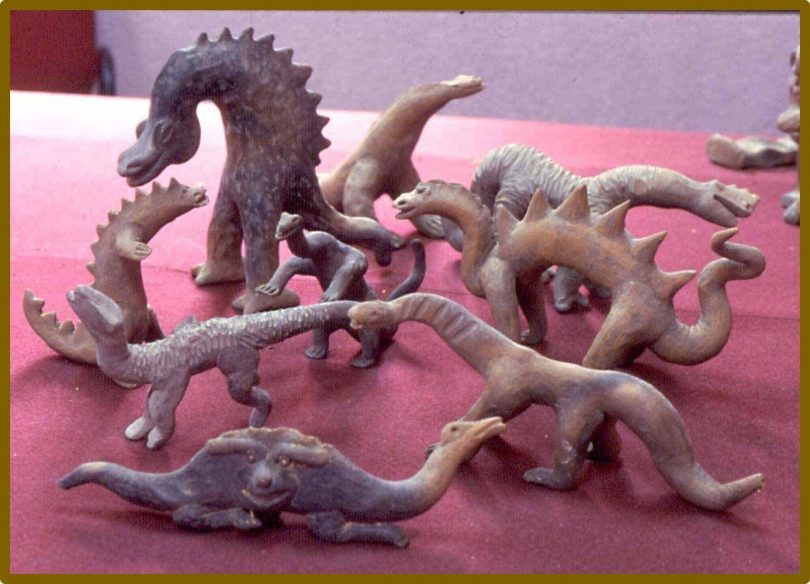

In 1944, German-born merchant and amateur archaeologist Waldemar Julsrud began collecting thousands of unusual ceramic figurines discovered near Acámbaro, Guanajuato, Mexico. The collection eventually grew to approximately 32,000 objects depicting humans, animals, and strange reptile-like creatures.¹
What makes the collection remarkable is that some of the figurines bear striking similarities to familiar reconstructions of dinosaurs and other prehistoric reptiles. Archaeologist Charles C. Di Peso, who investigated the collection and ultimately rejected its authenticity, nevertheless described figures resembling Brontosaurus, Tyrannosaurus rex, Stegosaurus, Trachodon, Dimetrodon, and other Mesozoic reptilian forms.¹
The Acámbaro figurines have therefore generated controversy for decades. If the dinosaur-like figures were genuinely produced by an ancient Mexican culture, they would raise an extraordinary question: How could their makers have depicted animals resembling dinosaurs long before modern paleontology reconstructed them?
But Are the Figurines Ancient?
This is where the evidence becomes disputed.
Julsrud believed the artifacts were associated with ancient cultures of the region. Some early laboratory tests also appeared to support considerable antiquity. However, archaeologist Charles Di Peso examined the collection and excavation area in the early 1950s and concluded that the controversial figurines were modern objects that had been recently buried.¹
Thermoluminescence testing later added another chapter to the controversy. Early tests reportedly produced dates thousands of years old. However, researchers Gary Carriveau and Mark Han subsequently reexamined the thermoluminescence evidence and concluded that those dates were invalid. Their 1976 study in American Antiquity stated that the evidence indicated the tested figurines had been fired relatively recently.²
Thermoluminescence is particularly relevant because fired ceramics effectively have their luminescence clock reset when they are heated. Scientists can therefore use the accumulated signal to estimate the amount of time since the pottery was last fired.³
Consequently, it would be inaccurate to state as established fact that the Acámbaro dinosaur figurines are 3,000 years old. Their authenticity and age remain the central issue surrounding the collection.
Nevertheless, the collection itself is real, enormous, and historically interesting. Thousands of unusual figurines were assembled, and even the archaeologist who argued that they were modern acknowledged that some represented recognizable dinosaur-like forms.
The real question is therefore not whether the Acámbaro figurines exist. They do. The question is when they were actually made.
If convincing evidence could establish that the dinosaur-like figurines genuinely predate modern knowledge and reconstruction of dinosaurs, their significance would be extraordinary. Until that antiquity can be independently demonstrated, however, the Acámbaro figurines should be presented as intriguing but disputed evidence rather than as established proof that ancient people depicted living dinosaurs.
Sources
1. Di Peso, Charles C. (1953). “The Clay Figurines of Acambaro, Guanajuato, Mexico.” American Antiquity, 18(4), 388–389.
Cambridge University Press article
2. Carriveau, Gary W., and Mark C. Han (1976). “Thermoluminescent Dating and the Monsters of Acambaro.” American Antiquity, 41(4), 497–500.
Cambridge University Press article
3. Smithsonian Institution, Human Origins Program. “Dating.” Explanation of thermoluminescence dating and its application to fired ceramics.
Smithsonian Human Origins Program
