

Researchers have discovered ancient petroglyphs and pictographs depicting unusual animals throughout the American Southwest. Some of these images have been interpreted as resembling dinosaurs.
Rock Art includes three terms worth separating:
- Petroglyph = carved, pecked, or incised into rock.
- Pictograph = painted or drawn onto rock.
- Cave painting/drawing = a pictograph specifically located on a cave wall.
While those interpretations are disputed, the rock art itself is genuine and raises an interesting question: What animals were these ancient artists attempting to portray?

THE HAVASUPAI CANYON “DINOSAUR”
One of the most interesting examples comes from Havasupai Canyon in northern Arizona.
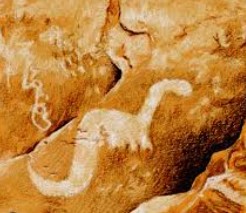
In 1924, Samuel Hubbard, curator of archaeology at the Oakland Museum, led the Doheny Scientific Expedition into Havasupai Canyon. Hubbard subsequently published the expedition’s findings in Discoveries Relating to Prehistoric Man by the Doheny Scientific Expedition in the Havasupai Canyon, Northern Arizona.¹
Among the discoveries Hubbard documented and photographed was an unusual Native American rock image that he interpreted as representing a dinosaur. The original expedition photograph identified the figure as “The Dinosaur” and recorded Robert L. Carson as the photographer, with Charles W. Gilmore, Samuel Hubbard, J. F. Roop, and Fred V. Shaw listed as witnesses. The figure was reported as approximately 11 inches high.²
Hubbard believed the resemblance was significant enough to write:
“The fact that the animal is upright and balanced on its tail would seem to indicate that the prehistoric artist must have seen it alive.”³
The identification is disputed. Paleontologist Phil Senter later reexamined the Havasupai image and argued that it is better interpreted as a stylized bird rather than a dinosaur.³ This interpetation demands that we stretch our imagination beyond what our eyes actually see: a dinosaur.
The important distinction is therefore between the artifact and its interpretation. The 1924 expedition documented and photographed the image, and Hubbard interpreted it as a dinosaur. Whether the ancient artist actually intended to portray a dinosaur remains unknowable.
THE KACHINA BRIDGE PETROGLYPHS
Another frequently cited example is found at Kachina Bridge in Natural Bridges National Monument, Utah.
Among the ancient markings at Kachina Bridge is a figure that, when viewed as a whole, creationist researchers have interpreted as resembling a long-necked sauropod dinosaur.
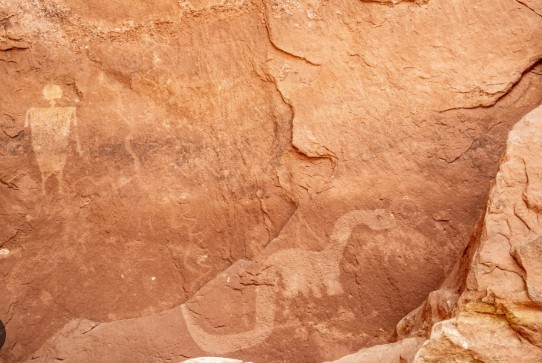
In 2011, the same paleontologist, Phil Senter, challenged this interpretation and also disputed the Havasupai Canyon dinosaur depictions. Senter and archaeologist Sally Cole conducted an on-site examination of four alleged dinosaur images at Kachina Bridge. They concluded that the best-known “sauropod” appearance might have resulted from two separate human-made petroglyph elements combined visually with natural mineral or mud staining. They therefore argue that it was perhaps not originally carved as a single dinosaur figure.⁴ Their findings are biased and certainly not conclusive.
Regardless, these are human-made petroglyphs and are genuine ancient rock art. The disagreement concerns whether the individual markings and natural staining should be visually combined into the dinosaur-like figure seen today.
ANCIENT ROCK ART THROUGHOUT UTAH AND COLORADO
These examples exist within a much larger tradition of Native American rock art throughout the American Southwest.
The National Park Service documents extensive petroglyphs and pictographs at Dinosaur National Monument in Utah and Colorado. Many are attributed to the Fremont peoples, who inhabited the region approximately A.D. 300–1300.⁵
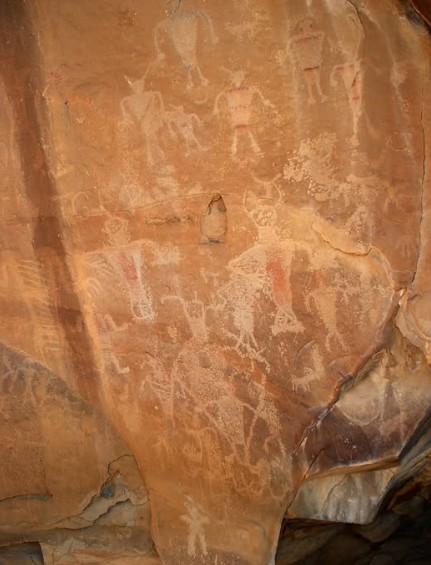
These ancient artists depicted human figures, bighorn sheep, elk, deer, dogs, birds, snakes, lizards, other animal-like forms, and abstract designs. The National Park Service acknowledges that the exact meaning of many of these ancient images remains unknown.⁵
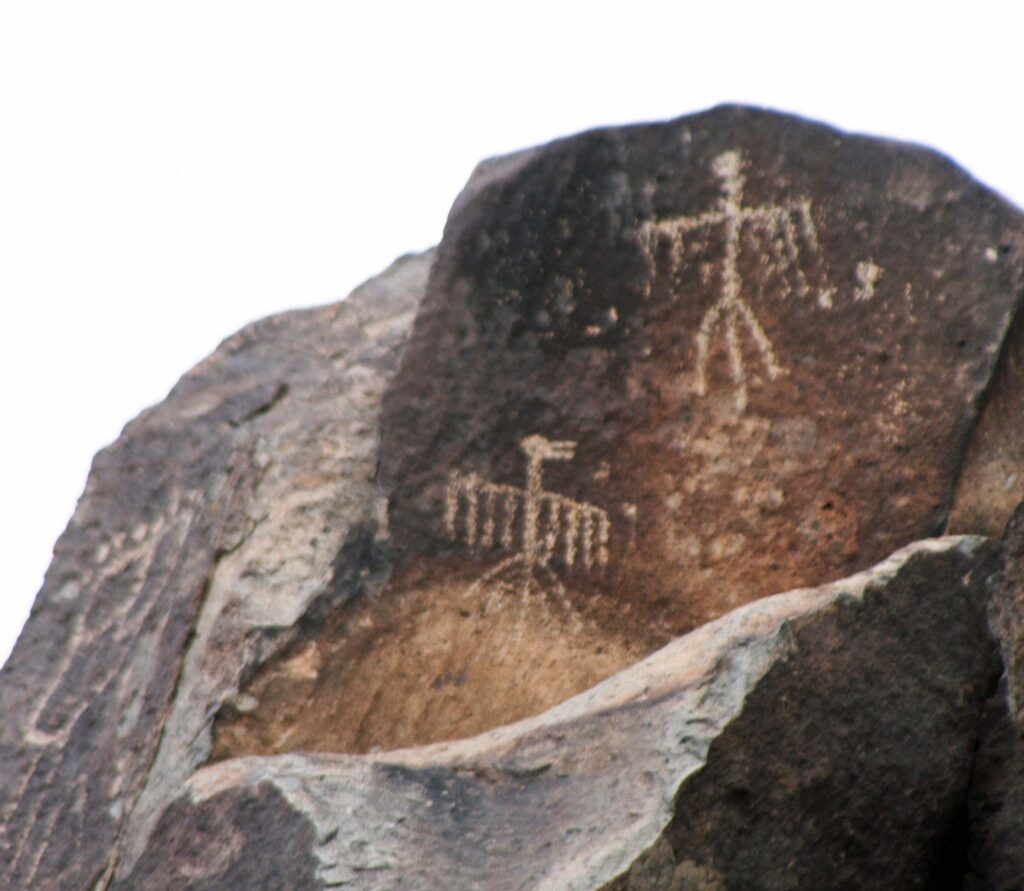
This caution matters when examining unusual rock art. Resemblance alone cannot prove that an ancient artist actually saw a dinosaur. Some images may depict familiar animals, symbolic creatures, combinations of figures, or shapes whose meanings have been lost, such as the thunderbird depictions in the image below.
At the same time, interpretation should follow the evidence rather than assumptions about what an ancient artist could or could not have seen.
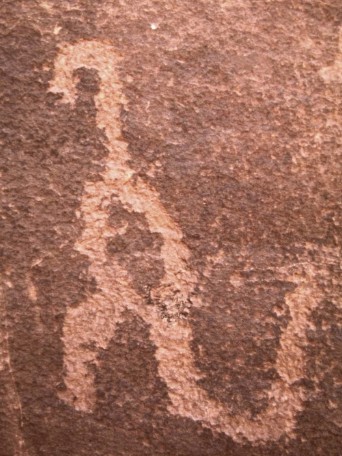
The Havasupai image was sufficiently dinosaur-like that Samuel Hubbard identified it as a dinosaur nearly a century ago. The Kachina Bridge markings likewise became famous for their apparent resemblance to a sauropod, although later examination disputes that interpretation.
These images therefore should not be presented as proof that humans and dinosaurs lived together. But their history should not be misrepresented either. Ancient Native American artists unquestionably depicted animals on rock throughout the Southwest, and some of those images have been interpreted, both historically and more recently, as resembling dinosaurs.
The question remains: What animals did the original artists intend to portray?
Sources
¹ Samuel Hubbard, Discoveries Relating to Prehistoric Man by the Doheny Scientific Expedition in the Hava Supai Canyon, Northern Arizona, with supplement (1927). The published report documents the Doheny expedition of October and November 1924 and its archaeological investigations in Havasupai Canyon.
² Robert L. Carson photograph, Doheny Scientific Expedition, 1924. Hubbard’s expedition report reproduced the Havasupai figure and identified it as “THE DINOSAUR.” The published photograph listed Carson as photographer and Charles W. Gilmore, Samuel Hubbard, J. F. Roop, and Fred V. Shaw as witnesses.
³ Phil Senter, “Rock Art ‘Dinosaurs’: The Origin of the Mesozoic Myth,” Palaeontologia Electronica (2012). Senter documents Hubbard’s original interpretation and quotation and presents the alternative interpretation that the Havasupai figure represents a stylized bird.
https://palaeo-electronica.org/content/2012-issue-2-articles/275-rock-art-dinosaurs
⁴ Phil Senter and Sally J. Cole, “‘Dinosaur’ Petroglyphs at Kachina Bridge Site, Natural Bridges National Monument, Southeastern Utah: Not Dinosaurs After All,” Palaeontologia Electronica 14 (2011). Their on-site examination concluded that the famous apparent sauropod combines separate petroglyph elements with natural mineral or mud staining.
https://palaeo-electronica.org/2011_1/236/index.html
⁵ National Park Service, Dinosaur National Monument, “Petroglyph and Pictograph Sites.” The National Park Service attributes many of the area’s petroglyphs and pictographs to Fremont peoples living in the region approximately A.D. 300–1300 and documents numerous human, animal, and abstract forms.
https://home.nps.gov/dino/learn/historyculture/viewing-petroglyphs-and-pictographs.htm
