
Published 09/2019- updated 09/2026
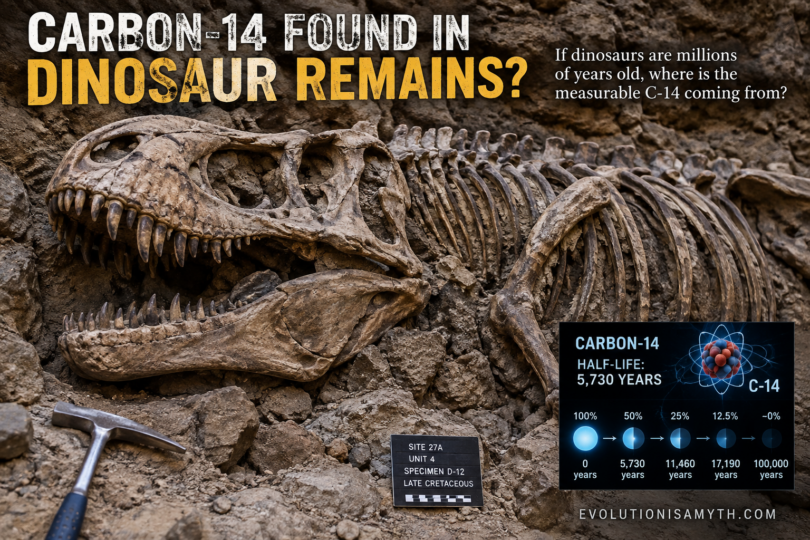
Carbon-14 has a half-life of 5,730 years
After each half-life, half of the remaining carbon-14 decays into nitrogen-14. Consequently, conventional radiocarbon dating has a practical upper limit measured in tens of thousands of years, and material believed to be tens of millions of years old should contain essentially no detectable original carbon-14. Yet measurable carbon-14 has been reported in dinosaur fossil material.
In 2015, Brian Thomas and Vance Nelson published radiocarbon measurements in the Creation Research Society Quarterly from fossil specimens, including dinosaur bones. Their study reported measurable carbon-14 in all 16 fossil samples tested, including samples from seven dinosaurs. The reported apparent radiocarbon ages were in the tens of thousands of radiocarbon years.¹
The authors emphasized that their purpose was not simply to accept these conventional radiocarbon ages as the actual ages of the dinosaurs. Rather, they argued that the key observation was the presence of measurable carbon-14 in fossils assigned conventional ages of many millions of years.
Additional dinosaur bones have also produced measurable radiocarbon results. A group that presented results at the 2012 Western Pacific Geophysics Meeting reported measurements from several dinosaur specimens with apparent radiocarbon ages generally between approximately 22,000 and 39,000 radiocarbon years.²
A MAINSTREAM STUDY ALSO DETECTED CARBON-14
Perhaps even more interesting is that carbon-14 in dinosaur fossil material is not limited to creationist laboratories or publications.
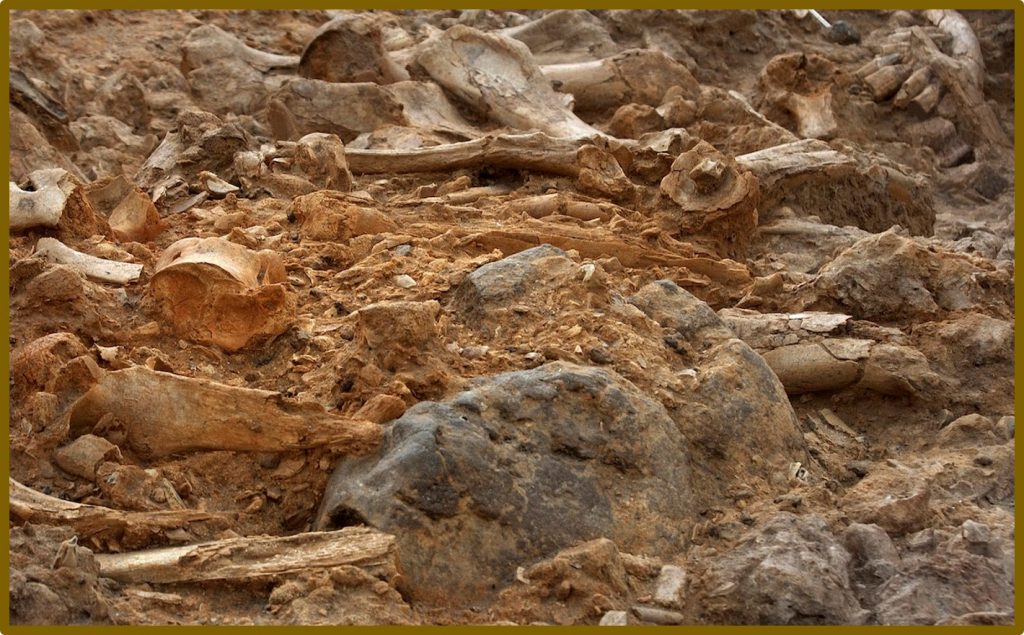
In 2019, researchers publishing in the peer-reviewed journal eLife analyzed Late Cretaceous Centrosaurus bone from Alberta, Canada, using accelerator mass spectrometry. The dinosaur bone was not “radiocarbon dead.” They detected measurable carbon-14 in its organic carbon.³
The researchers did not conclude that the dinosaur was thousands of years old. Instead, they found evidence of modern microbial communities within the fossil and interpreted much of the organic material and radiocarbon as relatively recent carbon that had entered the porous fossil.³
This distinction is important. The presence of carbon-14 in dinosaur fossil material is an observation. The origin of that carbon-14 can be a disputed question– for one convinced of Naturalism, it must be contamination.
IS IT SIMPLY CONTAMINATION?
The conventional explanation is that dinosaur fossils are open systems. Groundwater, microorganisms, dissolved carbon, recrystallization of bone minerals, and radioactive processes can potentially introduce younger carbon into ancient fossil material. A 2020 paper devoted specifically to this question argued that such processes can explain apparently young radiocarbon measurements from dinosaur fossils.⁴
Creation researchers challenge that explanation. Thomas and Nelson reported that their samples underwent laboratory pretreatment intended to remove contamination and argued that the consistency of measurable carbon-14 across their fossil samples deserves further investigation.¹ The Institute for Creation Research likewise argues that measured levels cannot simply be dismissed as laboratory background or surface contamination.⁵
More recently, Answers in Genesis has defended the dinosaur radiocarbon results in detail, arguing that standard pretreatment procedures, measured laboratory backgrounds, and calculations concerning possible in-situ carbon-14 production do not adequately explain the reported measurements.⁶
Thus there are two competing interpretations:
Conventional interpretation: The dinosaurs really are tens of millions of years old, therefore measurable carbon-14 must represent younger carbon introduced into the fossil or produced after fossilization.
Young-earth interpretation: If pretreatment has adequately removed younger contamination and measurable carbon-14 remains within the fossil material, its presence is evidence that the fossils are dramatically younger than their conventional geological ages.
The disagreement should not obscure the underlying observation: measurable carbon-14 has in fact been detected in dinosaur fossil material.
WHY THIS MATTERS
A dinosaur conventionally dated at 66 to 100 million years old would have passed through thousands of carbon-14 half-lives. Any carbon-14 originally present in the animal would therefore have disappeared to levels unimaginably below anything that could be measured today.
That makes the critical question remarkably straightforward:
If measurable carbon-14 remains after careful pretreatment of dinosaur fossil material, where did it come from?
Creation researchers contend that the simplest explanation is that at least some dinosaur fossils are far younger than the conventional geological timescale allows. Conventional researchers contend that younger carbon entered the fossils long after the dinosaurs died.
Carbon-14 therefore does not, by itself, prove which interpretation is correct. But its repeated detection in supposedly ancient fossil material raises a legitimate question that deserves experimental investigation rather than dismissal based solely on the specimen’s assumed geological age.
SOURCES
Andrew A. Snelling, “What’s the Truth About Radiocarbon Dating and the Ages of Fossils?” Answers in Genesis, 2026.
Answers in Genesis detailed response
Brian Thomas and Vance Nelson, “Radiocarbon in Dinosaur and Other Fossils,” Creation Research Society Quarterly 51, no. 4 (2015): 299–311.
Creation Research Society Quarterly paper
Paleochronology Group, radiocarbon measurements of dinosaur bones presented at the 2012 Western Pacific Geophysics Meeting.
Dinosaur bone radiocarbon data and laboratory results
Evan T. Saitta et al., “Cretaceous Dinosaur Bone Contains Recent Organic Material and Provides an Environment Conducive to Microbial Communities,” eLife 8 (2019).
Peer-reviewed eLife study
Philip J. Senter, “Radiocarbon in Dinosaur Fossils: Compatibility with an Age of Millions of Years,” The American Biology Teacher 82, no. 2 (2020): 72–79. This paper presents the conventional explanation for measurable carbon-14 in dinosaur fossils.
University of California Press article
Brian Thomas, “Carbon-14 Found in Dinosaur Fossils,” Institute for Creation Research, 2015.
Institute for Creation Research