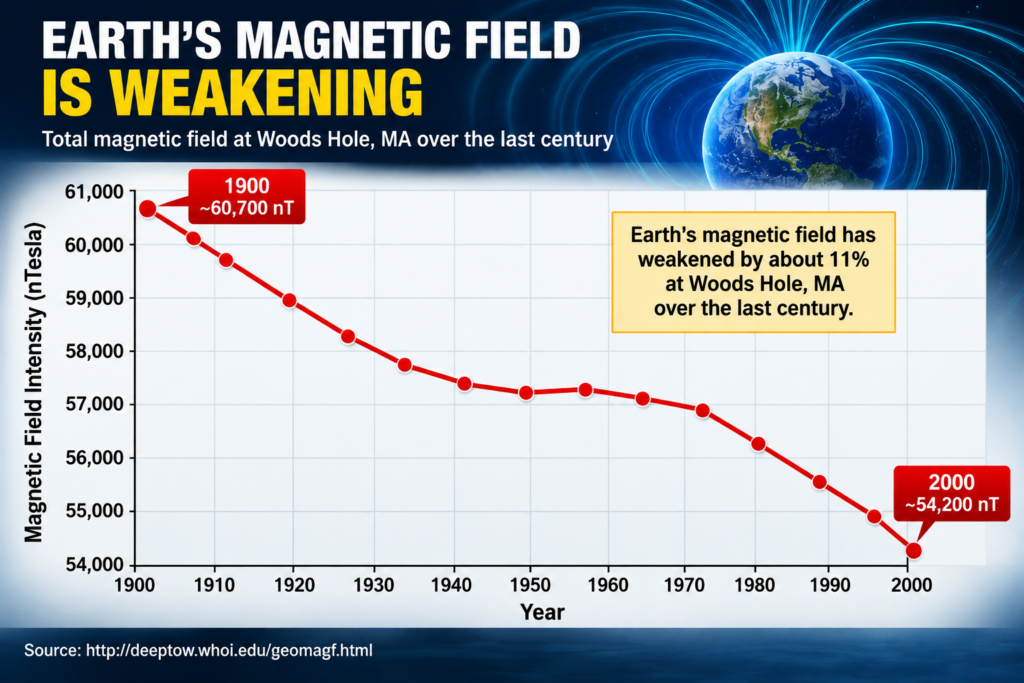
EARTH’S MAGNETIC FIELD IS WEAKENING & CARBON-14 IS INCREASING
Radiocarbon-14 is measured in samples sent to labs. Samples with less Carbon-14 are assumed as being older than those with more. Carbon-14 date calculations assume that the earth’s magnetic field is not constant but is decaying (weakening) each year. Therefore, in light of a weakening magnetic field, Carbon-14 tests can have calculations off by tens of thousands of years.
Carbon-14 dating depends upon knowing how much carbon-14 was present in the atmosphere when an organism was alive. But atmospheric carbon-14 has not remained constant throughout history.
One important reason is Earth’s changing magnetic field. Earth’s magnetic field varies on timescales from milliseconds to millions of years. Earth’s magnetic field has varied in the past. The map below was generated from a mathematical model of the geomagnetic field generated from observations. http://deeptow.whoi.edu/geomagf.html
Carbon-14 is produced primarily when cosmic rays enter Earth’s atmosphere and initiate reactions that ultimately convert nitrogen-14 into radioactive carbon-14. Earth’s magnetic field partially shields the planet from these incoming cosmic rays. Consequently, changes in the strength and configuration of the magnetic field can change the rate at which carbon-14 is produced.¹
A stronger magnetic field generally provides greater shielding from cosmic rays, resulting in less carbon-14 production. A weaker field allows greater cosmic-ray penetration and generally increases carbon-14 production.
This is not merely a creationist argument. The relationship between geomagnetic-field variation and atmospheric carbon-14 production is well established in the scientific literature. Researchers studying radiocarbon records acknowledge that long-term changes in carbon-14 production are influenced substantially by variations in Earth’s magnetic field.¹ ²
CARBON-14 HAS NOT BEEN CONSTANT
The original radiocarbon dating method developed by Willard Libby treated atmospheric carbon-14 as approximately constant. Subsequent measurements of independently dated materials, especially tree rings, demonstrated that atmospheric carbon-14 has varied through time.
This discovery required scientists to develop radiocarbon calibration curves.
Modern radiocarbon laboratories therefore do not simply take a measured carbon-14 concentration and assume that today’s atmospheric conditions existed throughout the past. Conventional radiocarbon ages are compared with calibration curves constructed from independently dated materials such as tree rings and, farther back in time, corals, sediments, speleothems, and other records.³
This is an important correction to simplistic descriptions of carbon dating. Scientists themselves recognize that an uncalibrated radiocarbon age is not necessarily the same thing as a calendar age.
The internationally accepted IntCal20 calibration curve specifically states that:
“Radiocarbon (14C) ages cannot provide absolutely dated chronologies…directly but must be converted to calendar age equivalents using a calibration curve compensating for fluctuations in atmospheric 14C concentration.”³
That statement is significant. Atmospheric carbon-14 has fluctuated enough that radiocarbon measurements require correction before they can be interpreted as calendar dates.
THE EARTH’S MAGNETIC FIELD AFFECTS THOSE FLUCTUATIONS
Researchers have identified Earth’s magnetic field as one of the major causes of long-term changes in carbon-14 production.
Tree-ring research has been especially important because individual rings can provide independently determined calendar ages that can then be compared with their measured carbon-14 concentrations. These records have demonstrated variations in atmospheric carbon-14 and helped scientists investigate their relationship to geomagnetic and solar activity.¹
A recent study using the IntCal20 carbon-14 record states that the long-term trend observed in Holocene carbon-14 measurements results mainly from variations in geomagnetic-field intensity and changes in the global carbon cycle.²
In other words, one of the assumptions sometimes associated with a simplified description of carbon dating, that atmospheric carbon-14 has always remained constant, is demonstrably incorrect.
Modern science acknowledges the variation and attempts to compensate for it.
WHY THIS MATTERS FOR RADIOCARBON DATING
Suppose an organism lived during a period when atmospheric carbon-14 concentrations differed substantially from today’s level. Its initial carbon-14 concentration would also have differed from what would be expected under modern atmospheric conditions.
If that specimen were dated using a simple constant-atmosphere model, without calibration, its calculated radiocarbon age could differ from its actual calendar age.
That is precisely why calibration is necessary.
The important question, therefore, is no longer:
“Has atmospheric carbon-14 always been constant?” We know that it has not.
A more meaningful question is:
How accurately can scientists reconstruct past atmospheric carbon-14 concentrations, particularly as we move beyond the period covered by continuous, absolutely dated tree-ring chronologies?
For approximately the last 14,000 calendar years, IntCal20 has a particularly strong atmospheric record based heavily upon tree rings. Farther back, however, the calibration curve necessarily incorporates additional evidence, including floating tree-ring chronologies, marine and lake sediments, speleothems, and corals. These older portions require corrections and statistical integration of different records and their associated uncertainties.³
This does not mean that older radiocarbon dates are automatically wrong. It does mean that radiocarbon dating is considerably more complicated than simply measuring radioactive decay and reading an age from a clock.
The method depends upon assumptions, measurements, calibration records, carbon-cycle behavior, regional effects, reservoir corrections, solar activity, and changes in Earth’s magnetic field.
THE MAGNETIC FIELD IS NOT A CONSTANT
Earth’s magnetic field itself is dynamic. Its strength, orientation, and geographical configuration change with time. Paleomagnetic measurements preserved in rocks and archaeological materials demonstrate substantial geomagnetic variation in the past.¹
Those variations matter because the magnetic field acts as a shield against cosmic radiation.
Changing magnetic field → changing cosmic-ray penetration → changing carbon-14 production → changing atmospheric carbon-14 concentration.
That relationship is established physics. Carbon-14 records are therefore useful for much more than dating archaeological specimens. Scientists actually use variations in carbon-14 to investigate past solar activity and geomagnetic behavior.² ⁴
This presents an important qualification whenever radiocarbon dating is described as though carbon-14 were simply a clock ticking at a known rate.
The radioactive decay rate may be well measured, but knowing the decay rate is only part of the calculation. Scientists must also determine, or reconstruct, the amount of carbon-14 present when the biological material stopped exchanging carbon with its environment.
CALIBRATION CORRECTS FOR KNOWN VARIATION, BUT IT DOES NOT MAKE THE ISSUE DISAPPEAR
Modern radiocarbon calibration is specifically designed to address these variations, and any critique of carbon dating should acknowledge that fact.
However, calibration itself demonstrates the larger point: Atmospheric carbon-14 has not been constant.
The farther backward researchers attempt to extend the calibration curve, the less they can rely exclusively upon continuous, absolutely dated tree rings and the more they must integrate other records and models. IntCal20 currently extends radiocarbon calibration to approximately 55,000 calendar years before present, but the nature of the evidence changes substantially across that interval.³
Therefore, Earth’s changing magnetic field should not be presented as proof that every radiocarbon date is invalid. Rather, it demonstrates that the simple assumption of an eternally constant atmospheric carbon-14 concentration is false and that radiocarbon ages require calibration against an independently reconstructed history of atmospheric carbon-14.
For anyone evaluating claims about the distant past, that distinction is important.
Sources
1. Pearson, C. L. (2021). “Dendrochronology and Radiocarbon Dating.” Radiocarbon. Cambridge University Press.
2. Scientific Reports (2024). “Exploring solar dynamo behavior using an annually resolved carbon-14 compilation during multiple grand solar minima.” Nature Portfolio.
3. Reimer, P. J., et al. (2020). “The IntCal20 Northern Hemisphere Radiocarbon Age Calibration Curve (0–55 cal kBP).” Radiocarbon 62(4). Cambridge University Press.
4. Damon, P. E., and Linick, T. W. “Geomagnetic-Heliomagnetic Modulation of Atmospheric Radiocarbon Production.” Radiocarbon 28(2A), 266–278.
Earth’s magnetic field weakens each year impacting carbon-14 production. Less carbon 14 in the past means the tested specimens give off false older dates…”
“National Geographic News”, J. Roach, September 9, 2004
However, it was found that earth had not reached equilibrium (despite its assumed billions of years of age) and in fact “Radiocarbon was forming at a staggering 28-37% faster than it was decaying”.
Viruses mutate at extraordinary rates and are routinely presented as examples of evolution occurring before our eyes. But rapid genetic change is not necessarily genetic advancement. Most studied viral mutations are harmful, many...