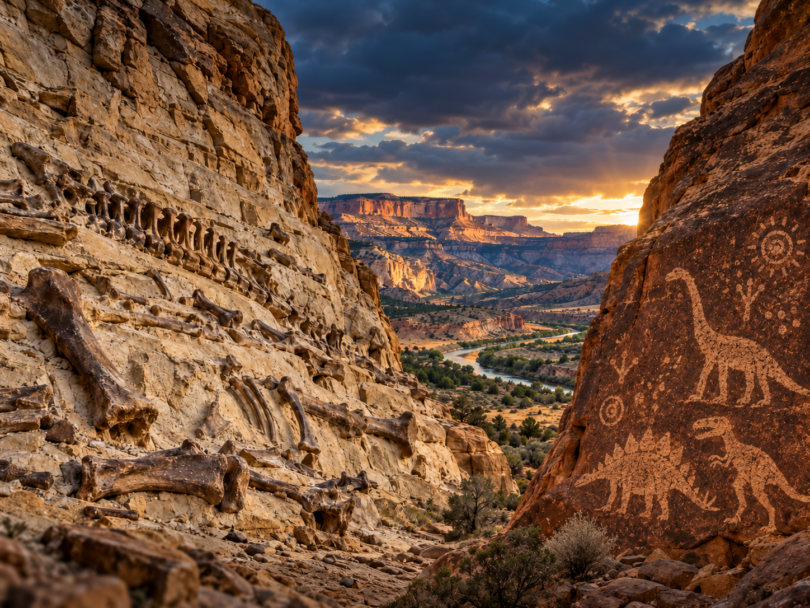
Some fossils preserve far more than bones. They appear to capture animals in the middle of what they were doing when they died. Fish have even been fossilized with other fish still lodged in their mouths or throats. Such fossils provide dramatic evidence that, at least in these cases, death and preservation occurred under unusual conditions that prevented the normal destruction and scattering of the remains.
Dead animals normally begin to decay and are subject to scavenging, bacterial activity, currents, and physical disturbance. Yet some fossils preserve animals with extraordinary completeness, sometimes even capturing their final meal.
Caught in the Act
One remarkable example comes from the famous Solnhofen Limestone of Germany. Researchers described a fossil of the flying reptile Rhamphorhynchus associated with the predatory fish Aspidorhynchus. A small fish was still lodged in the throat of the Rhamphorhynchus. The researchers reported that the prey showed no trace of digestion and concluded that the pterosaur had apparently just caught the fish and was in the process of swallowing it when it was attacked by the larger fish.¹
This is essentially a snapshot of an event interrupted in progress.

Other fossils provide similarly dramatic evidence. The famous “Fighting Dinosaurs” specimen from Mongolia preserves a Velociraptor and Protoceratops apparently locked in combat. The Velociraptor’s foot claw is positioned at the neck of the Protoceratops, while the Protoceratops has the Velociraptor’s arm in its jaws. Paleontologists conclude that the two animals were suddenly buried while fighting.²
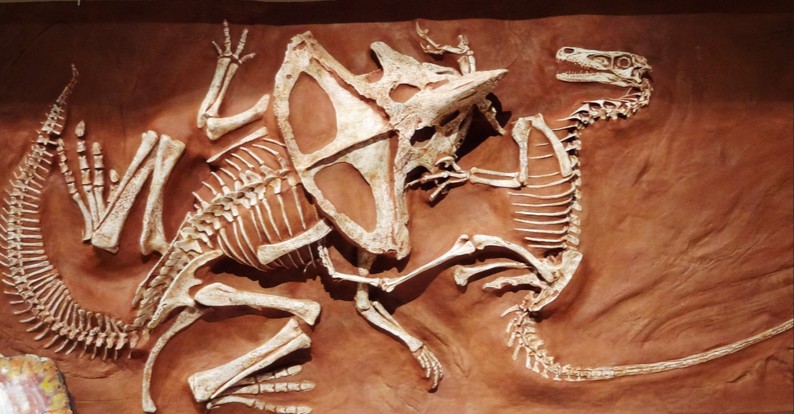
Whatever timescale one assigns to the surrounding rock formations, fossils such as these demonstrate something that can be directly observed: some animals were buried and preserved rapidly enough to capture extraordinarily short-lived behavior.
Undigested Dinosaur Muscle Tissue Preserved
An even more remarkable discovery involves the preservation of an animal’s last meal.
A 2003 peer-reviewed paper in PALAIOS is titled “Remarkable Preservation of Undigested Muscle Tissue Within a Late Cretaceous Tyrannosaurid Coprolite from Alberta, Canada.” The authors included Karen Chin, David Eberth, Mary Schweitzer, Thomas Rando, Wendy Sloboda, and John Horner.³
The researchers examined fossilized feces, known as a coprolite, attributed to a large tyrannosaurid. Inside it they identified microscopic structures that they concluded were fossilized remains of undigested muscle tissue.
The structures were examined both in thin sections and with scanning electron microscopy. Their morphology, organization, and location led the researchers to identify them as undigested muscle tissue from the tyrannosaurid’s meal.
Significantly, the researchers concluded that this exceptional preservation indicated a relatively short time within the dinosaur’s digestive tract, rapid lithification, and minimal subsequent recrystallization.
Even more relevant to the question of catastrophic preservation, the authors wrote:
“Rapid burial of the feces probably was facilitated by a flood event”³
on the ancient coastal lowland plain where it was deposited.
Thus, rapid burial and even flood-assisted burial are not concepts imposed upon these fossils solely by creationists. In this particular case, rapid burial by a flood event was proposed by the researchers themselves as part of the explanation for the exceptional preservation.
Rapid Burial Is an Observed Feature of the Fossil Record

These examples demonstrate an important point: rapid burial is a genuine and sometimes necessary component of fossil preservation.
A fish preserved in another animal’s throat, animals apparently preserved in the midst of combat, or undigested muscle tissue preserved within fossilized feces are difficult to reconcile with prolonged exposure before burial. These specimens required conditions capable of protecting remarkable biological details from destruction.
Rapid burial does not, by itself, determine the age of the surrounding rocks, nor does any individual fossil prove that all fossil-bearing strata were deposited during a single worldwide catastrophe. Those are separate questions involving the interpretation of the larger geological record.
However, these fossils demonstrate that catastrophic events can bury organisms rapidly and preserve details that would otherwise be lost.
From a biblical Flood perspective, widespread evidence of rapid burial, mass mortality, extensive sedimentary deposits, and exceptional fossil preservation is therefore significant. Massive moving waters can transport sediment, bury organisms, and create conditions favorable for exceptional preservation.
The fossils themselves establish the rapid burial. Whether these catastrophic deposits are best understood as numerous isolated events spread across conventional geological time or as evidence within a much larger catastrophic history is a question of interpretation that must be considered from the totality of the evidence.
Sources
- Frey, E., and Tischlinger, H. (2012). “The Late Jurassic Pterosaur Rhamphorhynchus, a Frequent Victim of the Ganoid Fish Aspidorhynchus?” PLOS ONE, 7(3): e31945.
- American Museum of Natural History. “Fighting Dinosaurs.” The specimen preserves Velociraptor mongoliensis and Protoceratops andrewsi apparently engaged in combat when rapidly buried.
https://www.amnh.org/explore/ology/paleontology/fighting-dinos2 - Chin, K., Eberth, D. A., Schweitzer, M. H., Rando, T. A., Sloboda, W. J., and Horner, J. R. (2003). “Remarkable Preservation of Undigested Muscle Tissue Within a Late Cretaceous Tyrannosaurid Coprolite from Alberta, Canada.” PALAIOS, 18(3), 286–294.
https://pubmed.ncbi.nlm.nih.gov/12866547/
Additional Resources
Answers in Genesis, “Lessons Learned from a Fossil.”
https://answersingenesis.org/fossils/how-are-fossils-formed/lessons-learned-from-a-fossil/
Answers in Genesis, “Do Fossils Show Signs of Rapid Burial?”
https://answersingenesis.org/fossils/how-are-fossils-formed/do-fossils-show-signs-of-rapid-burial/