09/28/2026
The fossil record is commonly presented as one of the principal lines of evidence for evolution over deep time. Yet the actual patterns preserved in the rocks are more complicated than the familiar picture of countless organisms gradually transforming into new forms through innumerable intermediate stages.
This does not mean the fossil record contains no organisms interpreted as transitional. It does. The more defensible question is whether the overall fossil record displays the continuous, finely graded succession that might intuitively be expected from slow morphological transformation over immense periods of time.
In several important respects, it does not.
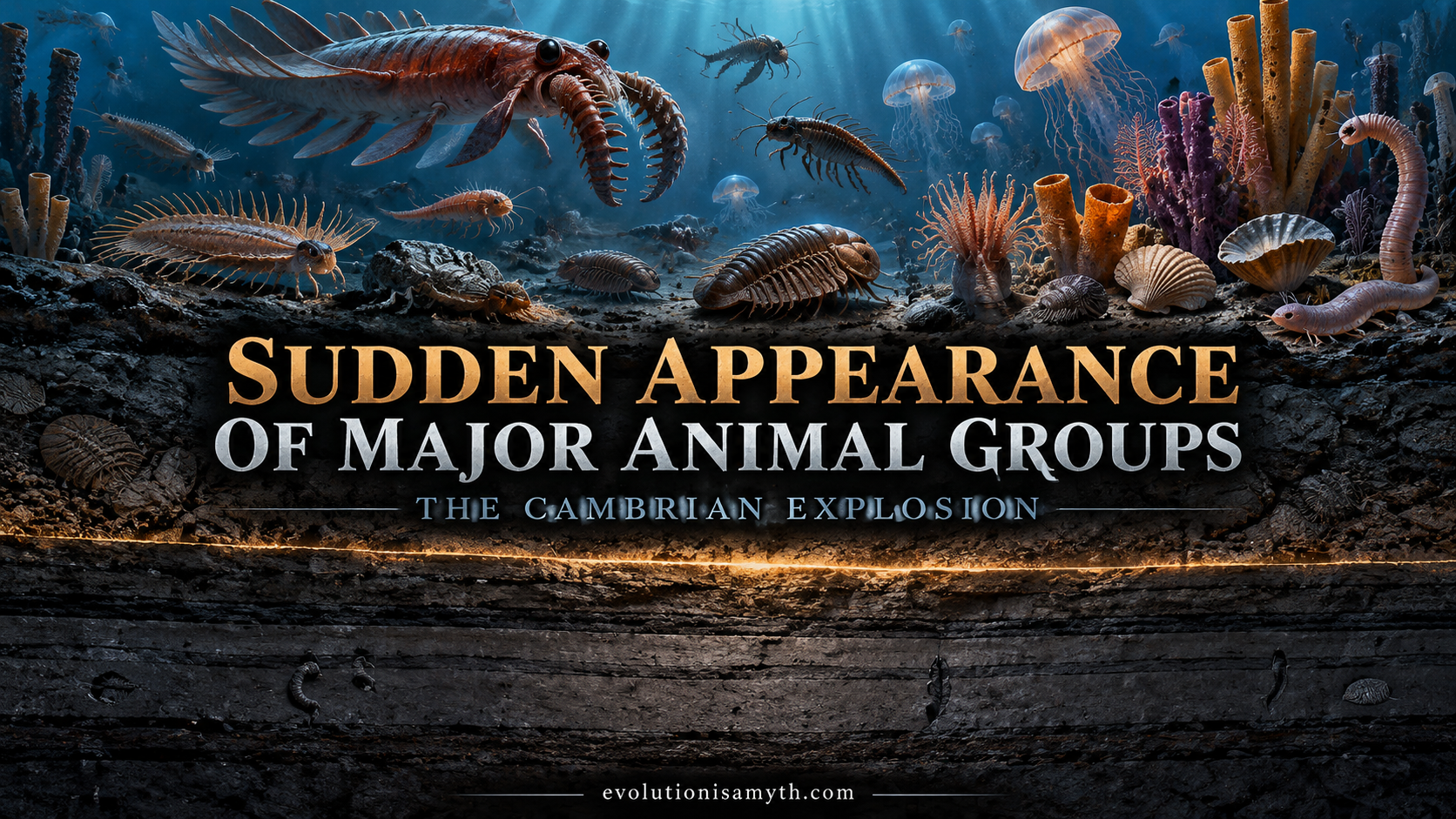
Perhaps the most famous example is the Cambrian Explosion. In conventional dating, approximately 540–520 million years ago, the fossil record records a remarkable expansion in animal diversity, ecological complexity, skeletal structures, and recognizable body plans.¹
Harvard paleontologist Charles Marshall described the Cambrian Explosion as a “unique episode in Earth history” in which essentially all animal phyla first appear in the fossil record.²
The phrase “Cambrian Explosion” should not be misunderstood to mean that literally no animals existed before the Cambrian. Ediacaran organisms and other possible animal evidence occur earlier, and evolutionary paleontologists now interpret the transition as a series of radiations extending across the Ediacaran-Cambrian boundary.³
Nevertheless, the striking increase in recognizable animal diversity remains a genuine feature of the fossil record. The disagreement concerns its explanation.
From a creation perspective, the important observation is not “nothing, then everything,” but that many fundamentally different animal architectures appear within a comparatively narrow portion of the fossil record without the vast abundance of clearly documented ancestral forms one might expect beneath them.
Another important pattern is stasis. Once many fossil species appear, their basic morphology can remain remarkably stable throughout much of their stratigraphic range. Trilobites remained trilobites throughout hundreds of millions of years of supposed evolution.
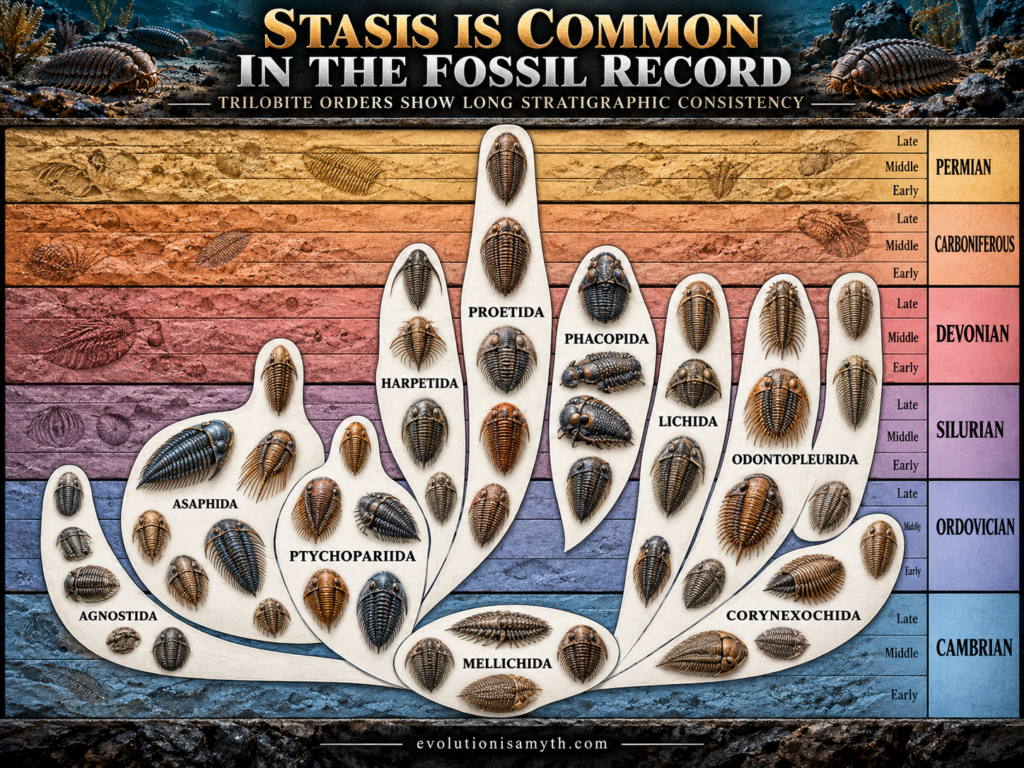
This pattern was central to the theory of punctuated equilibrium developed by paleontologists Niles Eldredge and Stephen Jay Gould. They argued that most fossil species show relatively little directional morphological change during most of their existence, with evolutionary change instead concentrated around comparatively brief episodes of speciation.⁴
This is not merely a historical observation. A 2025 review of fifty years of research into punctuated equilibrium concluded that stasis remains a commonly documented pattern in fossil lineages, although it is not universal and other patterns also occur.⁵
Thus, the popular image of fossils forming a continuously changing sequence is misleading. Long periods of morphological stability are an important part of the actual fossil record.
Fossils can unquestionably possess combinations of characteristics that scientists interpret as transitional between major groups. Fossils have therefore contributed substantially to evolutionary phylogenies.⁶
However, identifying an organism as possessing transitional characteristics is different from demonstrating that it was the actual ancestor of another fossil species.
Direct ancestor-descendant relationships are difficult to establish from fossils because the fossil record consists primarily of samples from past populations. Evolutionary trees therefore commonly reconstruct relationships by comparing shared anatomical characteristics, stratigraphic position, and, where possible, molecular evidence from living organisms.
Even paleontological discussions frequently distinguish between actual ancestors and organisms believed to belong near ancestral lineages.
The fossil record therefore does not provide a photographed genealogy of life. It provides preserved organisms from which evolutionary relationships are reconstructed.
The fossil record documents enormous amounts of extinction. Entire groups appear, persist for some interval, and disappear. Conventional paleontology identifies several major mass extinction events in addition to countless smaller extinction episodes.

Extinction itself does not contradict evolutionary theory. Evolutionary theory incorporates extinction as a central part of life’s history. However, extinction is important when evaluating what the rocks actually demonstrate directly.
The rocks preserve enormous numbers of organisms that once existed and later disappeared. The proposed evolutionary relationships connecting those organisms into an overarching tree of common ancestry require additional interpretation of the fossil evidence.
Ordinary dead organisms usually decay, are scavenged, disarticulated, weathered, or otherwise destroyed. Exceptional preservation therefore commonly requires conditions that protect remains from normal destruction.
Rapid sedimentation and burial can be especially important.
Some fossil deposits preserve articulated skeletons, delicate organisms, soft tissues, enormous concentrations of shells, or entire communities. Such deposits provide evidence that at least some fossil-bearing sediments accumulated rapidly under unusual conditions rather than through an uninterrupted process of extremely slow deposition.
This point does not demonstrate that every fossil was produced during one catastrophe. Different fossil deposits clearly formed under different circumstances. But it does demonstrate something important: catastrophic or high-energy processes are entirely capable of producing substantial portions of the fossil record.
Marine organisms constitute an enormous portion of the fossil record, and many of the best-known fossil-bearing sedimentary formations were deposited in marine environments.
This is not surprising even within conventional geology because marine environments often provide excellent conditions for sediment accumulation and preservation. Hard-shelled marine organisms are also substantially more likely to fossilize than many terrestrial organisms.
Marine sedimentary rocks are additionally found today across large portions of the continents, including regions now far above sea level.
Conventional geology explains these formations through repeated marine transgressions, regressions, tectonic uplift, and plate movements over immense periods of time. A global-Flood model instead asks whether widespread marine sediments and marine fossils across the continents could reflect much larger catastrophic inundation and sedimentation.
The fossils themselves establish the former presence of marine environments. The timescale and mechanism responsible for depositing the enormous sedimentary sequences remain questions of geological interpretation.
Some fossil deposits contain organisms buried essentially where they lived, while others contain transported or concentrated remains. Paleontologists study these processes through the field of taphonomy.
Consequently, it would be incorrect to say that all fossils constitute mixed catastrophic graveyards.
Nevertheless, some deposits clearly record mass mortality, rapid burial, transportation, current concentration, or unusual ecological mixing. These deposits deserve particular attention because they demonstrate the enormous geological work that water, sediment flows, storms, volcanic events, and other catastrophic processes can accomplish rapidly.
None of these observations by itself disproves evolution, and evolutionary paleontologists have developed explanations for each of them.
The scientific observations include:
- Major animal groups appear relatively abruptly in portions of the fossil record.
- Morphological stasis is common within many fossil species.
- Extinction is pervasive.
- Direct ancestor-descendant relationships are often difficult to demonstrate.
- Much of the fossil record is marine.
- Fossilization frequently depends upon unusual burial and preservation conditions.
- Some fossil beds unmistakably record rapid sedimentation, transport, or mass mortality.
- The fossil record is incomplete and strongly affected by preservation biases.
Evolutionary theory supplies one historical interpretation connecting these observations into a branching tree of common ancestry extending over hundreds of millions of years.
The crucial point is therefore not that fossils somehow “disprove evolution” merely by existing. Rather, it is that the fossil record itself contains patterns, abrupt appearances, stasis, extinction, catastrophic burial, and enormous marine sedimentary deposits that deserve to be examined independently of the evolutionary story imposed upon them.
The fossils are observations. The history reconstructed from them is an interpretation.
SOURCES
¹ Zhuravlev, A. Y. and Wood, R., “The two phases of the Cambrian Explosion,” Scientific Reports 8, 16656 (2018).
https://www.nature.com/articles/s41598-018-34962-y
² Marshall, C. R., “Explaining the Cambrian ‘Explosion’ of Animals,” Annual Review of Earth and Planetary Sciences 34 (2006): 355–384.
https://doi.org/10.1146/annurev.earth.33.031504.103001
³ Wood, R. et al., “Integrated records of environmental change and evolution challenge the Cambrian Explosion,” Nature Ecology & Evolution 3 (2019): 528–538.
https://www.nature.com/articles/s41559-019-0821-6
⁴ Gould, S. J. and Eldredge, N., “Punctuated equilibria: the tempo and mode of evolution reconsidered,” Paleobiology 3 (1977): 115–151.
https://www.cambridge.org/core/journals/paleobiology/article/punctuated-equilibria-the-tempo-and-mode-of-evolution-reconsidered/416469B94B074D3F7311C805274679D4F
⁵ Hunt, G. et al., “Punctuated equilibrium: state of the evidence,” Paleobiology (2025).
https://www.cambridge.org/core/journals/paleobiology/article/punctuated-equilibrium-state-of-the-evidence/253FF4A0AC3D137D83F0E4453A972D4F
⁶ Raff, R. A., “Written in stone: fossils, genes and evo-devo,” Nature Reviews Genetics 8 (2007): 911–920.
https://www.nature.com/articles/nrg2225