

Published 09/2019– updated 09/24/2026
The Moon is moving away from Earth. This is not speculation. Lunar laser ranging measures its present recession at approximately 3.8 centimeters, or 1.5 inches, per year.¹
The reason is primarily tidal interaction. The Moon’s gravity produces tides on Earth, while Earth’s rotation carries the tidal bulges slightly ahead of the Moon. This interaction transfers angular momentum from Earth’s rotation to the Moon’s orbit. Earth gradually rotates more slowly while the Moon moves farther away.
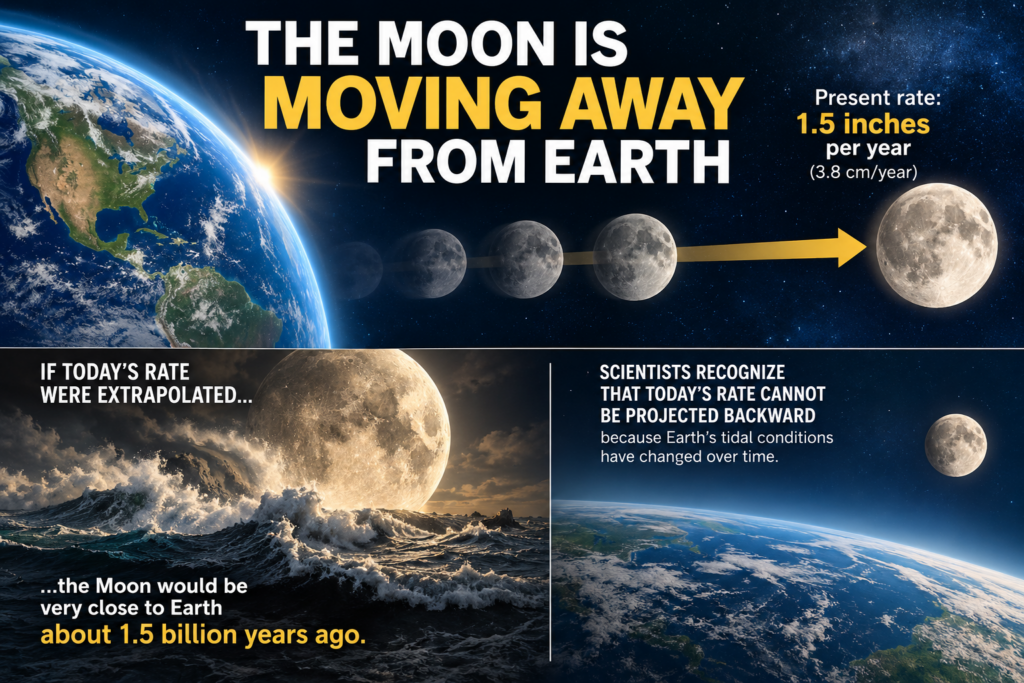
At first glance, the calculation seems simple. Measure how rapidly the Moon is moving away today and run the clock backward. But there is a problem:
A peer-reviewed study published in Proceedings of the National Academy of Sciences states:
“Extrapolation of the current rate of lunar recession of ~3.8 cm/y back in time places the Moon at a close position to Earth as recently as 1.5 billion years ago.”²
This presents an obvious problem if the Earth-Moon system is approximately 4.5 billion years old. Today’s measured recession cannot represent the Moon’s average recession throughout that entire history. Another geophysical study describes today’s 3.8-centimeter-per-year recession rate as “anomalously high” and likewise explains that assuming the modern rate of tidal dissipation produces an Earth-Moon age of only about 1.5 billion years.³ Clearly, something has to change when the clock is run backward.
The obvious response is that Earth’s tidal environment has not remained constant. Ocean depth, continental positions, ocean-basin geometry, tidal resonance, Earth’s rotation, and the changing Earth-Moon distance can all affect tidal dissipation and therefore lunar recession.
Mainstream scientists consequently propose that average tidal dissipation was substantially lower during portions of Earth’s history.
But this introduces an important distinction between what is measured and what is reconstructed.
The PNAS researchers acknowledge:
“The details of this past evolution, and hence the corresponding trajectory of lunar recession, remain highly uncertain.”²
That statement gets to the heart of the issue.
We directly measure the Moon moving away today. We do not directly measure how rapidly it was moving one billion, two billion, or four billion years ago. Those ancient rates must be reconstructed from models and interpreted geological evidence.
The lunar recession problem illustrates an important limitation when reconstructing the distant past. An accurately measured process in the present does not automatically tell us what that process was doing billions of years ago.
Scientists recognize this with the Moon. The present recession rate cannot simply be extrapolated backward because doing so produces a result incompatible with the conventional 4.5-billion-year chronology. The solution is to reconstruct past tidal conditions.
Legitimate physical reasons support the view that tidal dissipation has changed. The configuration of continents and oceans strongly affects Earth’s tides, and today’s oceans may produce an unusually high rate of tidal dissipation.
Nevertheless, those ancient conditions are reconstructed rather than directly observed.
This principle deserves consideration when evaluating other methods used to reconstruct deep time, including radiometric dating.
Radiometric dating is not identical to lunar recession. Geologists do not simply measure a radioactive decay rate today and blindly extrapolate it backward. Modern radiometric methods employ sophisticated techniques designed to identify initial daughter isotopes, contamination, alteration, and open-system behavior.
The broader point is methodological. A process can be measured with extraordinary precision today while its history still depends on assumptions and models about conditions that cannot be directly observed. Radiometric ages require scientists to determine whether the material being dated behaved as a sufficiently closed system, account for initial daughter material where applicable, establish the relevant isotopic history, and apply experimentally measured decay constants to reconstruct elapsed time.⁴
These methods may be sophisticated, but the distinction remains: Present measurement is observation. Reconstructing billions of years of history from that measurement is interpretation.
Creationist scientists have long pointed to lunar recession as an example of the difficulty of projecting present processes deep into the past. The Institute for Creation Research notes that using today’s tidal dissipation in a backward calculation places the Moon extremely close to Earth at approximately 1.5 billion years.⁵ Creationist researchers also recognize the conventional response that tidal dissipation could have been substantially different in the past. That qualification actually reinforces the larger point.
The Moon’s recession offers an important example of the difficulty of reconstructing processes across billions of years. The present recession rate can be measured with extraordinary precision, yet that measured rate cannot simply be projected backward through the conventional age of the Earth-Moon system. Different conditions in the unobserved past must be reconstructed to make the chronology work. Legitimate physical reasons may support different tidal conditions in the past. But the distinction remains important: we reconstruct those ancient conditions from models and indirect evidence, while we measure today’s recession directly.
This is why lunar recession matters to the debate over deep time. The conventional history of the Earth-Moon system requires billions of years, yet today’s precisely measured recession rate cannot simply be extended backward across that chronology. We must reconstruct different conditions in the unobserved past.
The present is observable. The distant past must be reconstructed. And the farther that reconstruction extends beyond direct observation, the more important it becomes to identify the assumptions connecting what we can measure today with what we believe happened long ago.
SOURCES
Jake Hebert, “Lunar Recession in the News,” Institute for Creation Research.
https://www.icr.org/article/12241
NASA Goddard Space Flight Center, “Five Millennium Catalog of Lunar Eclipses: Secular Variations.”
https://eclipse.gsfc.nasa.gov/LEcat5/secular.html
Margriet Lantink et al., “Milankovitch Cycles in Banded Iron Formations Constrain the Earth-Moon System 2.46 Billion Years Ago,” Proceedings of the National Academy of Sciences, 2022.
https://www.pnas.org/doi/10.1073/pnas.2117146119
Blackledge et al., “Tides on Other Earths: Implications for Exoplanet and Palaeo-Tidal Simulations,” Geophysical Research Letters, 2020.
https://doi.org/10.1029/2019GL085746
U.S. Geological Survey, review of isotope systematics and geochronology.
https://pubs.usgs.gov/of/1991/0565/report.pdf
