Published 09/2019- updated 09/2026
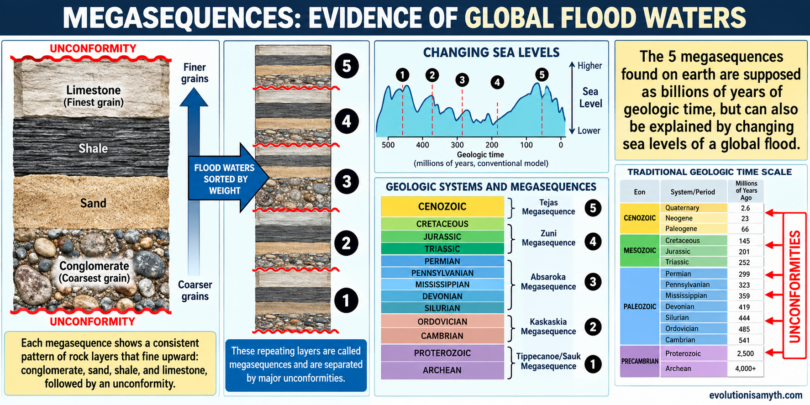
Across North America, geologists recognize enormous packages of sedimentary rock known as megasequences. These are not merely individual beds of sandstone, shale, or limestone. They are vast successions of sedimentary rocks that extend across large portions of the continent and are separated by major erosional boundaries called unconformities.
Conventional geology recognizes six major North American megasequences, commonly called the Sauk, Tippecanoe, Kaskaskia, Absaroka, Zuni, and Tejas sequences.¹ Each represents an enormous episode of erosion, inundation, sediment transport, deposition, and eventual retreat of the sea.
The scale and repeating nature of these formations make them remarkable.
At the base of many sedimentary successions are coarse materials such as conglomerates, pebbles, and coarse sand. Above these may occur progressively finer sandstone, siltstone, shale, and extensive carbonate deposits. This general progression reflects a key principle of sediment transport: fast-moving water can carry larger, heavier particles, while declining current velocity causes larger particles to settle first and progressively smaller particles to settle as energy decreases.
In other words, the rocks themselves can preserve evidence of changing water energy.
A powerful current can erode an existing surface and transport tremendous quantities of rock and sediment. As that current loses energy, its ability to carry the largest material declines. Boulders and gravel may be deposited first, followed by sand and then finer mud and silt. Carbonate sediments may dominate portions of the succession under different sedimentary and chemical conditions as the marine environment changes.
This provides an intriguing picture when viewed through the Genesis Flood model: enormous surges of water advancing across the continents, eroding the surface, transporting sediment, and then depositing vast sedimentary packages as the energy and conditions of those waters changed.
But there is another important observation.

If there were only one such sequence, it might represent a single major advance and retreat of water. Instead, the North American sedimentary record contains multiple enormous sequences separated by widespread erosional unconformities.²
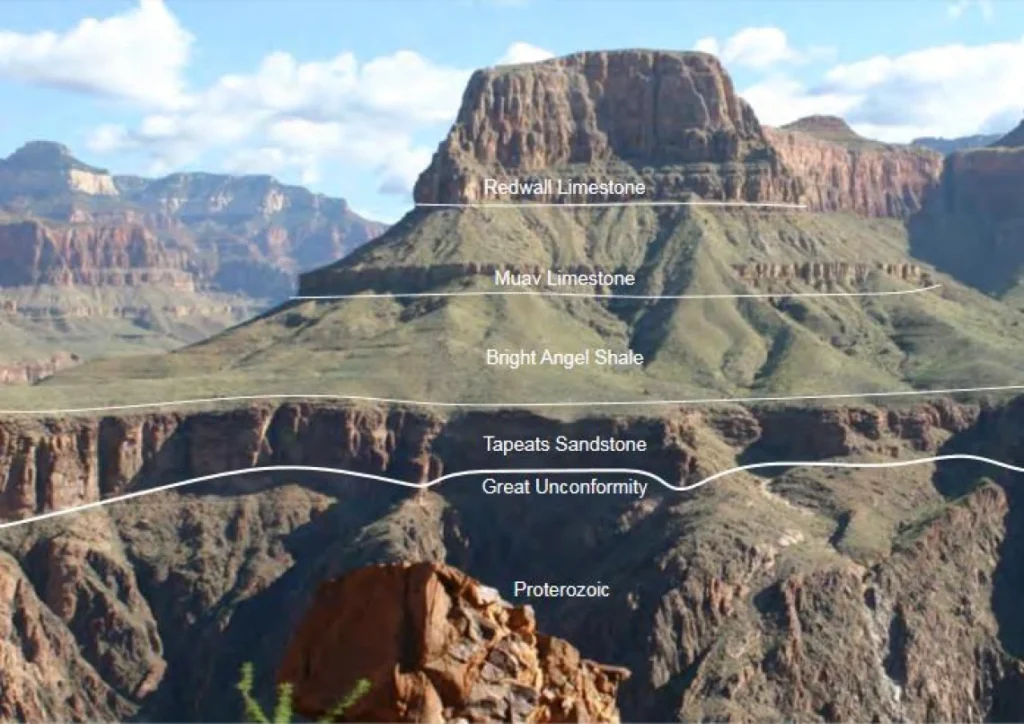
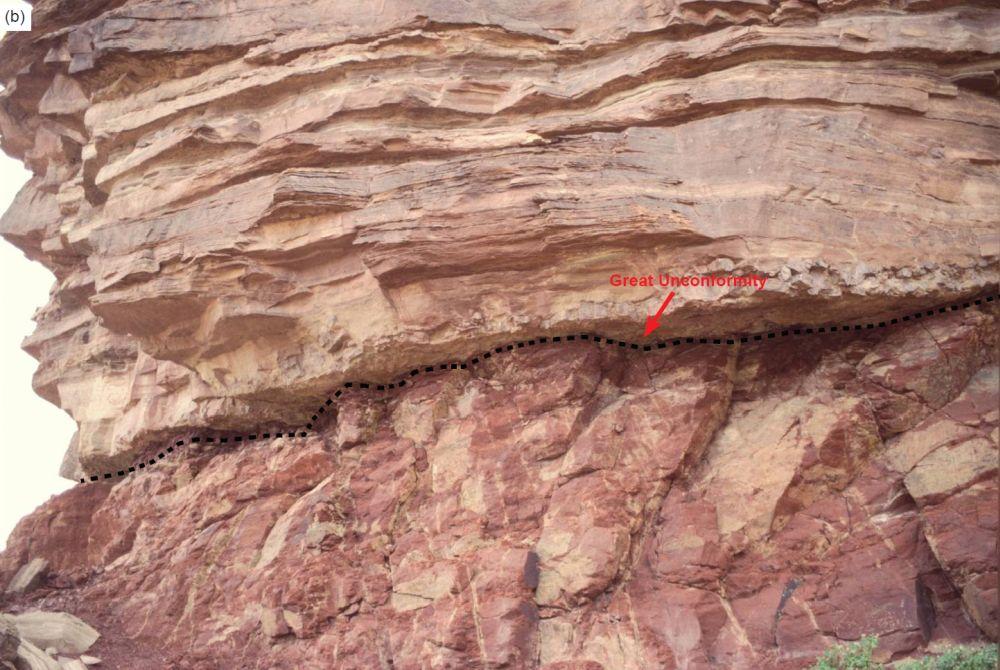
An unconformity represents erosion or non-deposition between rock bodies. In the Flood model, these widespread surfaces can be interpreted as periods when powerful water movement stripped away previously deposited material before another enormous sedimentary sequence was laid down.

The result can be pictured as a repeating cycle:
High-energy water advances across the continent → widespread erosion → coarse sediment is transported and deposited → water energy and depositional conditions change → finer sediments and other marine deposits accumulate → another major erosional episode occurs → another megasequence begins. And then the pattern repeats.
The question is therefore larger than simply, “Can water sort sediment?” Of course it can. The more significant question is: What produced repeated episodes of erosion and marine sedimentation on such an enormous geographic scale?
Conventional sequence stratigraphy explains these packages through repeated marine transgressions and regressions occurring over immense periods of geologic time. Geologists recognize that ancient seas repeatedly advanced and retreated across large portions of North America.³ The disagreement is therefore not primarily over whether enormous movements of marine water occurred. The disagreement concerns their cause, speed, magnitude, and timescale.
The Genesis Flood provides a different framework for interpreting these observations. Rather than representing unrelated events separated by millions of years, the megasequences can be interpreted as successive stages within one enormous global catastrophe.
Genesis describes waters that “prevailed exceedingly on the earth” until “all the high hills under the whole heaven were covered” (Genesis 7:19). Such an event would not necessarily produce one homogeneous layer of mud. A violent global catastrophe involving enormous water movement would be expected to produce changing current velocities, erosion, sediment transport, repeated depositional events, and massive shifts in where sediment accumulated.
Answers in Genesis argues that the major North American megasequences can be understood as successive advances and fluctuations of Flood waters across the continent. As high-energy water moved over the land, it eroded enormous surfaces and transported sediment. As currents changed and lost transporting capacity, they deposited sediment. Renewed water movement could then erode portions of those deposits before laying down the next great sequence.⁴
This interpretation offers a possible explanation for why the pattern occurs repeatedly. The Flood was not a single wave followed by perfectly still water. Genesis describes an extended catastrophe in which the waters increased, prevailed, and eventually receded. Enormous tectonic and hydrodynamic changes within such a model could produce multiple large-scale pulses of erosion and deposition.
The megasequences therefore present an important geological observation: North America contains multiple, continent-scale packages of sedimentary rock separated by major erosional surfaces, and much of this sediment records deposition associated with ancient marine environments.
The conventional model interprets these as repeated sea-level changes and depositional episodes occurring over hundreds of millions of years. The Flood model asks whether these same large-scale patterns could instead preserve successive stages of a single catastrophic inundation.
From a Flood perspective, the repeating pattern makes sense: powerful waters advance, the continent is eroded, enormous quantities of sediment are transported, the currents change and sediments are deposited, and then another massive movement of water begins the process again.
Rather than a quiet record of countless ages, megasequences can be viewed as the geological footprints of enormous waters repeatedly sweeping across a continent.
Sources
¹ U.S. Geological Survey, “Stratigraphic Setting,” identifying the six major North American depositional sequences and their bounding unconformities.
² U.S. Geological Survey, regional stratigraphic studies documenting widespread unconformities and the North American Sloss sequences.
³ U.S. Geological Survey, studies of marine transgressions and regressions across North America.
⁴ Answers in Genesis, “A Deeper Understanding of the Flood—A Complex Geologic Puzzle,” discussion of megasequences, unconformities, sediment sorting, and the Flood interpretation. and https://answersingenesis.org/geology/rock-layers/sedimentary-record-demonstrates-minimal-flooding-continents-during-sauk-deposition/