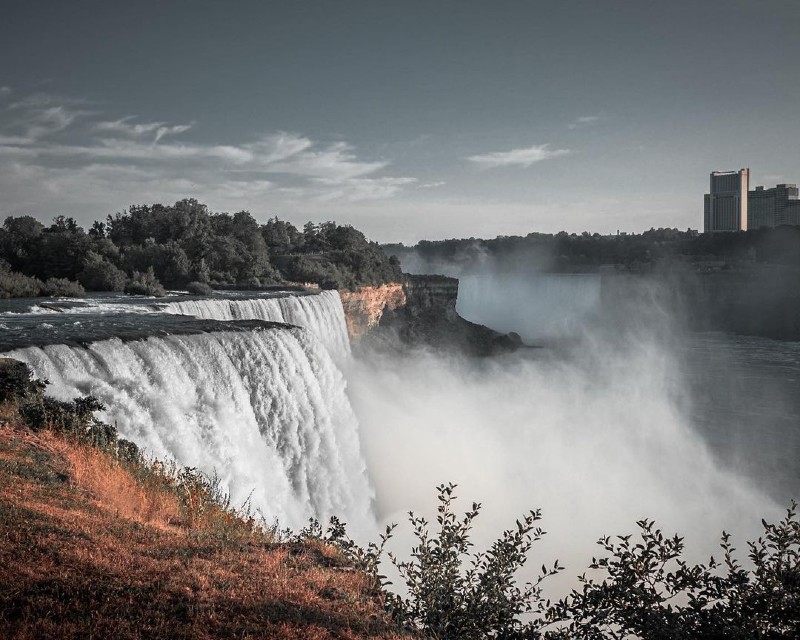
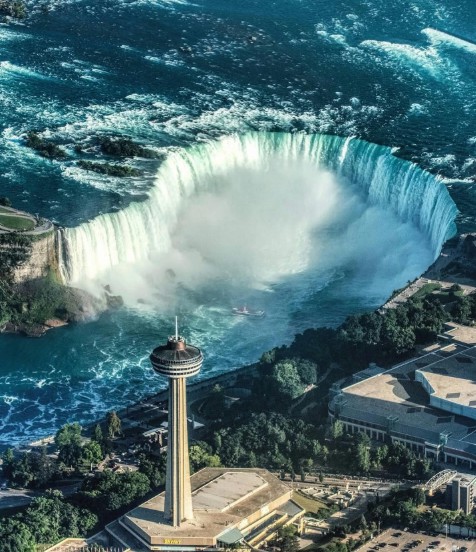
The enormous volume of water pouring over the Niagara Escarpment continually erodes the underlying rock, causing the Falls to retreat upstream and leaving the spectacular Niagara Gorge behind.
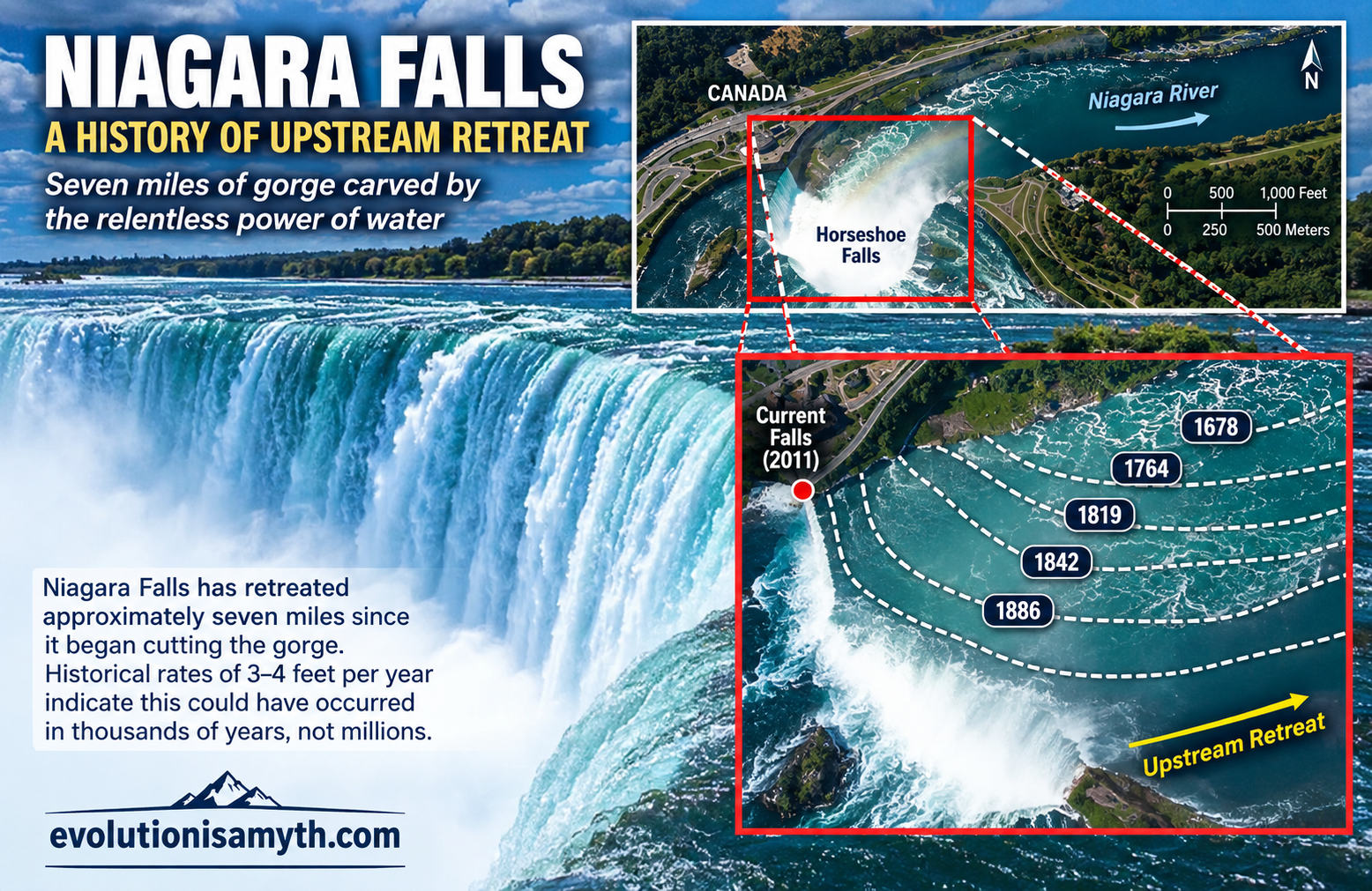
The gorge extends approximately seven miles from the present Falls downstream to the Niagara Escarpment at Queenston. Niagara Parks states that Niagara Falls has retreated approximately seven miles since it began cutting the gorge.¹ This means that the gorge itself is essentially a record of the Falls progressively eroding its way upstream.
What makes this especially interesting is the measured rate of erosion at 3 to 4 feet per year.
Before modern water diversion and erosion-control measures, Niagara Falls was retreating much faster than it does today. Niagara Parks reports that the Falls historically receded an estimated 3 to 4 feet per year.² A U.S. government geological history similarly reports an average recession rate of approximately 2.9 feet per year, with measured recession between 1842 and 1969 averaging approximately 3.6 feet per year.³
At those rates, seven miles of gorge represents only thousands of years of erosion, not millions.
Today, the rate is considerably slower because enormous quantities of Niagara River water are diverted for hydroelectric generation and the flow over the Falls is regulated. Niagara Parks estimates the modern rate at approximately one foot every ten years under these altered conditions.² Therefore, simply observing today’s reduced erosion rate does not tell us how quickly the gorge formed when substantially more erosive power was available.
Mainstream geology dates the beginning of the present Niagara River system to the retreat of the last continental ice sheet approximately 12,500 years ago. Niagara Parks acknowledges, however, that the water flow was not constant throughout this period. According to its reconstruction, Niagara River flow fell to approximately 10 percent of its present volume for several thousand years when glacial drainage was rerouted, before later returning to the Niagara system.¹ Thus, even the conventional reconstruction does not assume a single uniform erosion rate operating continuously throughout the history of the gorge.
This matters because the observable geology shows that enormous quantities of water can remove tremendous amounts of rock in comparatively short periods of geological time. Niagara Parks even describes one episode at the Whirlpool in which the river encountered an older, sediment-filled gorge and rapidly excavated it, possibly within weeks or even days.¹
From a biblical Flood perspective, Niagara Falls fits naturally into a post-Flood landscape undergoing enormous drainage and erosion as waters remaining from the Flood and subsequent Ice Age moved through the Great Lakes basin toward the Atlantic. The seven-mile gorge does not require millions of years. Even conventional geology places its formation entirely within the recent geological past, while historical measurements show that Niagara Falls could retreat several feet per year before modern human intervention.
The disagreement, therefore, is not over whether Niagara Gorge was carved by enormous quantities of rapidly moving water. It clearly was. The disagreement concerns the history assigned to that water and how the changing erosion rates are reconstructed into the past.
Sources
- Niagara Parks, “Niagara Falls Geology: Facts & Figures.”
Niagara Parks geology and erosion facts - Niagara Parks, Tour Study Guide, “Erosion of the Falls.” Niagara Parks reports historical recession of approximately 3–4 feet per year and approximately one foot per ten years following modern flow controls.
Niagara Parks Tour Study Guide - U.S. government geological history of Niagara Falls, reporting an overall recession rate of approximately 2.9 feet per year and approximately 3.6 feet per year from 1842–1969.
History of Niagara Falls