FACT: There is no single growth rate.
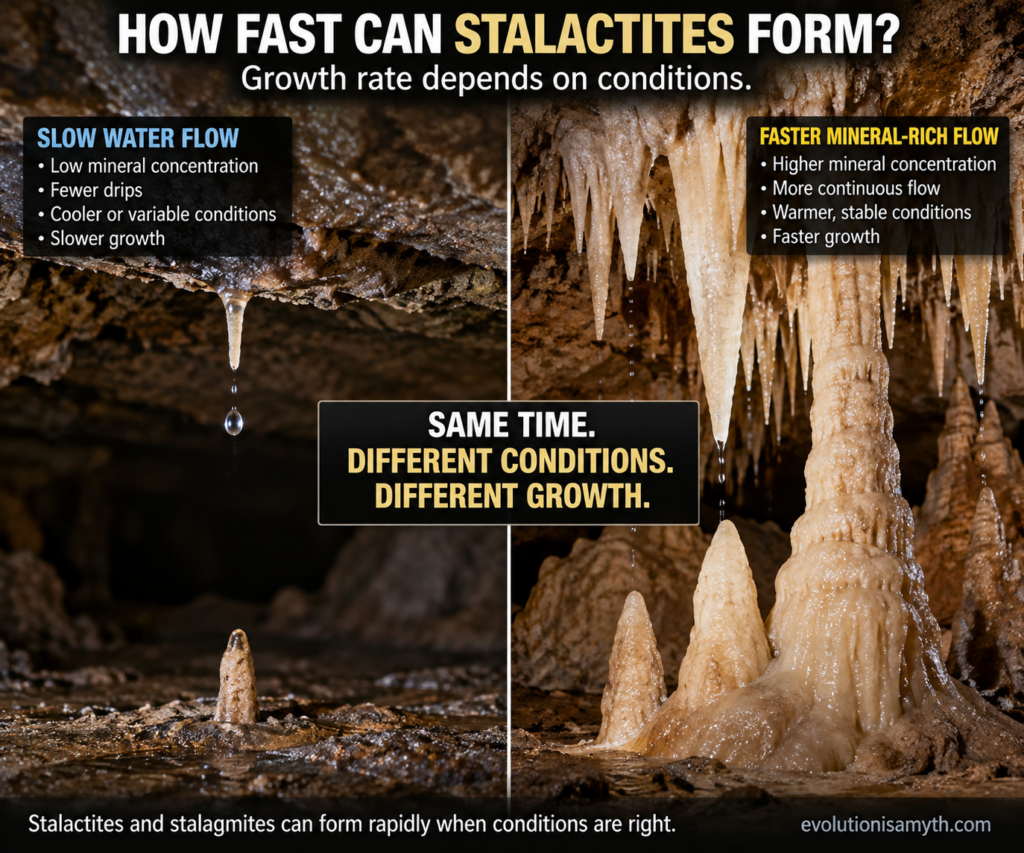
Stalactites and stalagmites form when mineral-rich water deposits calcium carbonate. Their rate of growth depends upon several variables, including the amount and chemistry of the water, calcium concentration, temperature, carbon dioxide levels, and the rate at which water drips or flows across the growing formation.¹
FACT: Because these conditions change, growth rates change as well.
We Can Watch Them Grow
Some of the most interesting examples come from mines, tunnels, and other structures of known age. When a formation occurs inside a tunnel that was excavated at a known date, its maximum possible age is automatically constrained by the age of the tunnel.
Photographs taken in 1987 from workings in the Mount Isa lead-zinc mine in Queensland, Australia, for example, have been cited showing substantial stalactite growth on structures constructed only decades earlier.² Whatever their precise rate of growth, formations growing on structures younger than themselves provide a useful reminder that impressive mineral deposits do not necessarily require immense periods of time.
Scientific measurements confirm that growth rates can vary substantially. Researchers studying modern stalagmites have identified temperature, drip rate, calcium concentration, cave-air carbon dioxide, and other environmental factors as important controls on the rate of calcite deposition.³
One study examined annually laminated stalagmites that had grown during known periods of approximately 30 to 160 years. The researchers were able to compare observed growth directly with predicted growth based upon the chemistry of calcium-carbonate precipitation.⁴
Even stalactites growing close together can grow at very different rates. A study of 306 soda-straw stalactites in Coufin Cave, France, found average growth rates ranging from approximately 0.09 mm per year in the slowest group to 0.92 mm per year in the fastest, a roughly tenfold difference within the same study area.⁵
Growth Rate Is Not a Geological Clock
This is the important point.
We should not look at the present growth rate of a stalactite or stalagmite and automatically assume that the same rate has remained unchanged throughout its entire history.
Water supply can increase or decrease. Mineral concentrations can change. Temperature and carbon dioxide levels fluctuate. Growth can accelerate, slow dramatically, or stop altogether.
The Australian Museum explains that different cave formations result according to whether mineral-rich water drips, seeps, flows, or remains in pools. As dissolved carbon dioxide escapes from the water, calcium carbonate crystallizes and builds stalactites, stalagmites, flowstone, and other formations.⁶
This means the size of a cave formation, by itself, is not a reliable measure of its age.
Modern geologists recognize this variability, which is why scientific dating of ancient speleothems does not ordinarily depend simply upon measuring their length and extrapolating today’s growth rate backward. Researchers can instead use annual laminations, uranium-series dating, radiocarbon markers, known historical events, and other methods to establish chronology.
What Does This Mean for a Biblical Timescale?
Rapidly growing formations do not, by themselves, prove that every stalactite or stalagmite is young. But they demonstrate something important: large or impressive cave formations do not necessarily require hundreds of thousands or millions of years simply because they appear to grow slowly today.
The observable evidence establishes the central point:
Stalactites and stalagmites do not have one fixed growth rate. Under favorable conditions, mineral formations can develop surprisingly quickly. Therefore, their size alone cannot tell us how old they are.
From a biblical creation perspective, this leaves open the possibility that substantially different post-Flood hydrological conditions could have produced periods of much more rapid mineral deposition than we observe in many caves today.
A global Flood and its aftermath would have involved dramatically different amounts and movements of groundwater. If those conditions produced greater water flow through newly exposed fractures and cave systems, rates measured under today’s conditions would not necessarily represent rates during that earlier period.
Sources
- Genty, D., Baker, A., & Vokal, B. (2001). “Intra- and inter-annual growth rate of modern stalagmites.” Chemical Geology, 176, 191–212.
https://doi.org/10.1016/S0009-2541(00)00399-5 - Answers in Genesis, “Stalactites Do Not Take Millions of Years.”
https://answersingenesis.org/geology/caves/stalactites-do-not-take-millions-of-years/ - Genty, Baker & Vokal (2001), Chemical Geology. The researchers investigated temperature, drip rate, calcium-ion concentration, and other variables affecting modern stalagmite growth.
- Baker, A., Genty, D., Dreybrodt, W., Barnes, W. L., Mockler, N. J., & Grapes, J. (1998). “Testing Theoretically Predicted Stalagmite Growth Rate with Recent Annually Laminated Samples: Implications for Past Stalagmite Deposition.” Geochimica et Cosmochimica Acta, 62(3), 393–404.
https://doi.org/10.1016/S0016-7037(97)00343-8 - Perrette, Y. & Jaillet, S. (2010). “Spatial distribution of soda straws growth rates of the Coufin Cave (Vercors, France).” International Journal of Speleology, 39, 61–70.
https://doi.org/10.5038/1827-806X.39.2.2 - Australian Museum, “Limestone Caves” and “How Do Minerals Form?”
https://australian.museum/learn/minerals/shaping-earth/limestone-caves/
Photographic evidence has shown that a stalagmite shawl developed in a mining tunnel in less than 150 years. Other long stalactites and fair-sized stalagmites in a disused mining shaft have also been observed. There are also a host of stalactites growing under the Australian War Memorial; or perhaps even the Western Australian waterwheel which was frozen in limestone after only 65 years. The fact remains differing flows of materials can impact growth rates. It is only logical that when most are observed under current rates they can be backward calculated as very old but different natural conditions could have been much different in the past—such as a global flood cutting many of the underground caves where these structures are found in the first place.
Fast-growing stalagmites and stalactites are created by minerals running through the rock layers above and dripping or running into the cave. Because the rate of flow of these waters may have varied over thousands of years the rate observed today has nothing to do with the rates of the flow when forming.
Using a rapid growth rate, these cave formations could easily fit the biblical time line after the worldwide Flood 4,400 years ago. Unfortunately, evolutionary scientists struggle to keep the biblical time line out of science; although science, time after time, falls right into step with it.”
https://creationtoday.org/rapid-cave-formation/

https://answersingenesis.org/geology/caves/stalactites-do-not-take-millions-of-years/