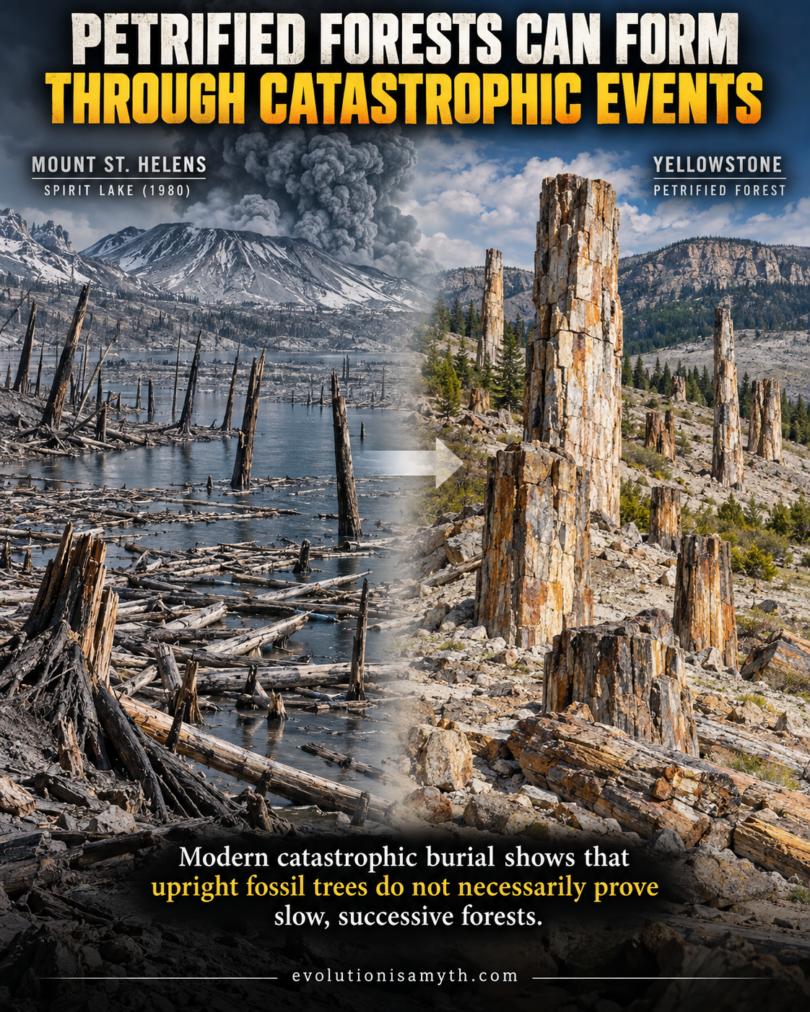
For decades, upright petrified trees at places such as Yellowstone National Park were commonly interpreted as the remains of successive forests that grew, died, were buried, and were eventually replaced by new forests growing above them. Some of Yellowstone’s famous fossil-tree deposits were therefore presented as evidence of long periods of geological time.

Then Mount St. Helens erupted on May 18, 1980.
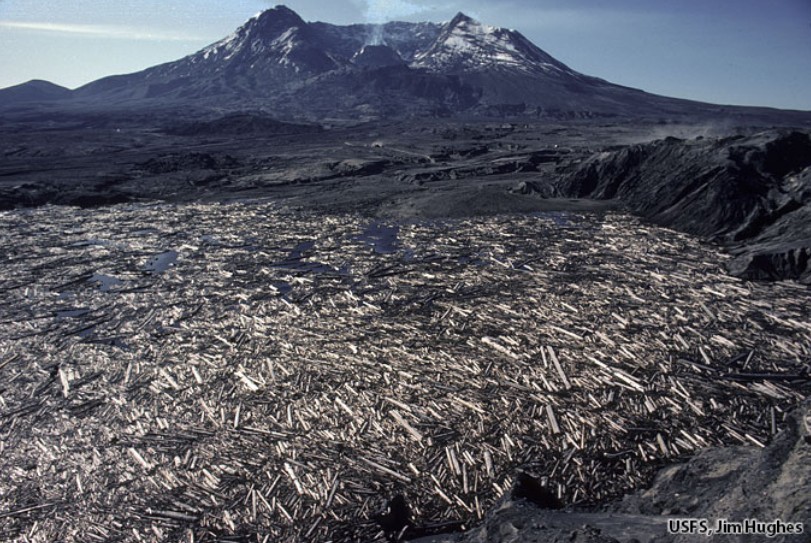
The eruption devastated enormous areas of surrounding forest. Trees were uprooted, stripped of their branches, snapped apart, and swept into Spirit Lake like toothpicks. By the afternoon after the eruption, an estimated one million logs floated on the lake.¹ The event provided scientists with an extraordinary opportunity to observe what happens to an entire forest during a catastrophic volcanic event.
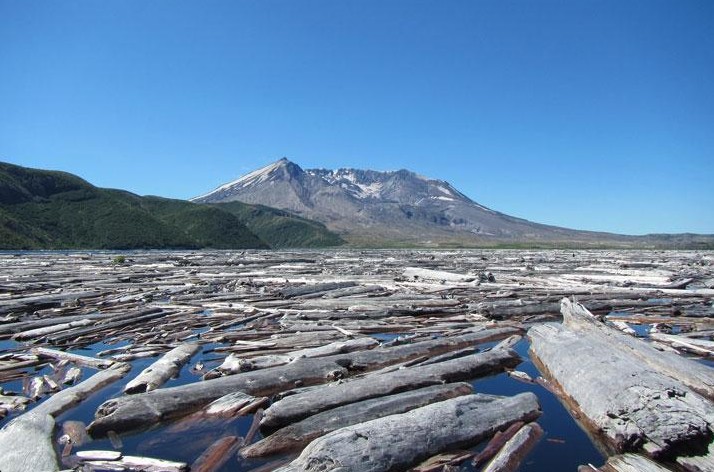
One particularly important observation involved trees floating vertically. Because the lower portions of some trunks were denser or became waterlogged first, numerous logs assumed an upright orientation in the lake. Some eventually sank to the lake bottom while remaining vertical or nearly vertical. Researchers examining Spirit Lake reported thousands of such upright trunks, some becoming partially buried in sediment.²
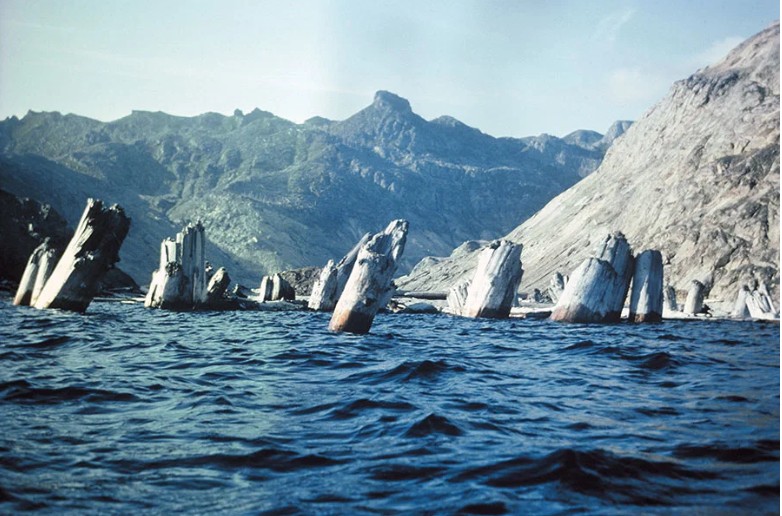
This observation is significant because an upright fossil tree is not necessarily a tree preserved exactly where it originally grew. A transported tree can also settle vertically and subsequently become buried. These “rootless” tree stumps were no longer a mystery on how they were formed.
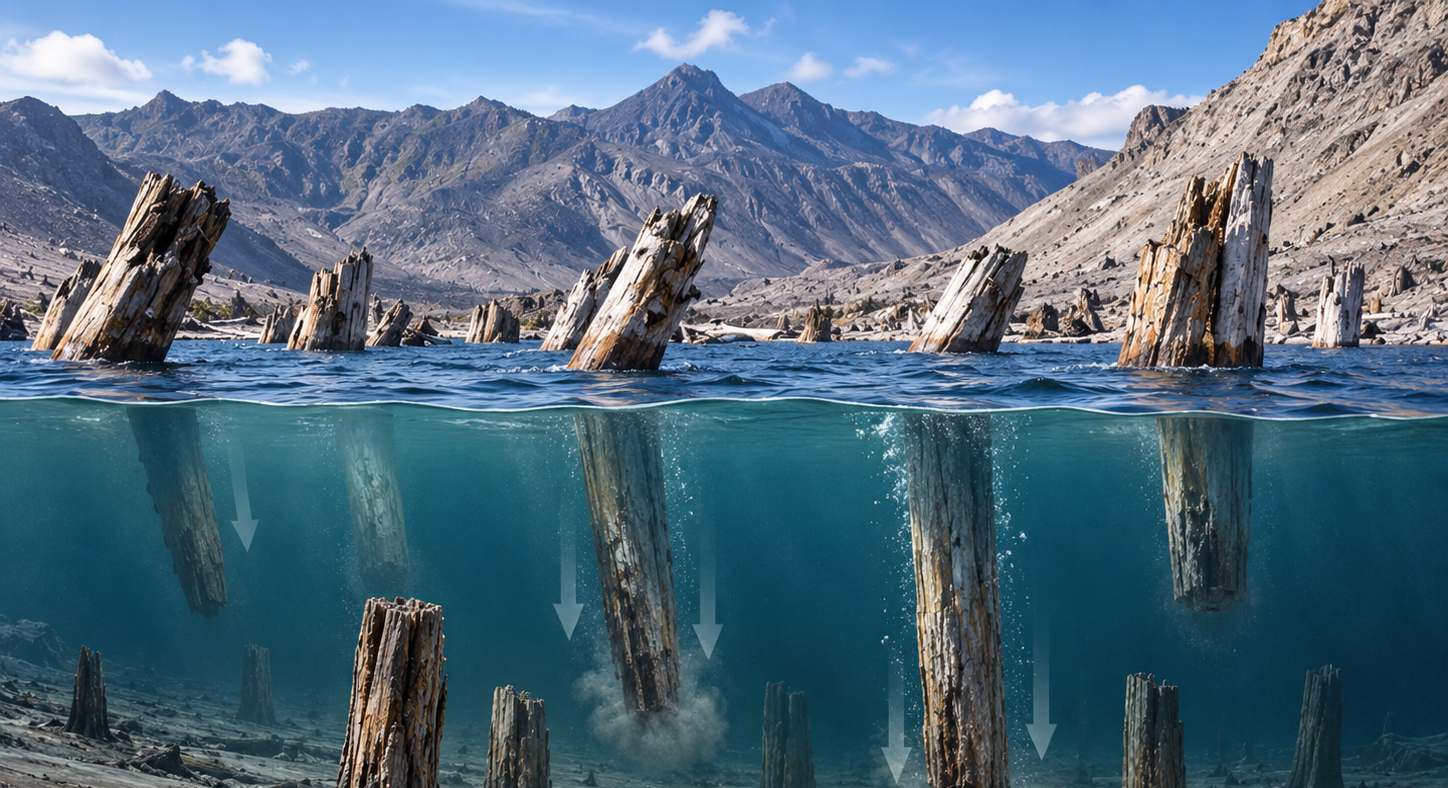
AI Illustration of waterlogged tree trunks sinking upright into lake sediment following catastrophic forest destruction.
As an example, Chaco Canyon’s arid environment doesn’t support many trees, but petrified wood is the most common fossil in the park. The shale layers underneath the stump reveal that this tree has moved from its original location. If the tree had grown in this spot, the roots would have disturbed the soil underneath. This stump eroded, or was carried, to its current location. These were likely formed in a similar manner as thoses we observed at the Mount Saint Helens erruption.
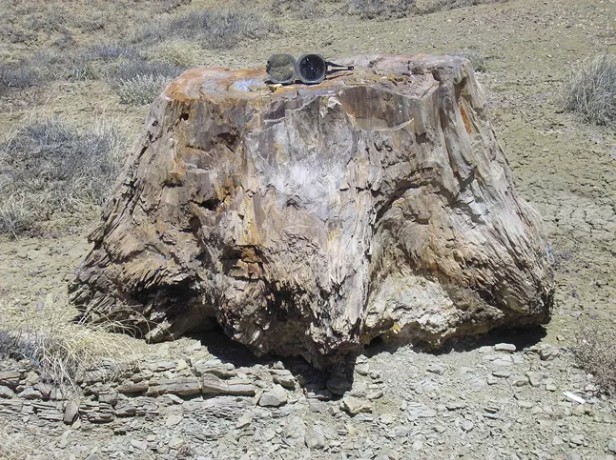
NPS photo by Jack Wood.
Rootless petrified tree stumps at Yellowstone:
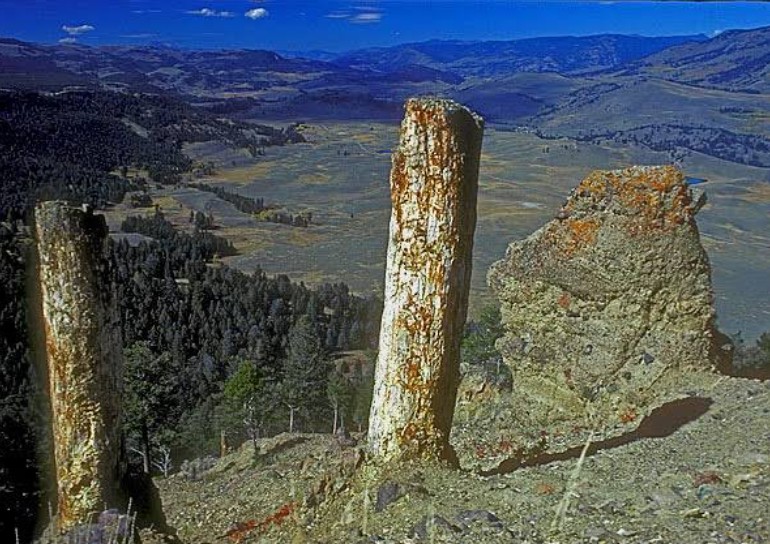
Interestingly, the National Park Service now makes this same observation concerning Yellowstone stumps. Its description of Specimen Ridge explains that an earlier interpretation regarded Yellowstone’s petrified trees as forests preserved where they grew. They state that after observing the Mount St. Helens evidence, geologists now recognize that rapidly moving debris caused by volcanic activity certainly could uproot trees, transport them considerable distances, and sometimes deposit them upright without roots.³

The stumps with roots on the sides of the mountains were snapped off during the catastrophe. The National Park Service now explains that Yellowstone contains both kinds of examples. Some trees appear to have been buried approximately where they grew, while others were transported and deposited by volcanic debris flows known as lahars.⁴ This is an important distinction because the mere presence of an upright fossil tree cannot by itself establish that the tree represents a forest that grew at that exact location.
These stumps have a striking similarity to those at Mount Saint Helens.
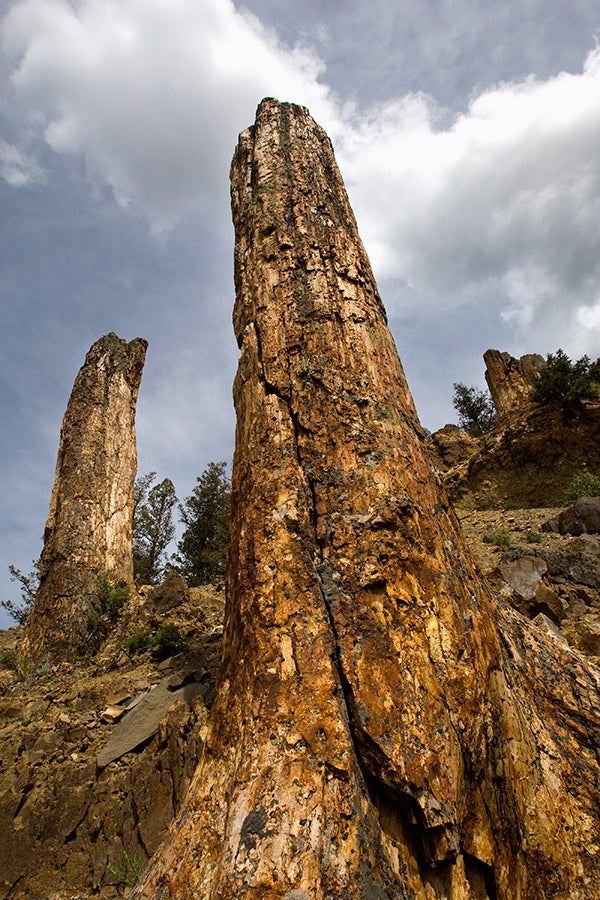
Yellowstone’s petrified wood occurs extensively within volcanic debris deposits. Lahars are fast-moving mixtures of water, mud, rock, and volcanic material that can destroy and bury forests rapidly. NPS specifically notes that such deposits can bury fallen trees and standing forests and that silica-rich volcanic environments promote the mineralization that eventually produces petrified wood.⁵
Mount St. Helens therefore provides a dramatic modern demonstration of a principle to keep in mind when interpreting ancient fossil forests: catastrophic processes can uproot enormous numbers of trees, transport them, orient some vertically, and bury them in sediment in a very short period of time.
That does not by itself determine the total age of Yellowstone’s deposits or prove that every petrified tree there resulted from a single catastrophe. It does demonstrate something much more specific and observable: upright fossil trees are not automatically evidence of forests growing successively in place over immense periods of time.
This is precisely the kind of geological lesson Mount St. Helens provides. Processes witnessed occurring in hours, days, and years can sometimes produce features that, without direct observation, might appear to require far longer periods.
SOURCES
¹ NASA documents the enormous floating log mat still present at Spirit Lake decades after the eruption, while Mount St. Helens studies describe the catastrophic transport of the surrounding forest. Answers in Genesis
² Creationist field research at Spirit Lake reported large numbers of upright submerged trunks and sediment accumulating around some of their bases. Answers in Genesis
³ The National Park Service specifically says that the Mount St. Helens eruption demonstrated that volcanic debris flows could uproot trees, transport them, and deposit them upright, changing interpretation of Yellowstone’s fossil forests. National Park Service
⁴ NPS states that Yellowstone contains both trees buried where they grew and others that were transported and deposited upright. National Park Service
⁵ Yellowstone’s petrified trees occur extensively within lahar deposits, and NPS explains that volcanic ash and silica-rich groundwater favor petrification of buried wood. National Park Service